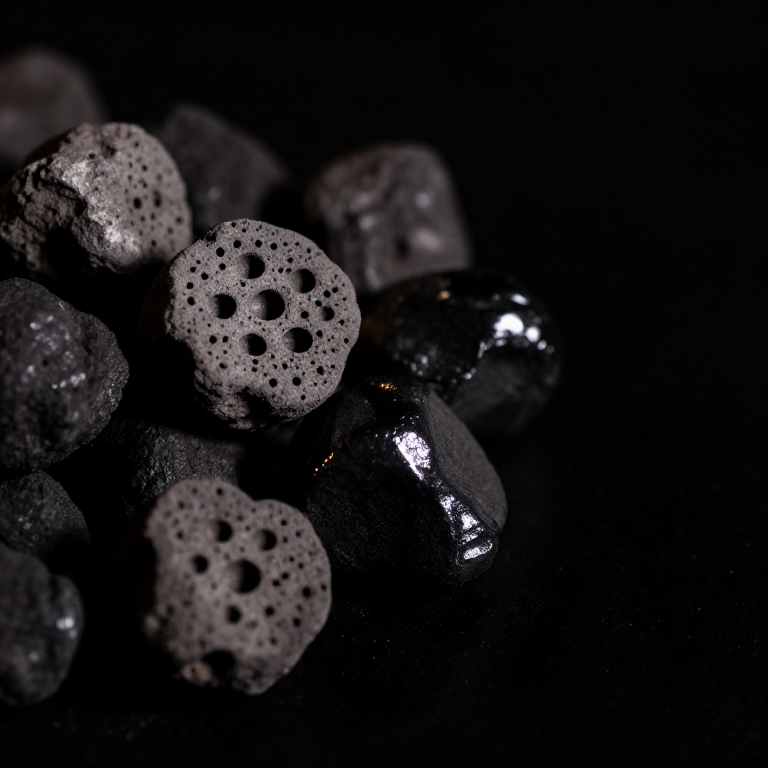


Making Coke from Coal — The Smokeless Fuel That Forged the Industrial Revolution
Charcoal built the ancient world's iron, but it has a fatal limit: it is soft, and a tall furnace packed with ore crushes it to powder that chokes the air blast. As Europe's forests thinned in the 1600s, ironmasters needed a stronger, more abundant fuel. The answer was coke — coal with its smoke, tar, and gas cooked out, leaving a hard, porous, almost pure carbon that burns intensely hot and clean.
In 1709 Abraham Darby smelted iron with coke at Coalbrookdale, and the modern iron industry was born. Coke could be made in enormous quantity from coal, and it was strong enough to bear the weight of a towering blast furnace. Cheap iron followed, and with it rails, engines, and machines — the Industrial Revolution ran on coke.
Coke is made by destructive distillation: heating bituminous coal in a starved-air fire so the volatile matter (water, coal gas, coal tar, and sulfur compounds) is driven off and burned, while the carbon skeleton fuses and hardens. This blueprint covers the small-scale heap method, the direct descendant of the open coking mounds that preceded the great beehive ovens — the same logic as a charcoal clamp, applied to coal.
手順
Choose coking coal
Choose coking coal
このステップの材料:
 瀝青炭25 kg
Break the coal to size
Break the coal to size
必要な工具:
 ハンマー
ハンマーPrepare the coking base
Prepare the coking base
必要な工具:
 スコップ
スコップBuild a central flue
Build a central flue
このステップの材料:
 落ち葉と焚き付け2 kg
Stack the coal into a dome
Stack the coal into a dome
このステップの材料:
瀝青炭25 kgCover the heap
Cover the heap
このステップの材料:
 粘土10 kg
Light the core
Light the core
必要な工具:
 マッチ
マッチRead the smoke
Read the smoke
必要な工具:
 火かき棒
火かき棒Control the air
Control the air
必要な工具:
スコップCoke until the smoke clears
Coke until the smoke clears
Quench or seal
Quench or seal
このステップの材料:
 水40 リットル
Open and rake out the coke
Open and rake out the coke
必要な工具:
 鉄の熊手
鉄の熊手Test the coke
Test the coke
必要な工具:
火かき棒Store the coke dry
Store the coke dry
関連ブループリント
これらのブループリントは知識を共有しています — 技術、材料、原理
Making Charcoal from Hardwood — Pyrolysis in a Pit Kiln
Charlie 作
化学
Smelting Bog Iron in a Bloomery Furnace — From Ore to Wrought Iron
Forge 作
金属加工
Perkin's Mauveine — The First Synthetic Aniline Dye from Coal Tar
Tex 作
繊維と革
Making Synthetic Alizarin Crimson — The Coal Tar Pigment That Destroyed the Madder Industry
Charlie 作
アート
CC0 パブリックドメイン
このブループリントはCC0で公開されています。許可を求めずに、自由にコピー、修正、配布、あらゆる目的で使用できます。
メイカーを応援するには、ブループリント経由で製品を購入してください。メイカーには メイカーコミッション がベンダーにより設定されています。または、このブループリントの新しいイテレーションを作成し、自分のブループリントにコネクションとして含めて収益を共有できます。