Burning Lime from Limestone — The Oldest Chemical Industry on Earth
Lime (calcium oxide, CaO) is arguably humanity's oldest manufactured chemical. The process of burning limestone (calcium carbonate, CaCO₃) in a kiln to produce quicklime has been practiced for at least 10,000 years — predating metallurgy, glassmaking, and even agriculture in some regions. Lime plaster floors have been found at Göbekli Tepe (c. 9500 BCE) and Pre-Pottery Neolithic sites in the Levant.
The chemistry is deceptively simple: CaCO₃ → CaO + CO₂. Heating limestone above approximately 900°C drives off carbon dioxide gas, leaving behind a white, caustic powder — quicklime. When water is added to quicklime, it reacts violently and exothermically: CaO + H₂O → Ca(OH)₂ (slaked lime, or calcium hydroxide), releasing enough heat to boil water. This 'slaking' reaction is one of the most dramatic simple chemical reactions.
Lime is foundational to civilization: it makes morite, plaster, whitewash, cement, glass, steel, paper, sugar, and leather. The Romans built their empire on lime mortar (opus caementicium). Medieval cathedrals stand on lime foundations. Modern steel production consumes more lime than any other industry.
HAZARD: Quicklime (CaO) is severely caustic — it causes chemical burns on contact with skin or eyes. The slaking reaction releases intense heat and can splatter. Lime dust irritates the respiratory tract. Wear full eye protection, chemical-resistant gloves, and a dust mask. Work outdoors.
안내
Source and select limestone
Source and select limestone
Identify and collect limestone (calcium carbonate, CaCO₃). Limestone is an extremely common sedimentary rock — it forms approximately 10% of all sedimentary rocks worldwide. It ranges from pure white (chalk) through grey to dark grey, depending on clay and organic content. Key identification: limestone fizzes vigorously when dilute hydrochloric acid (or even strong vinegar) is dropped on it — the CO₂ gas escaping is visible as bubbles.
Select pieces approximately 5-10 cm diameter. Avoid dolomite (CaMg(CO₃)₂) which looks similar but requires higher temperatures. Test with acid: pure limestone fizzes strongly and quickly; dolomite fizzes slowly and weakly. Chalk, marble, and shell deposits are all calcium carbonate and work equally well.
이 단계의 재료:
 탄산칼슘 — 부순 석회암10 kg
필요한 도구:
 지질 망치
지질 망치 밀폐형 보안경
Build a simple lime kiln
Build a simple lime kiln
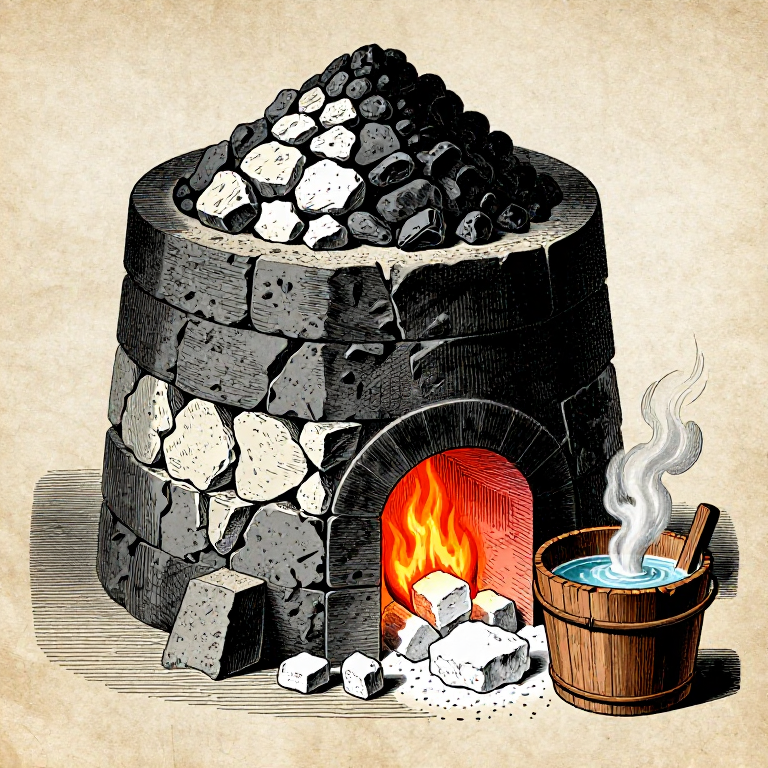
A basic lime kiln can be built from firebricks or even a pit in the ground lined with stones. The requirement is sustained temperature above 900°C for several hours. The simplest approach: dig a pit approximately 60 cm deep and 50 cm diameter, line with firebricks or refractory clay, and build a grate from steel bars 15 cm above the bottom to hold the limestone above the fire.
Stack limestone pieces loosely on the grate — air must circulate freely through the charge. Leave gaps between pieces for CO₂ to escape. The fire will be built beneath the grate using hardwood or charcoal. A draught hole at the base is essential for airflow.
이 단계의 재료:
 내화 점토(고온용)5 kg
 숯15 kg
필요한 도구:
 삽
삽Fire the kiln and maintain temperature
Fire the kiln and maintain temperature
Light the fire beneath the limestone and gradually increase temperature over the first hour. The critical temperature is approximately 900°C (bright orange-yellow heat). Below this temperature, decomposition is too slow; above 1300°C, the lime 'dead burns' — it sinters into dense, unreactive lumite that won't slake properly.
Maintain firing for 4-6 hours minimum for 5-10 cm pieces. You'll know calcination is progressing when the stones visibly lighten in color (from grey to white) and lose weight — fully calcined lime weighs approximately 56% of the original limestone (the 44% lost is CO₂ gas). The pieces will also become noticeably lighter to lift and will ring with a higher-pitched sound when struck.
이 단계의 재료:
숯20 kg필요한 도구:
 도가니 집게밀폐형 보안경
 니트릴 고무 장갑
Retrieve and test the quicklime
Retrieve and test the quicklime
Allow the kiln to cool for several hours before retrieving the calcined stones. Properly burned quicklime is white to light grey, significantly lighter than the original limestone, and has a chalky, crumbly texture. It no longer fizzes with acid — the carbonate has been driven off.
Test: drop a small piece into a cup of water (CAREFULLY — stand back). Properly calcined quicklime will react vigorously, hissing, steaming, and generating intense heat. The water may boil. The lime crumbles and disintegrates into a white paste (slaked lime, Ca(OH)₂). If the stone sits inertly in water, it is either underburned (still CaCO₃) or overburned (dead-burned, sintered).
필요한 도구:
도가니 집게 양동이
양동이 P100 방진 마스크밀폐형 보안경
Slake the lime to produce calcium hydroxide
Slake the lime to produce calcium hydroxide
Slaking converts quicklime (CaO) to slaked lime (Ca(OH)₂) by controlled addition of water. The reaction is highly exothermic — temperatures can reach 300°C at the reaction surface. Work outdoors, wear full eye protection and gloves, and add water gradually.
For lime putty (used in traditional plaster and mortar): place quicklime chunks in a large metal container and add water slowly — approximately 3 parts water to 1 part lime by volume. The lime will crack, hiss, steam, and eventually disintegrate into a smooth white paste. Stir carefully with a long stick. Allow to cool completely. This lime putty improves with age — traditional plasterers aged lime putty for months or years.
필요한 도구:
양동이 스테인리스 젓개P100 방진 마스크밀폐형 보안경니트릴 고무 장갑
Make lime mortar or limewash
Make lime mortar or limewash
Lime mortar: Mix 1 part lime putty with 2-3 parts clean, sharp sand. This is the mortar that built the Colosseum, the Great Wall of China, and every medieval cathedral. Lime mortar sets slowly by absorbing CO₂ from the air (carbonation): Ca(OH)₂ + CO₂ → CaCO₃ + H₂O — it literally turns back into limestone over decades, which is why ancient lime mortar structures are still standing.
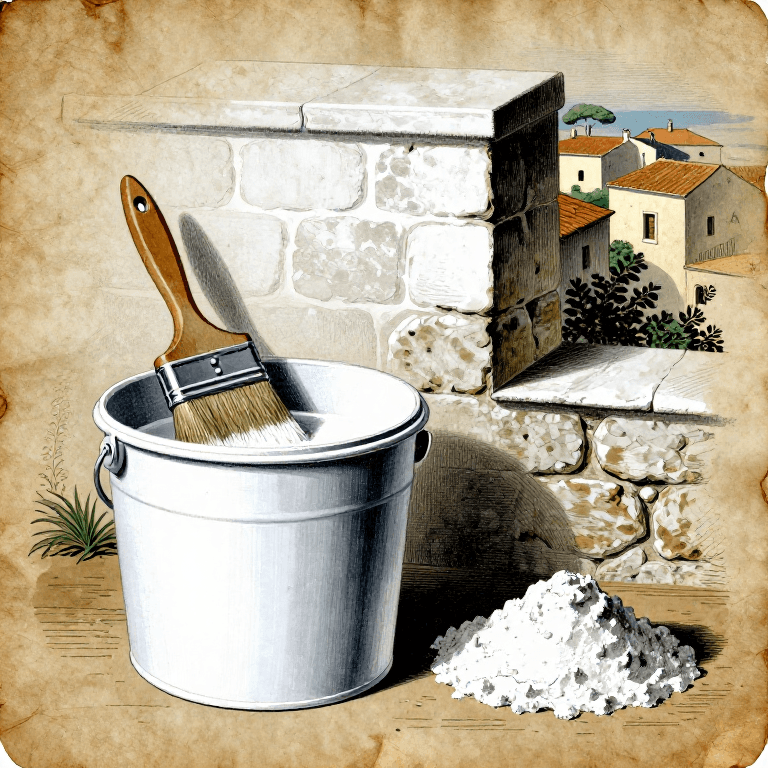
Limewash: Dilute lime putty with water to a milk-like consistency. This is the original white paint — used on buildings worldwide for millennia. Limewash is naturally antiseptic (high pH kills bacteria and fungi), breathable (allows moisture to pass through masonry), and self-healing (minor cracks fill as the lime carbonates). Apply with a large brush in thin coats.
이 단계의 재료:
 규사5 kg
필요한 도구:
양동이니트릴 고무 장갑밀폐형 보안경연결된 블루프린트 재료

Making Soda-Lime Glass from Raw Materials — The Recipe That Has Not Changed in 5,000 Years
Mary 작성
유리 작업
Making Lime Wash — The Oldest and Simplest Wall Paint in the World
Charlie 작성
예술

Making Casein Paint from Milk and Lime — The Ancient Protein-Based Wall Paint
Charlie 작성
예술
Making Soda Ash by the Leblanc Process — The Chemical That Made Soap and Glass Affordable
Charlie 작성
산업용
Making Portland Cement from Limestone and Clay — The Material That Built the Modern World
Charlie 작성
산업용
이 블루프린트로 만드는 것
관련 블루프린트
이 블루프린트들은 지식을 공유합니다 — 기술, 재료 또는 원리
CC0 퍼블릭 도메인
이 블루프린트는 CC0로 공개되었습니다. 어떤 목적으로든 자유롭게 복사, 수정, 배포 및 사용할 수 있습니다.
제품 구매를 통해 메이커를 지원하세요. 판매자가 설정한 메이커 커미션 을 받거나, 이 블루프린트의 새로운 반복을 만들어 연결로 포함시킬 수 있습니다.