

Building a Horizontal Water Wheel for Grain Milling — The First Mechanical Power Source
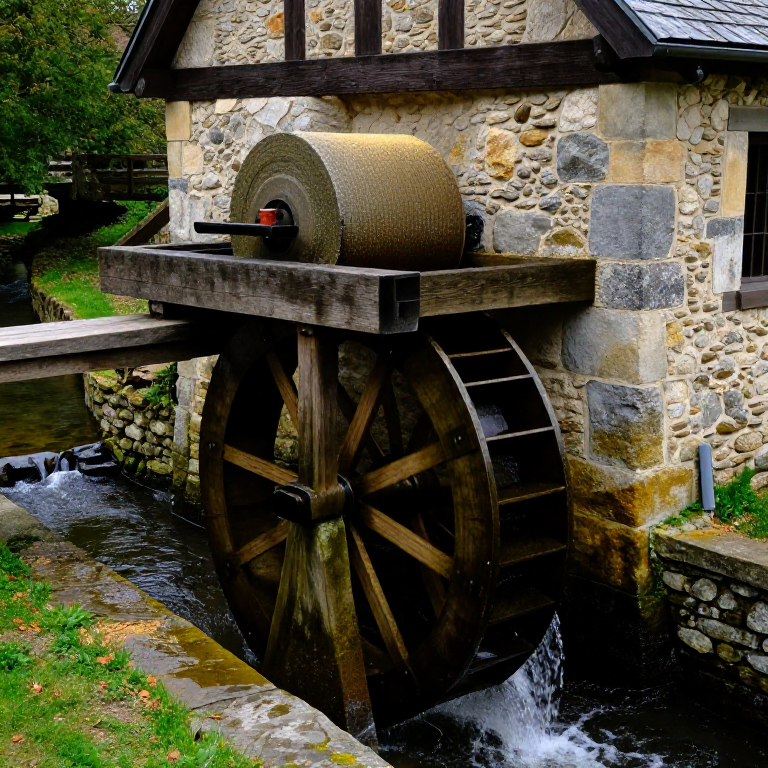
The water wheel is humanity's first machine for converting natural energy into useful mechanical work. The earliest type — the horizontal water wheel (also called a Norse mill or Greek mill) — appeared around 300-200 BCE in the eastern Mediterranean and Central Asia. Water flowing through a channel strikes paddles mounted on a vertical shaft, which rotates a millstone directly above. No gears are needed: the shaft connects the water paddles below to the grinding stone above in a single vertical axis.
Before the water wheel, grain was ground by hand using saddle querns or rotary hand mills — backbreaking labor that consumed hours of human effort daily. A small horizontal water wheel produces 0.5-2 horsepower continuously, replacing the work of 5-10 people and freeing human labor for other tasks. The Roman engineer Vitruvius described the vertical water wheel (a more efficient design using gears) around 25 BCE, but the simpler horizontal design persisted in mountainous regions of Scandinavia, Scotland, Greece, and Afghanistan well into the 20th century.
The water wheel is the ancestor of every turbine, generator, and hydroelectric dam. The principle — directing flowing water against blades to create rotary motion — is identical whether the machine is a 2,000-year-old Norse mill grinding barley or a 21st-century Francis turbine producing gigawatts of electricity.
안내
Survey the water source
Survey the water source
A horizontal water wheel requires a stream with consistent flow and sufficient head (height difference) to direct water forcefully against the paddles. The ideal site has a drop of at least 1.5-2 meters over a short horizontal distance, which can be achieved naturally (a waterfall or steep stream section) or artificially by digging a millrace — a channel that diverts water from upstream and delivers it to the wheel at a controlled angle.
Measure the stream flow by timing how long it takes to fill a known container (a 20-liter bucket). You need at least 30-50 liters per minute for a small mill. Too little water and the wheel cannot develop enough torque to grind grain; too much and the channel must be built impractically large. Mark the wheel position where the water exits the millrace channel at maximum velocity.
필요한 도구:
 양동이
양동이Carve the central shaft (tirl)
Carve the central shaft (tirl)
The vertical shaft (called a 'tirl' in Norse mill terminology) is the single rotating element that connects the water paddles below to the millstone above. Select a straight-grained hardwood log — oak, ash, or beech — approximately 15 cm in diameter and 2-2.5 meters long. The bottom end will hold the paddles; the top end will drive the runner stone.
Shape the shaft to be perfectly round and straight. The top end is carved into a square or cross-shaped tenon (the 'rynd iron' socket) that fits into a corresponding slot cut in the upper millstone, locking them together so the stone rotates with the shaft. The bottom end is carved to accept the paddle assembly. The shaft must rotate freely without wobbling — any misalignment wastes energy in friction and vibration.
이 단계의 재료:
 경목 블록3 개
필요한 도구:
 손톱(핸드소)
 칼
칼Build the paddle wheel
Build the paddle wheel
The paddle wheel is a disc or hub with flat wooden blades radiating outward, mounted horizontally at the bottom of the shaft. Carve a hub approximately 30 cm in diameter with slots for 6-8 paddles. Each paddle is a flat hardwood board approximately 30 cm long, 15 cm wide, and 2-3 cm thick, inserted into the hub slots at a slight angle (10-15 degrees from radial) to catch the water jet efficiently.
The angled paddles are a critical refinement — flat radial paddles waste energy because the water impacts them at an inefficient angle for most of the rotation. Angling the paddles allows the water to push them through a longer arc before the jet loses contact, extracting more energy from each unit of water. Secure the paddles in their slots with wooden wedges and waterproof the joints with pine pitch.
이 단계의 재료:
경목 블록2 개Prepare the millstones
Prepare the millstones
A grain mill requires two flat, circular stones approximately 50-70 cm in diameter: a stationary lower stone (the bedstone) and a rotating upper stone (the runner stone). The best millstones are carved from a hard, coarse-grained stone that naturally self-sharpens as it wears — French burr stone (freshwater quartz) was the premium choice, but granite, gneiss, or even dense sandstone work for small mills.
Both stones must be perfectly flat on their grinding faces. The runner stone has a central hole through which grain feeds, and a square socket on the bottom that locks onto the shaft's rynd iron. The grinding faces are dressed (carved) with a pattern of shallow grooves called 'furrows' that channel ground flour outward to the edge while shearing the grain. Without furrows, the stones merely crush rather than cut, producing coarse meal rather than fine flour.
필요한 도구:
 망치
망치Build the mill housing
Build the mill housing
The mill housing is a small structure built directly over the water channel, with the paddle wheel beneath the floor and the millstones on the floor level. The floor must have a central hole for the shaft to pass through, with a bearing (a greased hardwood or stone socket) to support and center the shaft while allowing free rotation.
The lower bearing at the base of the shaft rests on a 'bridge tree' — a horizontal beam that can be raised or lowered with a lever mechanism (the 'lightening tree') to adjust the gap between the millstones. This gap control is the miller's primary adjustment: too close and the stones generate excessive heat that damages the flour; too far apart and the grain passes through without being fully ground. A skilled miller adjusts this gap by sound — the correct setting produces a steady, smooth grinding sound.
이 단계의 재료:
경목 블록5 개 쇠못30 개
필요한 도구:
손톱(핸드소)Build the millrace and sluice gate
Build the millrace and sluice gate
Dig a channel (millrace) from the stream to the paddle wheel, with a gradual slope that accelerates the water to maximum velocity at the wheel. The channel should be approximately 30-40 cm wide and lined with flat stones or clay to prevent erosion. The final section narrows into a chute that directs the water jet precisely onto the paddle blades at the optimal angle.
Install a wooden sluice gate at the entrance to the millrace — a vertical board that slides up and down in grooved side posts. When raised, water flows through to drive the wheel; when lowered, it blocks the flow and stops the mill. This simple control mechanism allows the miller to start, stop, and regulate the mill's speed by partially opening or closing the gate.
필요한 도구:
 삽
삽Install the hopper and shoe
Install the hopper and shoe
Above the millstones, mount a wooden hopper — an inverted pyramid-shaped box that holds the grain waiting to be ground. The bottom of the hopper feeds into a narrow trough called the 'shoe' (or 'slipper') that vibrates as the runner stone turns, shaking grain gradually into the central hole of the runner stone at a controlled rate.
The shoe is positioned so that a peg on the runner stone (the 'damsel') taps it once per revolution, creating the characteristic rhythmic clicking sound of a working mill. This vibration-fed system automatically meters grain into the stones at a rate proportional to the grinding speed — faster rotation means more taps per minute and faster grain feed. When the hopper runs empty, the shoe's clicking changes pitch, alerting the miller to reload — the origin of the expression 'keep your nose to the grindstone'.
Test-grind and adjust
Test-grind and adjust
Open the sluice gate and allow the water wheel to reach full speed. Pour a small quantity of dry grain (wheat, barley, or oats) into the hopper and listen as it feeds into the stones. The grinding sound should be a steady, smooth swish — crunching or squealing indicates the stones are too close. Adjust the lightening tree to set the gap correctly.
Collect the flour from the rim of the bedstone where it falls into a surrounding trough. The first few grindings will contain stone dust from the newly dressed stones — discard this flour. Once the stones are seasoned, the flour should be fine, cool to the touch, and free of gritty particles. A well-adjusted horizontal water mill grinds approximately 5-15 kg of flour per hour — enough to feed a small village, and replacing the daily hand-grinding labor of dozens of people with the tireless power of flowing water.
이 블루프린트로 만드는 것
관련 블루프린트
이 블루프린트들은 지식을 공유합니다 — 기술, 재료 또는 원리
CC0 퍼블릭 도메인
이 블루프린트는 CC0로 공개되었습니다. 어떤 목적으로든 자유롭게 복사, 수정, 배포 및 사용할 수 있습니다.
제품 구매를 통해 메이커를 지원하세요. 판매자가 설정한 메이커 커미션 을 받거나, 이 블루프린트의 새로운 반복을 만들어 연결로 포함시킬 수 있습니다.