


Forging an Iron Fish Hook — Drawing, Bending, and Barbing Wire Stock
Bone and bronze fish hooks served for thousands of years, but iron hooks changed the economics of fishing. Iron is cheaper than bronze, harder than bone, and can be drawn to finer gauges — meaning smaller hooks for smaller fish, and stronger hooks for larger ones. Iron hooks could be mass-produced by a village smith in batches of dozens, making them nearly disposable.
An iron fish hook is forged from a short length of iron wire or drawn rod. The wire is tapered to a sharp point, a barb is cut with a chisel, the shaft is bent into a J or U shape around a mandrel, and the eye is formed by bending a small loop at the top. The entire hook is then case-carburised to harden the point and barb so they hold their edge in use.
This is one of the simplest forge projects — it uses almost no material and teaches fine control of thin stock at low heat. It also demonstrates that not all forge work involves heavy hammering; the smith must work delicately to avoid burning the thin wire.
안내
Draw iron wire from rod stock
Draw iron wire from rod stock
이 단계의 재료:
 덩어리 숯1 kg
필요한 도구:
 단조 망치
단조 망치 대장간 집게
 화덕 (대장간 불)
Taper the point
Taper the point
Cut the barb
Cut the barb
Bend the hook shape
Bend the hook shape
Form the eye
Form the eye
Harden the point and barb
Harden the point and barb
Test and finish the batch
Test and finish the batch
연결된 블루프린트 재료
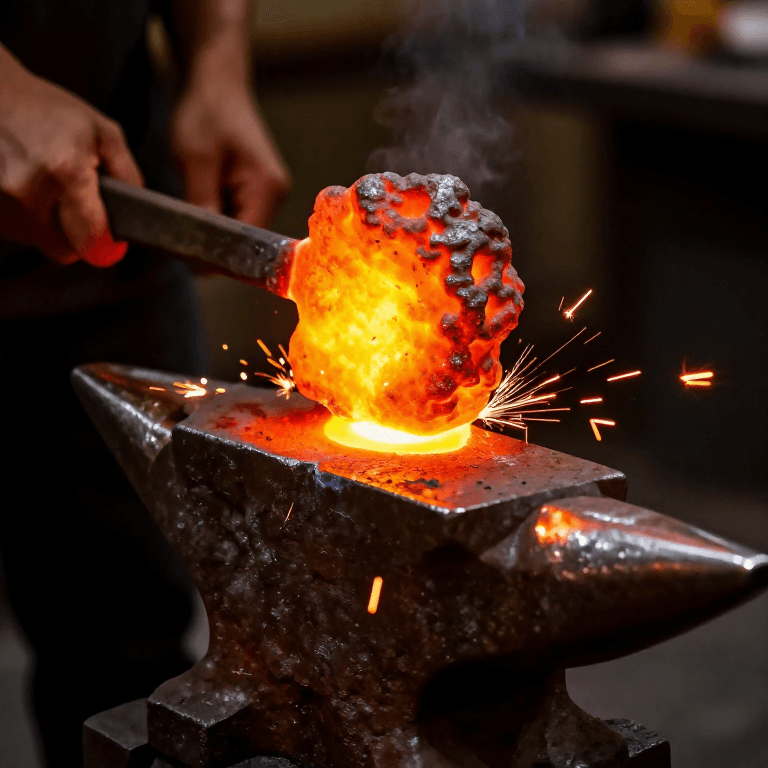
관련 블루프린트
이 블루프린트들은 지식을 공유합니다 — 기술, 재료 또는 원리
CC0 퍼블릭 도메인
이 블루프린트는 CC0로 공개되었습니다. 어떤 목적으로든 자유롭게 복사, 수정, 배포 및 사용할 수 있습니다.
제품 구매를 통해 메이커를 지원하세요. 판매자가 설정한 메이커 커미션 을 받거나, 이 블루프린트의 새로운 반복을 만들어 연결로 포함시킬 수 있습니다.