
Phenakistoscope
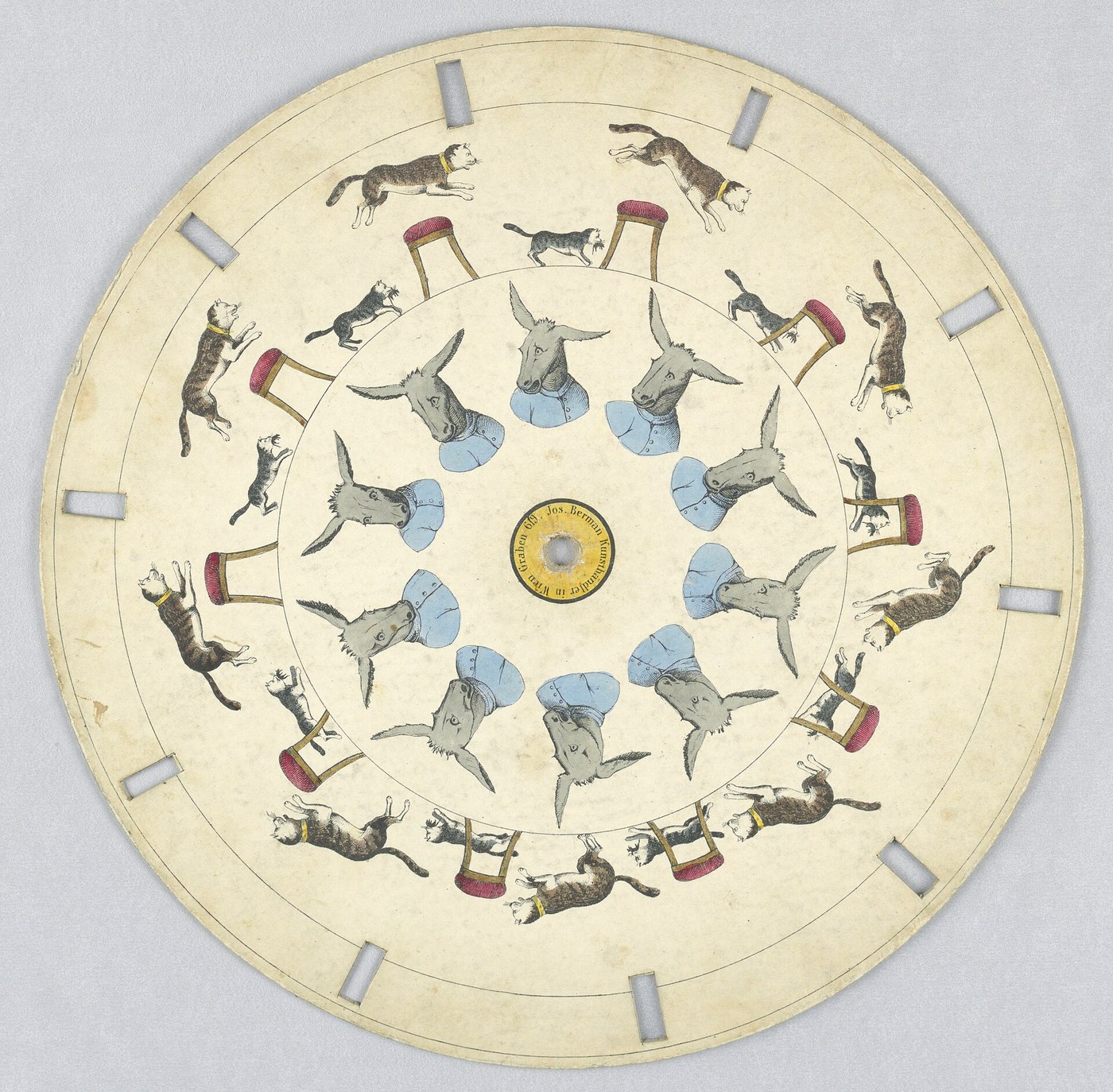
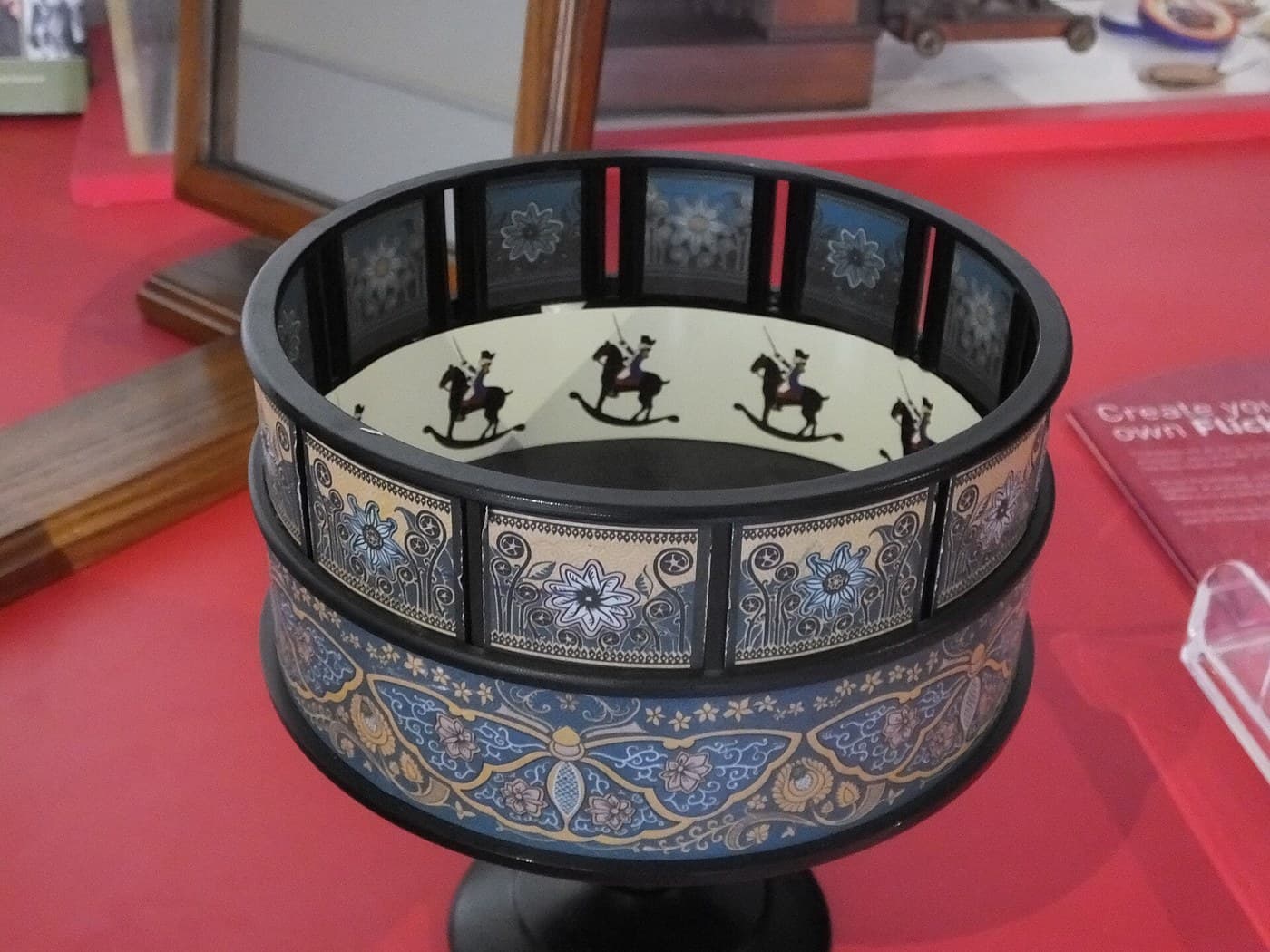
A disc of drawings and a mirror. Slits cut between the pictures let you glimpse each one for an instant as the disc spins, and the figure moves.
It is the same shutter idea as the zoetrope, arranged differently — and it came first. The awkward part is the viewing: the pictures face away from you, so you look through the slits at the disc's reflection in a mirror. That constraint is exactly why the zoetrope's drum replaced it commercially, and it is also why the phenakistoscope images survive as some of the most beautiful printed objects of the 1830s.
The geometry is the physics: the slit passes your eye at the instant the next drawing arrives in the position the last one occupied. Get the slit count right and the figure stands still and animates. Get it wrong and it drifts.
안내
Cut a card disc 250 mm across
Cut a card disc 250 mm across
Cut a disc of stiff card 250 mm in diameter. Stiff matters — a floppy disc wobbles and the figure jumps out of position.
이 단계의 재료:
 카드지1 장
필요한 도구:
 공예용 칼
공예용 칼 자가 복원 커팅 매트
Divide the disc into 12 sectors
Divide the disc into 12 sectors
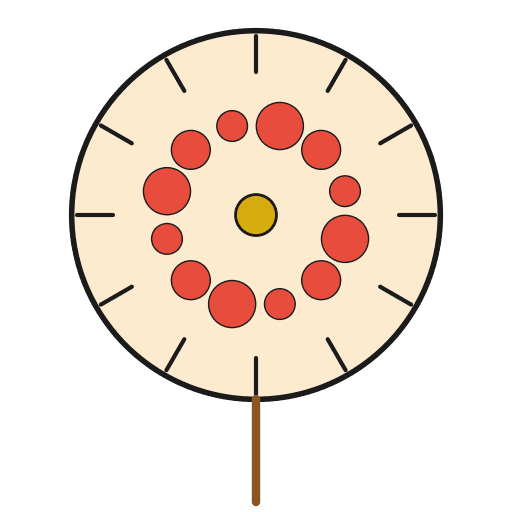
Mark the centre and divide the circumference into 12 equal sectors of 30°. Use a protractor or step the radius round the circle six times and halve each arc.
필요한 도구:
 자
자Cut one slit per sector
Cut one slit per sector
Cut a radial slit 2 mm wide and 25 mm long near the rim on each dividing line — 12 slits for 12 drawings. Equal numbers is what makes the image hold still instead of creeping round.
Draw the sequence facing outward
Draw the sequence facing outward
Draw one phase of the motion in each sector, all radiating from the centre with their feet toward the rim. A bouncing ball or a walking figure works; twelve frames is one full cycle.
Close the loop
Close the loop
Make frame 12 flow back into frame 1. A disc has no start, so any sequence that does not close shows a visible jolt once per revolution.
Pierce the centre and mount it
Pierce the centre and mount it
Push a pin or a dowel through the exact centre into a handle so the disc spins freely. Off-centre mounting makes the whole image swim.
이 단계의 재료:
 목재 다월봉1 개
Stand in front of a mirror
Stand in front of a mirror
Hold the disc with the drawings facing the mirror and your eye at the slits. You are looking at the reflection through the slits — this is the one genuinely awkward thing about the device, and there is no way round it.
Spin and find the working speed
Spin and find the working speed
Spin the disc and adjust the rate until the motion looks smooth. Time ten revolutions and multiply by 12 to get images per second.
필요한 도구:
 스톱워치
스톱워치Slow it to the flicker threshold
Slow it to the flicker threshold
Let it slow until the motion breaks into separate flashes and record that rate too. The gap between those two numbers is the working range of every projected moving image since.
Make a disc with 11 slits and 12 drawings
Make a disc with 11 slits and 12 drawings
Cut a second disc with one slit fewer than the number of drawings. The figure now creeps slowly around the disc as it animates, because each glimpse arrives slightly out of register. Deliberate stroboscopic drift.
Test the slit width
Test the slit width
Cut a third disc with 5 mm slits and compare. Wider slits give a brighter, blurrier image because more movement happens while the slit is open — the same exposure trade every shutter makes.
Compare against a zoetrope
Compare against a zoetrope
If you have a zoetrope, run both. The zoetrope needs no mirror and lets several people watch at once; the phenakistoscope is sharper and brighter but strictly one viewer. That single difference decided which one the Victorian toy trade sold.
History & Context
History & Context
1832, invented twice. Joseph Plateau, a Belgian physicist, produced the phenakistoscope in 1832. In late 1832, independently, the Austrian mathematician Simon von Stampfer arrived at essentially the same device, which he called the stroboscopic disc. Simultaneous independent invention is common in this period of optical toys, and neither man was copying the other.
Plateau's two discs. His arrangement used two discs on one spindle — one carrying equidistant radial windows to look through, one carrying the sequence of images. Single-disc versions viewed in a mirror became the standard form because they are far cheaper to make.
The explanation of the day. It was described in terms of persistence of vision, with an impression said to remain on the retina for roughly a fourteenth of a second. As with the thaumatrope and the zoetrope, that account is now considered insufficient: flicker fusion and apparent motion are handled by mechanisms beyond the retina. The device works exactly as it always did; the textbook explanation attached to it has been revised.
Why it lost. The mirror is the problem. One person at a time, at arm's length, facing a mirror. Horner's slitted drum of 1833 and especially Lincoln's 1867 zoetrope with interchangeable strips let several people watch and let one machine show many sequences. The phenakistoscope survived as a printed object rather than a device — the lithographed discs of the 1830s are collected as some of the finest colour printing of their decade.
Where the line goes. Thaumatrope, phenakistoscope, zoetrope, praxinoscope, projector. Each one solves a specific defect of the one before: two images become a sequence, the mirror becomes a drum, the slit becomes a mirror ring, and finally a lamp is put behind the strip. The whole of early cinema is in that list.
이 블루프린트로 만드는 것
CC0 퍼블릭 도메인
이 블루프린트는 CC0로 공개되었습니다. 어떤 목적으로든 자유롭게 복사, 수정, 배포 및 사용할 수 있습니다.
제품 구매를 통해 메이커를 지원하세요. 판매자가 설정한 메이커 커미션 을 받거나, 이 블루프린트의 새로운 반복을 만들어 연결로 포함시킬 수 있습니다.