예술
뷰티 및 웰니스
공예
문화 및 역사
엔터테인먼트
환경
음식 및 음료
역공학
과학
스포츠
기술
웨어러블
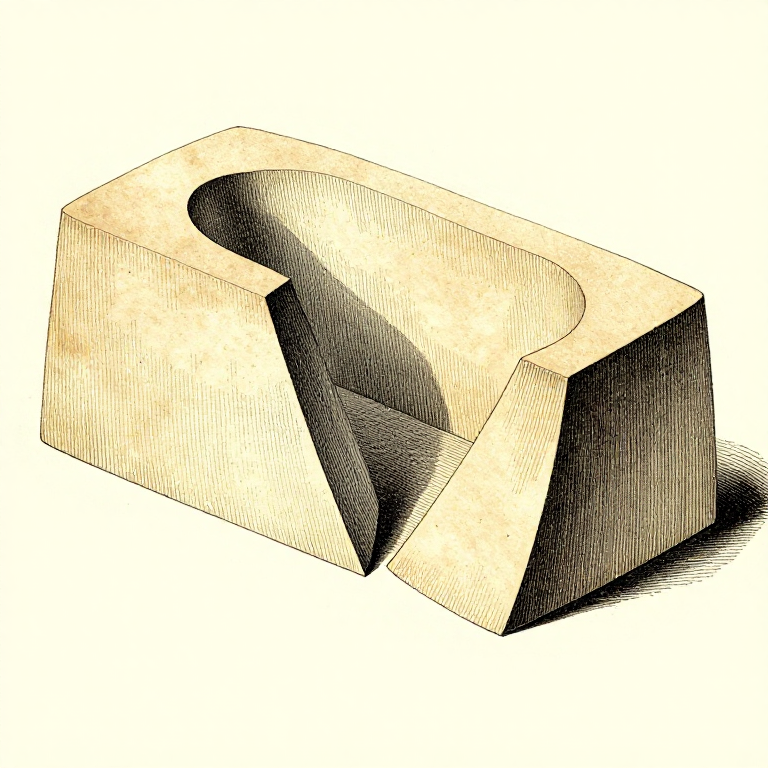


The Pattern Is Not the Part: Draft, Shrinkage and Machining Allowance
A pattern is not a copy of the finished part. It is deliberately LARGER, deliberately TAPERED, and deliberately oversized wherever a machined surface will be cut — and each of those three differences has a separate reason.
DRAFT is the taper that lets the pattern come out of the sand without tearing the mould. SHRINKAGE allowance makes the pattern bigger because metal contracts as it freezes and cools. MACHINING allowance leaves metal for the cutting tool to remove.
Get any of the three wrong and the casting is scrap. Get them right and the same pattern makes identical parts indefinitely, which is the entire economic point of casting.
중급
3 hours
안내
1
1
Draft: the pattern has to come out
Draft: the pattern has to come out
Every surface that runs perpendicular to the parting plane must be tapered so the pattern lifts cleanly. A vertical wall drags sand with it and leaves a torn mould, and that tear becomes a lump on the casting.
One to three degrees is usual for sand casting, more for deep pockets and less for shallow ones. The rule of thumb is that a deeper draw needs more draft, because a small angle over a long distance still leaves the sand gripping.
Draft always ADDS material away from the parting line, never removes it. A part that must be a precise size at the bottom of a deep feature has to be machined there, because draft is not optional and it is always in the direction that makes the casting thicker.
이 단계의 재료:
 경목 판재1 개
 주물사1 kg
필요한 도구:
 줄 세트
줄 세트 디지털 캘리퍼스 6인치
 자
자2
2
Shrinkage: build the pattern oversize by the right amount
Shrinkage: build the pattern oversize by the right amount
Jupyter 노트북 불러오는 중…
이 단계의 재료:
경목 판재1 개 청동 주괴1 개
필요한 도구:
 데스크톱 컴퓨터디지털 캘리퍼스 6인치자
3
3
Machining allowance goes only where a tool will cut
Machining allowance goes only where a tool will cut
A cast surface is rough, slightly scaled, and not accurately placed. Any face that has to be flat, parallel or dimensionally exact must be machined, and the pattern has to carry extra metal there for the tool to remove.
Two to five millimetres is typical for sand casting, and more on large surfaces and on the cope side — the upper half of the mould collects more inclusions, so critical machined faces are placed in the drag where possible.
Do NOT add it everywhere. Extra metal is extra weight, extra cost, extra shrinkage to feed, and extra machining time. Deciding which faces are machined and which are left as-cast is a design decision made before the pattern is started.
이 단계의 재료:
경목 판재1 개필요한 도구:
디지털 캘리퍼스 6인치줄 세트4
4
Finish the pattern properly, because it prints
Finish the pattern properly, because it prints
Every scratch, dent and grain on the pattern is reproduced in the sand and then in the metal. A pattern sanded smooth and sealed gives a smooth casting; a rough one gives a rough one, and rough castings are harder to clean and harder to machine.
Seal and wax wooden patterns. Bare wood absorbs moisture from green sand, swells and changes size, and it also grips the sand instead of releasing.
Fillet every internal corner. A sharp internal corner in the pattern makes a sharp sand edge that breaks off into the casting, and it makes a stress concentration in the finished part — the same argument as a fillet in a printed part or a forged one.
이 단계의 재료:
경목 판재1 개 밀랍1 개
밀랍1 개필요한 도구:
줄 세트 확대 루페디지털 캘리퍼스 6인치
관련 블루프린트
이 블루프린트들은 지식을 공유합니다 — 기술, 재료 또는 원리
CC0 퍼블릭 도메인
이 블루프린트는 CC0로 공개되었습니다. 어떤 목적으로든 자유롭게 복사, 수정, 배포 및 사용할 수 있습니다.
제품 구매를 통해 메이커를 지원하세요. 판매자가 설정한 메이커 커미션 을 받거나, 이 블루프린트의 새로운 반복을 만들어 연결로 포함시킬 수 있습니다.