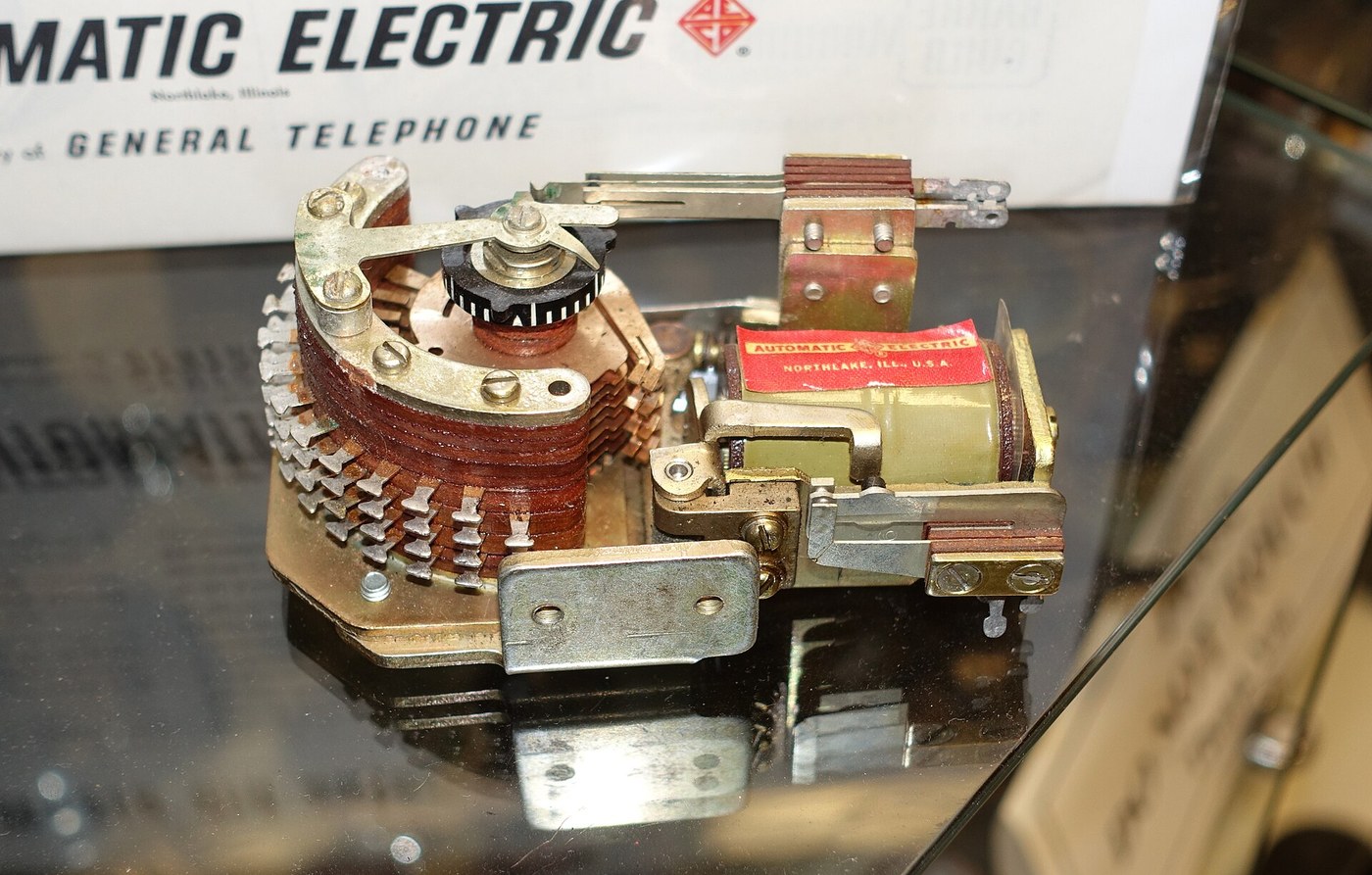


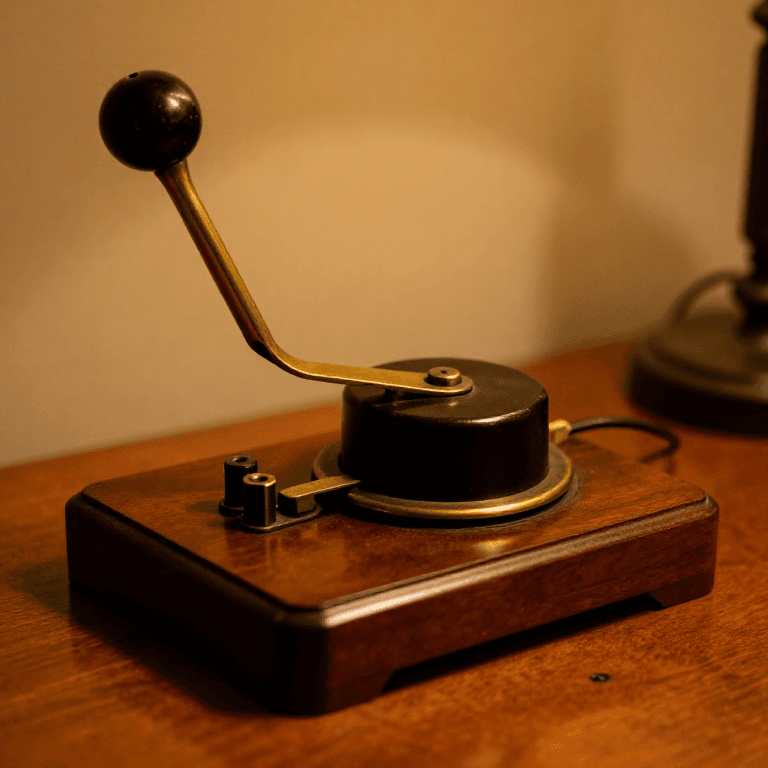
Strowger Telephone Exchange
Almon Strowger was an undertaker in Kansas City who believed he was losing business because the local telephone operator was married to a rival undertaker and was steering calls to him. Whether or not that is literally true, it names the real problem exactly: a manual exchange puts a human being in the middle of every private call.
His answer was to move the decision from the operator to the caller. Each pulse of the dial steps a mechanical wiper one position along a bank of contacts; ten pulses step it ten. The digits you send physically drive the selector to the wanted line. There is no interpreting, no discretion and no listener.
US Patent 447,918, "Automatic telephone-exchange", granted 10 March 1891 — the first automatic switching system, and the ancestor of every dial tone.
คำแนะนำ
Read US 447,918 and note the phrase that matters
Read US 447,918 and note the phrase that matters
Strowger claims connection between stations "without the assistance of an operator at the central station". That clause is the invention; the mechanism is how he gets there.
Count the connections a manual board needs
Count the connections a manual board needs
Work out how many cord pairs an operator needs for 100 subscribers, then 10,000. Manual switching scales with an operator per few hundred lines — the labour is the limit, not the wire.
Build a pulse generator: the dial
Build a pulse generator: the dial
Make a rotating disc with finger holes that, on returning, breaks the line contact once per digit. Dialling 7 sends seven clean interruptions.
วัสดุสำหรับขั้นตอนนี้:
 แผ่นไม้อัด1 แผ่น
เครื่องมือที่ต้องใช้:
 เลื่อยมือ
Govern the dial's return speed
Govern the dial's return speed
Fit a centrifugal governor or friction brake so it returns at a fixed rate — about ten pulses per second. Pulse TIMING carries the information, so an ungoverned dial dials wrong numbers.
Build a ratchet and pawl that steps once per pulse
Build a ratchet and pawl that steps once per pulse
Wind an electromagnet driving a pawl into a ratchet wheel. Each energise-release cycle advances exactly one tooth — this is the counter that receives the digits.
วัสดุสำหรับขั้นตอนนี้:
 ลวดทองแดงอาบน้ำยา40 เมตร
Fit a detent so it cannot slip back
Fit a detent so it cannot slip back
Add a spring detent holding each step. A selector that drops back one position connects the caller to the wrong subscriber, silently.
วัสดุสำหรับขั้นตอนนี้:
 ชุดสปริงกด1 ชิ้น
Arrange contacts in an arc for the wiper to sweep
Arrange contacts in an arc for the wiper to sweep
Lay ten contacts in an arc with a wiper on the ratchet shaft. Position N on the ratchet must land squarely on contact N.
วัสดุสำหรับขั้นตอนนี้:
 แผ่นทองเหลือง 260 เบอร์ 241 แผ่น
Test one digit end to end
Test one digit end to end
Dial 4 and confirm the wiper sits on contact 4 with a meter. The caller's finger has physically positioned a mechanism a mile away.
เครื่องมือที่ต้องใช้:
 มัลติมิเตอร์
Add a second axis for the next digit
Add a second axis for the next digit
Make the shaft step VERTICALLY on the first digit and ROTATE on the second. Two digits now address a 10×10 grid — one hundred lines from one selector.
วัสดุสำหรับขั้นตอนนี้:
 แท่งเหล็กกลมคาร์บอนต่ำ1 ชิ้น
See why this scales and a switchboard does not
See why this scales and a switchboard does not
Add a third digit by cascading another selector: a thousand lines. Capacity grows by a factor of ten per stage, and the machinery per subscriber stays constant.
Fit a release magnet that returns everything home
Fit a release magnet that returns everything home
Add a magnet that drops the wiper back to rest when the caller hangs up. Without a reset the selector is stuck holding a line nobody is using.
Add a busy test before connecting
Add a busy test before connecting
Sense whether the target contact already carries a call and return a tone instead. The engaged tone is a distributed decision made by the switch, with no supervisor anywhere.
Dial deliberately badly and watch it fail
Dial deliberately badly and watch it fail
Return the dial by hand, fast and then slow. You reach wrong numbers. The system trusts the timing absolutely — a worn governor was a real and common fault.
Count the moving parts per call
Count the moving parts per call
Tally ratchets, pawls, wipers and magnets used for a single connection. This is why exchanges were vast rooms of clattering machinery needing constant maintenance.
Compendium — moving the decision to the caller
Compendium — moving the decision to the caller
The patent. US 447,918, "Automatic telephone-exchange", granted 10 March 1891 to Almon B. Strowger of Kansas City, an undertaker with no engineering training. The origin story — that a rival undertaker's wife worked the switchboard and diverted his calls — is repeated everywhere and cannot be firmly documented, but the grievance it describes is genuine: manual exchanges gave operators knowledge of and discretion over every call. The first Strowger exchange opened at La Porte, Indiana in 1892.
The dial is a serial data link, and a slow one. Each digit is sent as a train of interruptions in the loop current, at roughly ten pulses per second, with the digit encoded as the COUNT of pulses. Dialling a seven-digit number takes several seconds and sends about forty pulses. It is a self-clocking serial protocol implemented with a spring, a cam and a governor, decades before anyone used those words — and the governor matters absolutely, because the receiving ratchet counts events in time and has no other check on what was meant.
Why two axes. The Strowger selector steps vertically on the first digit and rotates on the second, so its wiper addresses a two-dimensional bank: ten levels of ten contacts, a hundred lines from one mechanism. Cascading selectors multiplies capacity by ten per stage. That is what made automatic switching scale — a manual board needs operators roughly in proportion to traffic, whereas this needs a fixed amount of machinery per subscriber. Bell System engineers later calculated that at manual-switching ratios, telephone growth would have required a large fraction of the working population as operators.
What replaced it, and what did not. Electromechanical Strowger switches ran the world's telephones for the better part of a century before crossbar, then reed relay, then digital switching replaced them; the last were retired in the 1990s. What survived is the concept: the caller supplies the address, the network routes it with no human in the path, and the connection is made by a distributed set of machines each making a small local decision. That is also a fair description of packet routing, which is the same idea with the mechanism removed.
วัสดุ
5- 1 แผ่นตัวยึดตำแหน่ง
- 40 เมตรตัวยึดตำแหน่ง
- 1 ชิ้นตัวยึดตำแหน่ง
- ตัวยึดตำแหน่ง
- 1 ชิ้นตัวยึดตำแหน่ง
บลูพริ้นท์ที่เกี่ยวข้อง
บลูพริ้นท์เหล่านี้แบ่งปันความรู้ — เทคนิค วัสดุ หรือหลักการ

CC0 สาธารณสมบัติ
พิมพ์เขียวนี้เผยแพร่ภายใต้ CC0 คุณสามารถคัดลอก แก้ไข แจกจ่าย และใช้งานผลงานนี้เพื่อวัตถุประสงค์ใดก็ได้ โดยไม่ต้องขออนุญาต
สนับสนุนเมกเกอร์โดยซื้อสินค้าผ่านพิมพ์เขียวของพวกเขา ซึ่งพวกเขาจะได้รับ ค่าคอมมิชชันเมกเกอร์ ที่ผู้ขายกำหนด หรือสร้างเวอร์ชันใหม่ของพิมพ์เขียวนี้และรวมเป็นการเชื่อมต่อในพิมพ์เขียวของคุณเพื่อแบ่งรายได้