IṢẸ́ ỌNÀ
ẸWÀ ÀTI ÌLERA
IṢẸ́ ỌWỌ́
ÀṢÀ ÀTI ÌTÀN
ÌṢERÉ
ÀYÍKÁ
OÚNJẸ ÀTI OHUN MÍMU
REVERSE ENGINEERING
SÁYẸ́ǸSÌ
ERÉ ÌDÁRAYÁ
ÌMỌ̀-Ẹ̀RỌ
ÀWỌN OHUN WÍWỌ̀
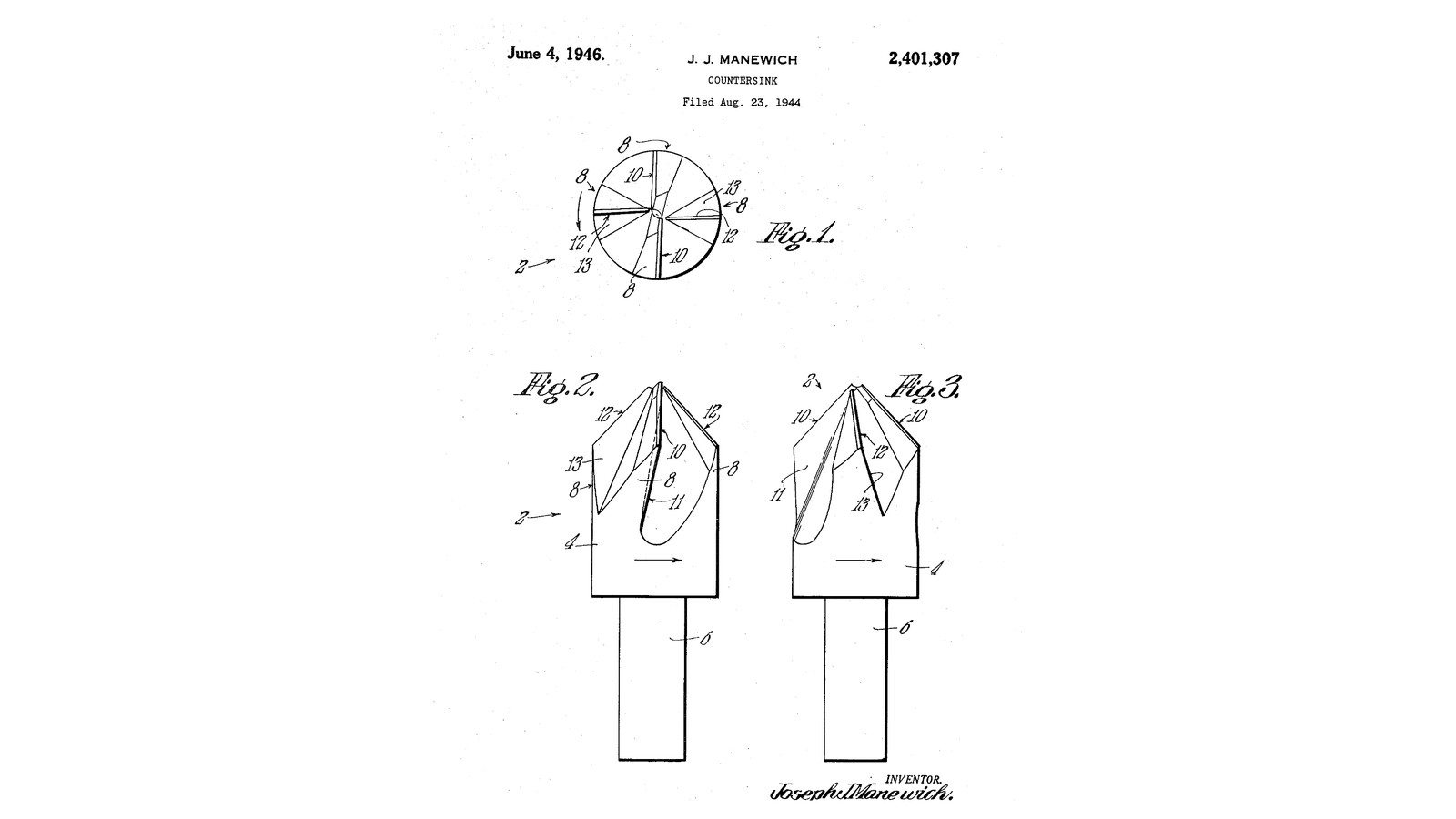


Four-Edge Chatterless Countersinks: Two Pairs of Edges Set Off the Centre Lines, One Raked Each Way (Manewich, 1946)
Joseph J. Manewich of Longmeadow, Massachusetts, received US 2,401,307, dated 4 June 1946, for a countersink that does not chatter. Four teeth are gashed in the cone. The inner ends of one pair of edges sit just ahead of a line through the centre, with their faces raked back. The other pair sit just behind a line at right angles, raked forwards. The edges keep changing how they meet the work as the tool goes in, and each steadies the one opposite, so it can run faster and leaves round, smooth countersinks.
We make a set of three in tool steel. The patent gives no sizes or angles; ours are stated.
Ilọsíwájú
About 1 day
Ìlànà
1
1
Why the edges are set off the centre lines
Why the edges are set off the centre lines
Ń ṣí ìwé Jupyter…
2
2
Read US 2,401,307
Read US 2,401,307
"It has been found that the countersink tool by reason of its novel construction and arrangement may be operated at a higher speed than may those of the prior art while at the same time objectionable chatter is eliminated."
3
3
Turn the blanks
Turn the blanks
From octagonal tool steel turn three blanks: a 90 degree cone to a point, 12, 16 and 20 mm across, a short body 4 and an 8 mm shank 6 50 mm long with three filed flats. Heat each to a cherry red and let it cool slowly in the air.
Àwọn ohun èlò fún ìgbésẹ̀ yìí:
 Ọ̀pá onígun mẹ́jọ irin irinṣẹ́2 ẹyọ
Àwọn irinṣẹ́ tí a nílò:
 Ẹ̀rọ Ìyí Irin
 Ìmú ẹ̀rọ ìyípo oníka mẹ́ta
 Ohun ìgé ẹ̀rọ ìyí
 Ọ̀bẹ ìgékúrò lórí ẹ̀rọ ìyí
 Ẹ̀rọ Ìwọ̀n Igun
 Òṣùwọ̀n Kálípà Díjítà Ìnṣì 6
 Àkójọ Ìfá
 Ilé Iná Alágbẹ̀dẹ
 Ẹmú Alágbẹ̀dẹ
 Gíláàsì ààbò
4
4
Mark and gash the four teeth 8
Mark and gash the four teeth 8
Blue the cone and scribe two diameters across its end at right angles. Mark the positive pair's edges 10 parallel to the first diameter, 0.5 mm ahead of it in the direction of turning, and the negative pair's edges 12 parallel to the second, 0.5 mm behind it. File or grind a gash 11 ahead of each edge, down the cone: for the edges 10 the face raked back about 8 degrees (positive), for the edges 12 raked forward about 5 degrees (negative). Give each edge a little clearance behind it.
Àwọn irinṣẹ́ tí a nílò:
 Àkójọ Ìfá Kékeré
 Ìdìmú Ẹ̀rọÀkójọ Ìfá
 Ẹ̀rọ ìfá orí tábìlìẸ̀rọ Ìwọ̀n Igun
5
5
Harden and temper
Harden and temper
Heat each head to a cherry red, until a magnet no longer sticks, and quench it point first in water, moving it about. Rub it bright with a stone, heat the shank gently 20 mm behind the head, and quench again as soon as a light straw colour reaches the cutting edges.
Àwọn irinṣẹ́ tí a nílò:
Ilé Iná Alágbẹ̀dẹẸmú Alágbẹ̀dẹ Magnẹ́ẹ̀tì Kékeré
 Àpótí ìtutù
 Omi
 Òkúta Ìpọ́n
 Ìbọ̀wọ́ wẹ́lídìnGíláàsì ààbò
6
6
Hone and test
Hone and test
Hone all four edges lightly with the stone. Countersink holes in hardwood and in a scrap of aluminium at a higher speed than usual: the cone should be round and smooth, with no chatter marks.
Àwọn irinṣẹ́ tí a nílò:
Òkúta Ìpọ́n Ẹ̀rọ Ìlùkòkò Aláìlókùn
 Àkójọ Orí Ìlùkòkò
 Pátákó Igi LíleGíláàsì ààbò
7
7
Troubleshooting
Troubleshooting
Four-edge countersink troubleshooting.
Flow
Loading...
8
8
History and honest limits
History and honest limits
**Joseph J. Manewich** of Longmeadow, Massachusetts, US 2,401,307, dated 4 June 1946, filed 23 August 1944. He claimed cutting edges in two pairs, "the innermost portions of the cutting edges of one pair thereof disposed adjacent said longitudinal axis and forwardly" of a plane through it, and those of the other pair "rearwardly" of another plane at right angles. He calls the first positive edges with positive rake and the second negative with negative rake. He gives no sizes, offsets or angles; ours are stated, with the house hardening.
Àwọn ohun-èlò
1- Àyè
Àwọn irinṣẹ́ tó nílò
21- Àyè
- Àyè
- Àyè
- Àyè
- Àyè
- Àyè
- 1 vendor sell this, none ship to you yetÀyè
Ìtọ́nisọ́nà yìí ń ṣe

Blueprint tó jọra
Àwọn blueprint wọ̀nyí pín ìmọ̀ — ọ̀nà, ohun-èlò tàbí ìlànà
CC0 Àgbègbè Gbogbogbò
Blueprint yìí ti jáde lábẹ́ CC0. O lè ṣe àdàkọ, yí padà, pín, àti lò láìsí ìyọ̀ǹda.
Ṣàtìlẹ́yìn Olùṣẹ́dá nípa rírà àwọn ọjà nipasẹ̀ Blueprint wọn Ẹ̀san Olùṣẹ́dá tí àwọn Olùtajà gbé kalẹ̀, tàbí ṣẹ̀dá àtúnṣe tuntun ti Blueprint yìí kí o sì fi sínú Blueprint rẹ gẹ́gẹ́ bí ìsopọ̀ láti pín owó-wíwọlé.