IṢẸ́ ỌNÀ
ẸWÀ ÀTI ÌLERA
IṢẸ́ ỌWỌ́
ÀṢÀ ÀTI ÌTÀN
ÌṢERÉ
ÀYÍKÁ
OÚNJẸ ÀTI OHUN MÍMU
REVERSE ENGINEERING
SÁYẸ́ǸSÌ
ERÉ ÌDÁRAYÁ
ÌMỌ̀-Ẹ̀RỌ
ÀWỌN OHUN WÍWỌ̀


Shaftless Dasher-Wheel Churn: Bevelled Buckets Drive the Cream to the Centre
Earlier dasher wheels turned on a shaft running through the churn.
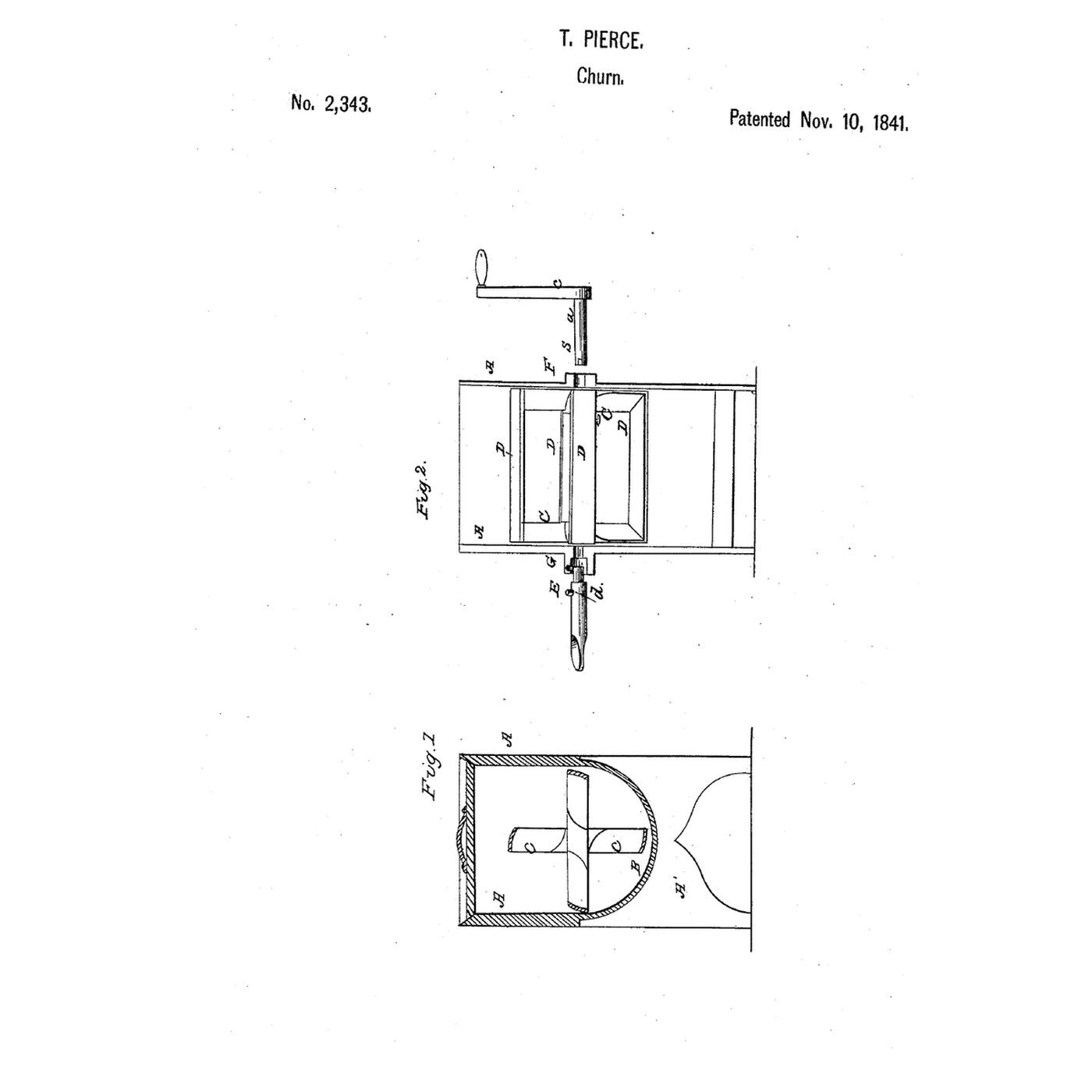
Thomas Pierce of Hartwick, New York, received US 2,343, dated 10 November 1841, for a churn whose "dasher wheel has no center shaft, but is sustained by axes which are passed through the sides of the box." Two crosses are joined by four buckets, all bevelled so that turning the wheel "shall conduct the cream from the ends and sides of the box toward the center." The winch's axle catches a pin in the cross by a notch; the box's bottom is semicircular and its end planks run down as legs.
This rung works out the bevels' push, then prints the wheel and grooved ends, bends a stainless half cylinder, and makes butter.
Ilọsíwájú
About 5 hours, plus printing
Ìlànà
1
1
Bevel push and box size
Bevel push and box size
Ń ṣí ìwé Jupyter…
2
2
A dash turning in a half cylinder before it
A dash turning in a half cylinder before it
The embedded blueprint turns a dash of two crosses and slats on a spindle in a half cylinder. Pierce drops the spindle and bevels the parts.
3
3
Read US 2,343
Read US 2,343
"The dasher consists of four arms at each end, formed by crossing two pieces of wood purposely shaped for that purpose; and of four buckets, which connect the four arms at each end, extend the length of the box; the arms and the buckets are each made beveling, or slanting on the inside from the forward edge to the hind part of the arms and buckets in such manner as that when the dasher wheel is made to revolve, they shall conduct the cream from the ends and sides of the box toward the center."
4
4
Print the parts
Print the parts
Print the dasher wheel standing on one cross (/uploads/blueprints/shaftless-dasher-wheel-churn-wheel.stl), with supports under the upper cross. Its hubs have sockets for the gudgeons, and one has the notch. Print two end pieces (/uploads/blueprints/shaftless-dasher-wheel-churn-end.stl) and the crank arm (/uploads/blueprints/shaftless-dasher-wheel-churn-crank-arm.stl). Print in PETG at 0.2 mm layers, 30 % infill, 4 walls; wash before first use.
Àwọn ohun èlò fún ìgbésẹ̀ yìí:
 Okùn PETG1 ẹyọ
Àwọn irinṣẹ́ tí a nílò:
 Ẹ̀rọ ìtẹ̀ 3D oníwàyà (FDM)
5
5
Bend the bottom
Bend the bottom
Cut a 0.5 mm stainless sheet 160 mm wide and about 305 mm long, deburr it, and bend it round a 130 mm form into a U: a 65 mm radius half circle with 50 mm straight sides. Seat it in the curved grooves of both end pieces in silicone, and let it cure.
Àwọn ohun èlò fún ìgbésẹ̀ yìí:
 Àwo irin tí kò ń yá - 3041 ẹyọ
 Ìdílẹ̀ Silikoni1 ẹyọ
Àwọn irinṣẹ́ tí a nílò:
 Ìlàǹkàn irin
 Ohun èlò ìmúkúrò èèpo
 Òòlù rọ́bà
 Àwọn clamp
 Okùn Ìdíwọ̀n
6
6
Gudgeons and winch
Gudgeons and winch
Cut two 30 mm stubs of 12 mm hardwood dowel as gudgeons. Drive a nail across one, near its inner end, to catch the wheel's notch. Set the wheel between the ends and push a gudgeon through each end into its hub, with a leather washer under each so the cream does not leak. Glue the crank arm and a dowel handle on the notched gudgeon.
Àwọn ohun èlò fún ìgbésẹ̀ yìí:
 Àwọn dowel igi líle1 ẹyọ
 Ìṣó1 ẹyọ
 Tẹ́ẹ́rẹ́ awọ1 ẹyọ
 Ìdìpọ̀ Igi1 ẹyọ
Àwọn irinṣẹ́ tí a nílò:
 Ayùn Ọwọ́
 Òòlù
Òòlù Bébà Ìfá
7
7
The patent drawing
The patent drawing
US 2,343 drawing sheet, public domain (expired patent).
8
8
Crank and make butter
Crank and make butter
Let the heavy cream stand until it reaches about 15 °C, checked with the thermometer. Pour in 500 ml. Turn the crank steadily and time until the butter comes; the bevels gather it in the middle. Pour off the buttermilk, add cold water, churn a little and pour off again until it runs clear; work in a pinch of salt and weigh the butter.
Àwọn ohun èlò fún ìgbésẹ̀ yìí:
 Ọ̀rá wàrà tó nípọn500 ml
 Iyọ̀ Òkun Rúkèrúdò1 ẹyọ
 Omi1 ẹyọ
Àwọn irinṣẹ́ tí a nílò:
 Ẹ̀rọ ìwọ̀n ooru oníhun tí ó dúró sí inú
 Aago Ìdúró
 Òṣùwọ̀n Díjítà Ilé Ìdáná
 Àwo ìdàpọ̀ ńlá ti irin tí kò ń yá
9
9
A wheel that will not turn, ends that leak
A wheel that will not turn, ends that leak
Shaftless dasher-wheel churn troubleshooting.
Flow
Loading...
10
10
History and honest limits
History and honest limits
**Thomas Pierce** of Hartwick, Otsego County, New York, received US 2,343, dated 10 November 1841. The hole for the winch's axle "is boxed or leathered so that the cream should not leak through"; a pin turned on an inclined recess in a cleat keeps the churn tight at both axes. "The dasher wheel may be made of wood, the axes, boxing, &c., may also be made of wood, bone, or any suitable material; the machine may be operated by any propelling power now in use." He claimed the bevel of the arms in combination with the bevel form of the buckets, to give the centripetal operation upon the cream.
**Honest limits.** Stainless sheet and printed parts stand in for his box and wooden wheel. FDM prints hold food in their layer lines, so wash well and replace when worn. Your times and weights are the result.
Àwọn ohun-èlò
10- 1 ẹyọÀyè
- Àyè
- 1 ẹyọÀyè
- 1 ẹyọÀyè
- 1 ẹyọÀyè
- 1 ẹyọÀyè
- 1 ẹyọÀyè
- 500 mlÀyè
- 1 ẹyọÀyè
- 1 ẹyọÀyè
Àwọn irinṣẹ́ tó nílò
13- Àyè
- Àyè
- Àyè
- 1 vendor sell this, none ship to you yetÀyè
- Àyè
- Àyè
- Àyè
- Àyè
Ìtọ́nisọ́nà yìí ń ṣe

Blueprint tó jọra
Àwọn blueprint wọ̀nyí pín ìmọ̀ — ọ̀nà, ohun-èlò tàbí ìlànà
Water-Jacketed Churn: Hot or Cold Water Under a Metal Plate Tempers the Cream
láti ọwọ́ Karen
OÚNJẸ ÀTI OHUN MÍMU
25
0
0
0
0
0
Oblique-Paddle Churn: Turn One Way to Gather the Butter, Back to Spread It
láti ọwọ́ TheChef
OÚNJẸ ÀTI OHUN MÍMU
16
0
0
0
0
0
Oblique-Wing Reel Churn: Four Wings Across the Line of the Axle
láti ọwọ́ YourGrandma
OÚNJẸ ÀTI OHUN MÍMU
9
0
0
0
0
0
CC0 Àgbègbè Gbogbogbò
Blueprint yìí ti jáde lábẹ́ CC0. O lè ṣe àdàkọ, yí padà, pín, àti lò láìsí ìyọ̀ǹda.
Ṣàtìlẹ́yìn Olùṣẹ́dá nípa rírà àwọn ọjà nipasẹ̀ Blueprint wọn Ẹ̀san Olùṣẹ́dá tí àwọn Olùtajà gbé kalẹ̀, tàbí ṣẹ̀dá àtúnṣe tuntun ti Blueprint yìí kí o sì fi sínú Blueprint rẹ gẹ́gẹ́ bí ìsopọ̀ láti pín owó-wíwọlé.