IṢẸ́ ỌNÀ
ẸWÀ ÀTI ÌLERA
IṢẸ́ ỌWỌ́
ÀṢÀ ÀTI ÌTÀN
ÌṢERÉ
ÀYÍKÁ
OÚNJẸ ÀTI OHUN MÍMU
REVERSE ENGINEERING
SÁYẸ́ǸSÌ
ERÉ ÌDÁRAYÁ
ÌMỌ̀-Ẹ̀RỌ
ÀWỌN OHUN WÍWỌ̀
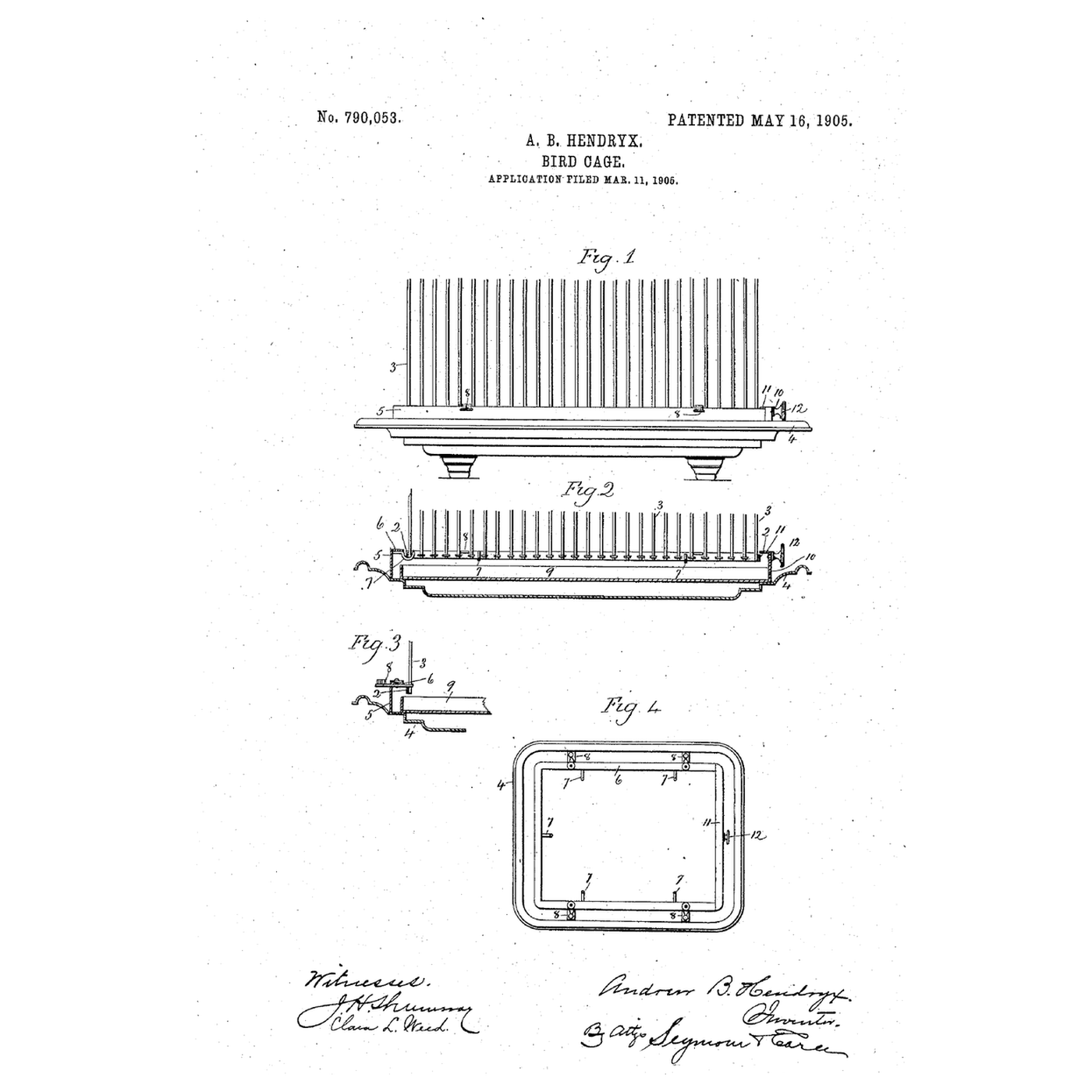


The Flanged-Base Cage Pan: A Pan Larger Than the Cage, Drawn Out From Under a Flange
A bird cage whose pan slides in under the base is cleaned without lifting the cage off; but the pan is smaller than the cage, so seeds and refuse collect beyond its edge and the cage must come off after all.
Andrew B. Hendryx of New Haven, Connecticut, received US 790,053, dated 16 May 1905, for a bird cage whose base has an upward rim on three sides, turned inward as a flange; the cage sets within the flange, and a pan slides in over the base beneath the flange, its front completing the rim, so that "the pan extending beneath the flange catches all refuse and may be readily withdrawn for cleaning".
This rung works out how much a smaller pan misses, then builds a flanged base for a bought cage with a pan that reaches under the flange, and counts the lentils each pan catches.
Àárín
About 4 hours
Ìlànà
1
1
What a small pan misses
What a small pan misses
Ń ṣí ìwé Jupyter…
2
2
A cage floor cleaned without lifting the cage
A cage floor cleaned without lifting the cage
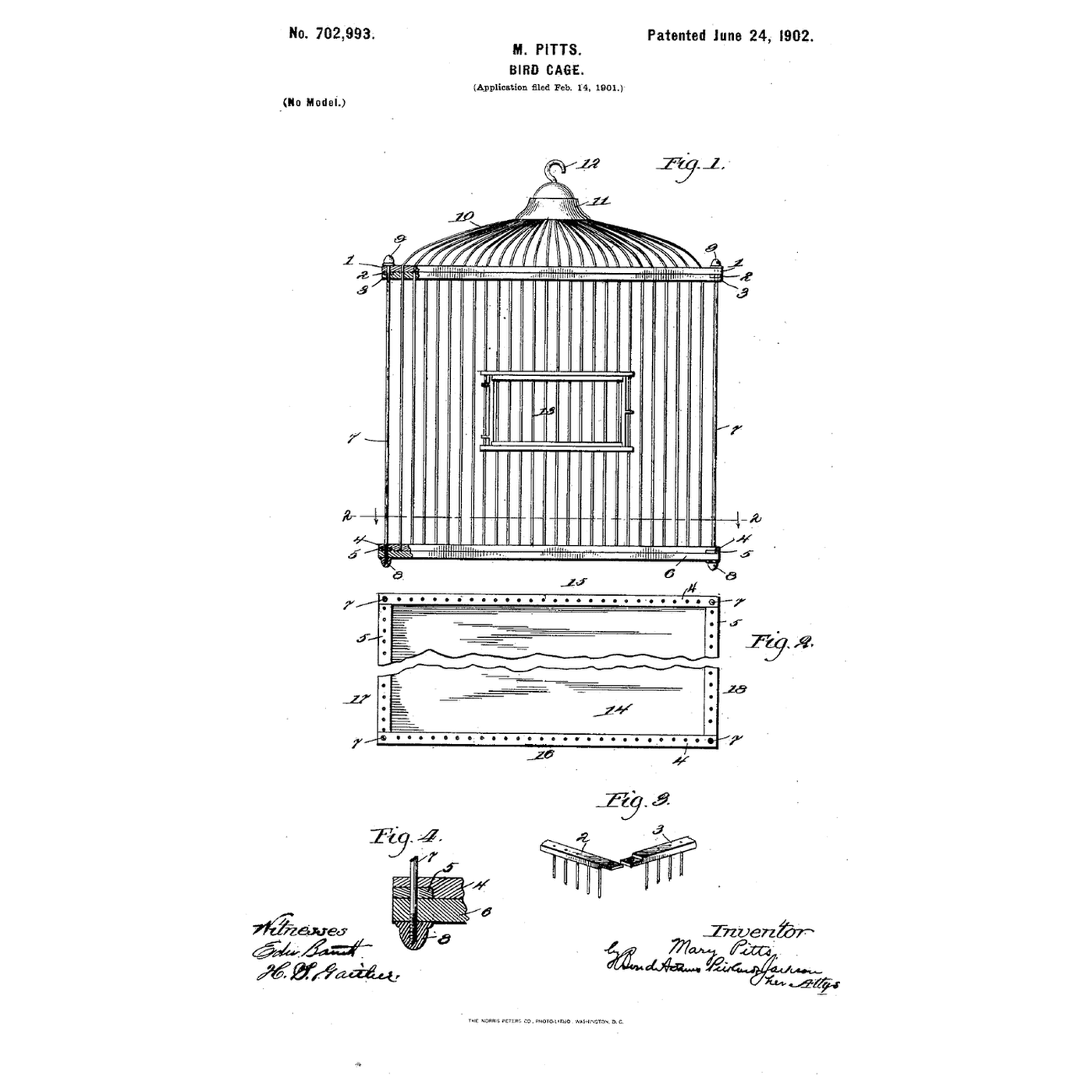
The embedded blueprint renews a cage's floor by pulling paper through from a roll. Hendryx instead slides a pan larger than the cage in under a flange, so everything that falls lands in it.
3
3
Read US 790,053
Read US 790,053
"The base 4 is of substantially usual form, and near its outer edge I attach an upright rim 5, which extends on two sides and across one end. At the upper edge this rim is turned inward, forming a flange 6."
"As the edge of the drawer extends beneath the flange 6 and as the cage sets within the flange, it follows that the drawer is of greater dimensions than the dimensions of the cage, so that all refuse falling within the cage must necessarily fall within the pan, and this pan and its contents may be readily withdrawn without disengaging the body of the cage from the base."
4
4
Build the base and pan
Build the base and pan
**Base.** Measure the bought cage's bottom rim. Saw a hardwood board 6 cm longer and wider than it.
**Rim and flange.** Cut a strip of aluminium sheet 4.5 cm wide and long enough for two sides and one end. Fold 1.5 cm of one edge out flat as a foot, 2 cm up as the rim, and the last 1 cm inward as the flange. Screw the feet to the board 1.5 cm in from its edge along those three sides, so the flange's inner edge stands 5 mm outside the cage's rim all round.
**Pan.** Fold a tray from aluminium sheet that slides in over the board under the flange and fills the rim, with sides 1.5 cm high, so it is 1.5 cm larger than the cage all round. At its open end fold a front as tall as the rim, turned in at the top like the flange, and screw a small dowel knob to it.
**Cage.** Drill four holes in the flange and pass a hook bent from galvanised wire down through each, so the cage's bottom rim rests on the hooks just below the flange's top, clear of the pan. Twist a wire clip over the rim at each hook to lock the cage to the base.
**Test.** Scatter a counted cupful of lentils over the cage floor and count those in the pan and outside it; repeat with a tray cut 2 cm smaller than the cage all round.
Àwọn ohun èlò fún ìgbésẹ̀ yìí:
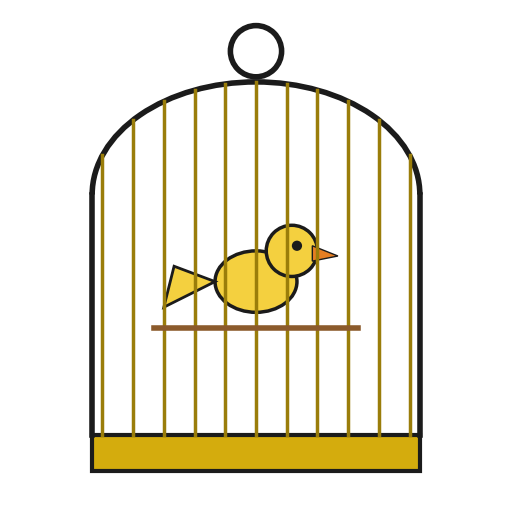 Àgò ẹyẹ1 ẹyọ
 Pátákó Igi Líle1 ẹyọ
 Àwo aluminiọ̀mù1 ẹyọ
 Ìṣó igi12 ẹyọ
 Àwọn dowel igi líle1 ẹyọ
 Okùn Irin Tí A Fi Sinkì Bò1 ẹyọ
 Ẹ̀wà lentil gbígbẹ1 ẹyọ
Àwọn irinṣẹ́ tí a nílò:
 Ayùn Ọwọ́
 Ìlàǹkàn irin
 Ìdìmú Tábìlì
 Ẹmú Ẹnu Pẹrẹsẹ
 Òòlù
Òòlù Ẹ̀rọ Ìlùkòkò Aláìlókùn
 Àkójọ Orí Ìlùkòkò
 Ìṣù àwọn ohun ìyí skurú
 Àwọn Ìfá (Ìfá Ọwọ́)
 Ìdíwọ̀n
 Ààmì Tí Kò Ní Parẹ́
 Gílásì Ààbò Tí Ó Mọ́
5
5
A pan that sticks, spills or leaves refuse behind
A pan that sticks, spills or leaves refuse behind
Flanged-base cage pan troubleshooting.
Flow
Loading...
6
6
History and honest limits
History and honest limits
**Andrew B. Hendryx** of New Haven, Connecticut, filed US 790,053 on 11 March 1905; it is dated 16 May 1905. The cage has a lower rim or bar 2 carrying the upright wires 3; hooks 7 on the flange receive the rim, and slides 8 on the flange pass over it to interlock cage and base. The pan 9 has a front 10 with an inward upper edge 11 and a knob 12. He noted that the rim and flange also give a finished look and allow a flat base, where cages with a drawer in the base must be deep. His claims cover the base with its rim and flange, the cage set within it, and the pan extending beneath the flange, with its front completing the fourth side.
**Honest limits.** A screwed aluminium rim on a board and a bought cage stand in for his; wire hooks replace his hooks and slides. The notebook assumes refuse falls evenly; its sizes are examples. Your lentil counts are the result.
Àwọn ohun-èlò
7- 1 ẹyọÀyè
- 1 ẹyọÀyè
- 1 ẹyọÀyè
- 12 ẹyọÀyè
- 1 ẹyọÀyè
- Àyè
- 1 ẹyọÀyè
Àwọn irinṣẹ́ tó nílò
12- Àyè
- Àyè
- Àyè
- Àyè
- 1 vendor sell this, none ship to you yetÀyè
- Àyè
Blueprint tó jọra
Àwọn blueprint wọ̀nyí pín ìmọ̀ — ọ̀nà, ohun-èlò tàbí ìlànà


CC0 Àgbègbè Gbogbogbò
Blueprint yìí ti jáde lábẹ́ CC0. O lè ṣe àdàkọ, yí padà, pín, àti lò láìsí ìyọ̀ǹda.
Ṣàtìlẹ́yìn Olùṣẹ́dá nípa rírà àwọn ọjà nipasẹ̀ Blueprint wọn Ẹ̀san Olùṣẹ́dá tí àwọn Olùtajà gbé kalẹ̀, tàbí ṣẹ̀dá àtúnṣe tuntun ti Blueprint yìí kí o sì fi sínú Blueprint rẹ gẹ́gẹ́ bí ìsopọ̀ láti pín owó-wíwọlé.