IṢẸ́ ỌNÀ
ẸWÀ ÀTI ÌLERA
IṢẸ́ ỌWỌ́
ÀṢÀ ÀTI ÌTÀN
ÌṢERÉ
ÀYÍKÁ
OÚNJẸ ÀTI OHUN MÍMU
REVERSE ENGINEERING
SÁYẸ́ǸSÌ
ERÉ ÌDÁRAYÁ
ÌMỌ̀-Ẹ̀RỌ
ÀWỌN OHUN WÍWỌ̀


The Free-Spindle Ticket Punch: A Loose Spindle Lifted by a Spring, Close to the Pivot
A punch whose spindle hangs on a small pivot breaks there, and cannot be set close to the levers' joint where the squeeze is strongest.
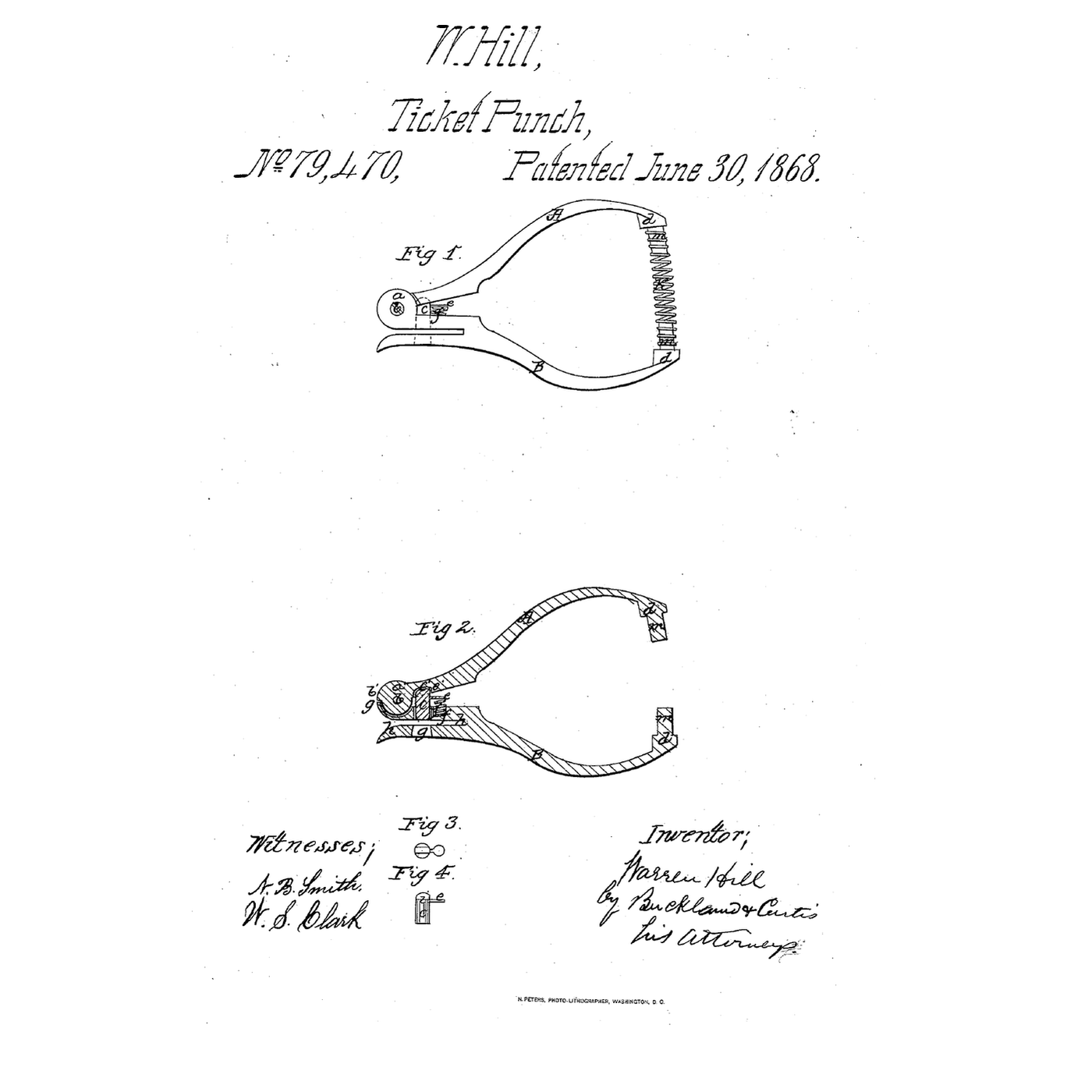
Warren Hill of Springfield, Massachusetts, received US 79,470, dated 30 June 1868, antedated 5 May 1868, as "an improvement upon the invention of the said William J. Phelps". His spindle is not attached to either lever: it slides in a cylindrical guide, a plate fixed to it projects into a recess over a spiral spring that raises it, and lever A bears on its rounded top. "By this construction I am enabled to place the die-spindle nearer the fulcrum of the levers, and also cause the lever A to bear wholly upon the extreme end of the die-spindle C, and thus increase the power of the punch to perforate the thicker board or paper tickets." Springs on stems at the levers' ends open them and serve as a finger loop, and the stems act as stops.
This rung works out the gain from moving the spindle toward the pivot, with a work check, then makes the punch with a free, spring-lifted spindle and punches card of two thicknesses.
Ilọsíwájú
About 6 hours
Ìlànà
1
1
Closer to the pivot
Closer to the pivot
Ń ṣí ìwé Jupyter…
2
2
The punch it improves
The punch it improves
The embedded blueprint pivots the spindle to one lever. Hill frees it, lifts it with a spring, and sets it nearer the fulcrum.
3
3
Read US 79,470
Read US 79,470
"To raise the die-spindle when the levers are opened again, I attach the projecting plate e rigidly to the side of the spindle, which has a circular portion and a neck, which enters the spindle, and is fastened securely therein; or I may form the die-spindle C and its projection e in one piece, or from one piece of metal. Beneath this circular plate e, I form a recess, f′, in B, and insert a spiral spring, f, the upper end of which bears against the plate, and tends to raise the die-spindle."
"I am aware that a device has been used as a ticket-punch, as shown in Letters Patent granted to William J. Phelps, and dated September 17, 1867; but my device differs from that very materially in its construction, inasmuch as said Phelps's device has a spindle which is pivoted to one lever by a small pivot, which is liable to breakage"
4
4
Make the punch and try thick card
Make the punch and try thick card
**Levers.** Cut two levers from flat bar, A with a semicircular ear at its end and B with cheeks to take it, and join them with a screw b as the pivot. Saw a ticket slot h across B's jaw close to the pivot.
**Guide, die and spindle.** Drill a guide j through B above the slot, set a hardened die plate below it with a slightly conical opening g underneath, and file a 5 mm rod as the spindle with a rounded top i. Solder a small washer to its side as the plate e.
**Spring.** Drill a recess f′ in B beside the guide, put a short spring in it under the washer, and file a recess c′ in A that bears on the spindle's top.
**Opening spring and stops.** Turn a stem m down from each lever's end and fit one long spring over both stems, so it opens the levers and makes the finger loop; leave the stems long enough to stop the levers just as the spindle meets the die.
**Test.** Punch thin card and then card twice as thick, reading the squeeze with the spring scale. Compare with the pivoted-spindle punch.
Àwọn ohun èlò fún ìgbésẹ̀ yìí:
 Ọ̀pá Pẹrẹsẹ Irin Pẹ́lẹ́0.35 mítà
 Ọ̀pá Róbótó Irin Rírọ̀0.1 mítà
 Pẹpẹ irin rírọ̀1 ẹyọ
 Wáṣà Pẹrẹsẹ1 ẹyọ
 Ohun ìdì paipu láìní òjé1 ẹyọ
 Fúlọ́ksì1 ẹyọ
 Àkójọpọ̀ orísun ìtẹ̀mọ́lẹ̀1 ẹyọ
 Skurú ẹ̀rọ1 ẹyọ
 Bébà Líle1 ẹyọ
Àwọn irinṣẹ́ tí a nílò:
 Ayùn Irin
 Àwọn Ìfá (Ìfá Ọwọ́)
 Àkójọ Ìfá Kékeré
 Ìdìmú Tábìlì
 Ẹ̀rọ Ìlùkòkò Aláìlókùn
 Àkójọ Orí Ìlùkòkò
 Ọ̀pá Iná Pùróféènì
 Irin ìsúdì
 Ẹ̀rọ Ìwọ̀n Agbára (Òṣùwọ̀n Ìsúnkì)
 Òṣùwọ̀n Kálípà Díjítà Ìnṣì 6
 Ìbọ̀wọ́ Iṣẹ́ Awọ
 Gílásì Ààbò Tí Ó Mọ́
5
5
A punch whose spindle sticks, jumps or stops short
A punch whose spindle sticks, jumps or stops short
Free-spindle ticket punch troubleshooting.
Flow
Loading...
6
6
History and honest limits
History and honest limits
**Warren Hill** of Springfield, Hampden County, Massachusetts, received US 79,470, dated 30 June 1868, antedated 5 May 1868; J. P. Buckland witnessed it, as he had Phelps's. His levers were pivoted at the end with a semicircular ear on A entering cheeks on B, secured by the screw b; a projection b′ on A met a part g′ on B to limit opening; and a collar on the spindle with the spring round it could replace the side plate. His claim is the spindle C, projection e and spring f with the recessed lever A and slotted lever B.
**Honest limits.** Filed flat bar, a soldered washer and bought springs stand in for his made parts. The notebook ignores friction; its forces and lengths are examples. Your punched card is the result.
Àwọn ohun-èlò
9- 0.35 mítàÀyè
- 0.1 mítàÀyè
- 1 ẹyọÀyè
- 1 ẹyọÀyè
- Àyè
- 1 ẹyọÀyè
- Àyè
- 1 ẹyọÀyè
- 1 ẹyọÀyè
Àwọn irinṣẹ́ tó nílò
12- Àyè
- Àyè
- 1 vendor sell this, none ship to you yetÀyè
- 2 vendors sell this, none ship to you yetÀyè
Blueprint tó jọra
Àwọn blueprint wọ̀nyí pín ìmọ̀ — ọ̀nà, ohun-èlò tàbí ìlànà
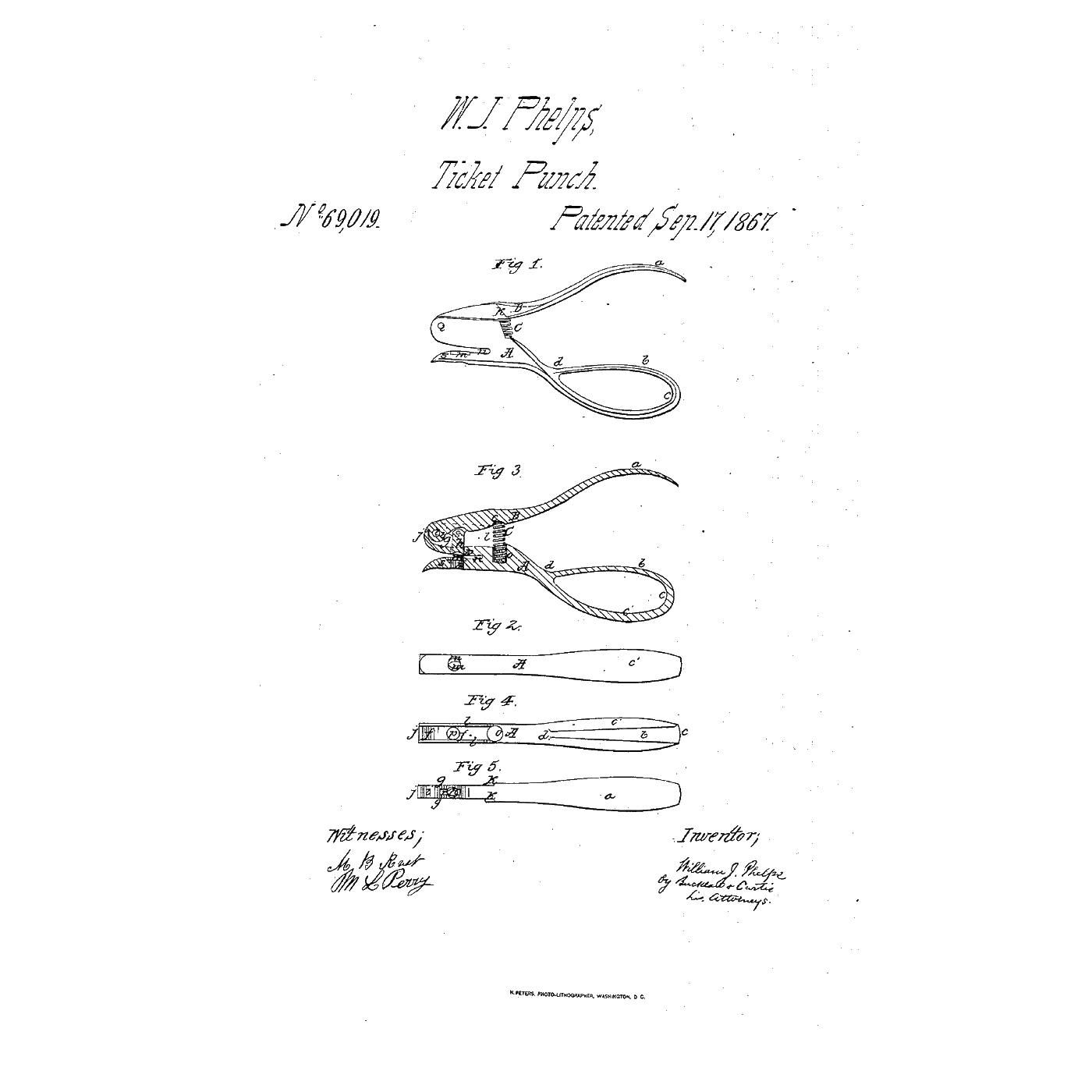
The Die-Spindle Ticket Punch: A Shaped Die on a Pivot, a Slot for the Ticket
láti ọwọ́ Martin
Àwọn Irinṣẹ́ Irin
23
0
0
0
0
0
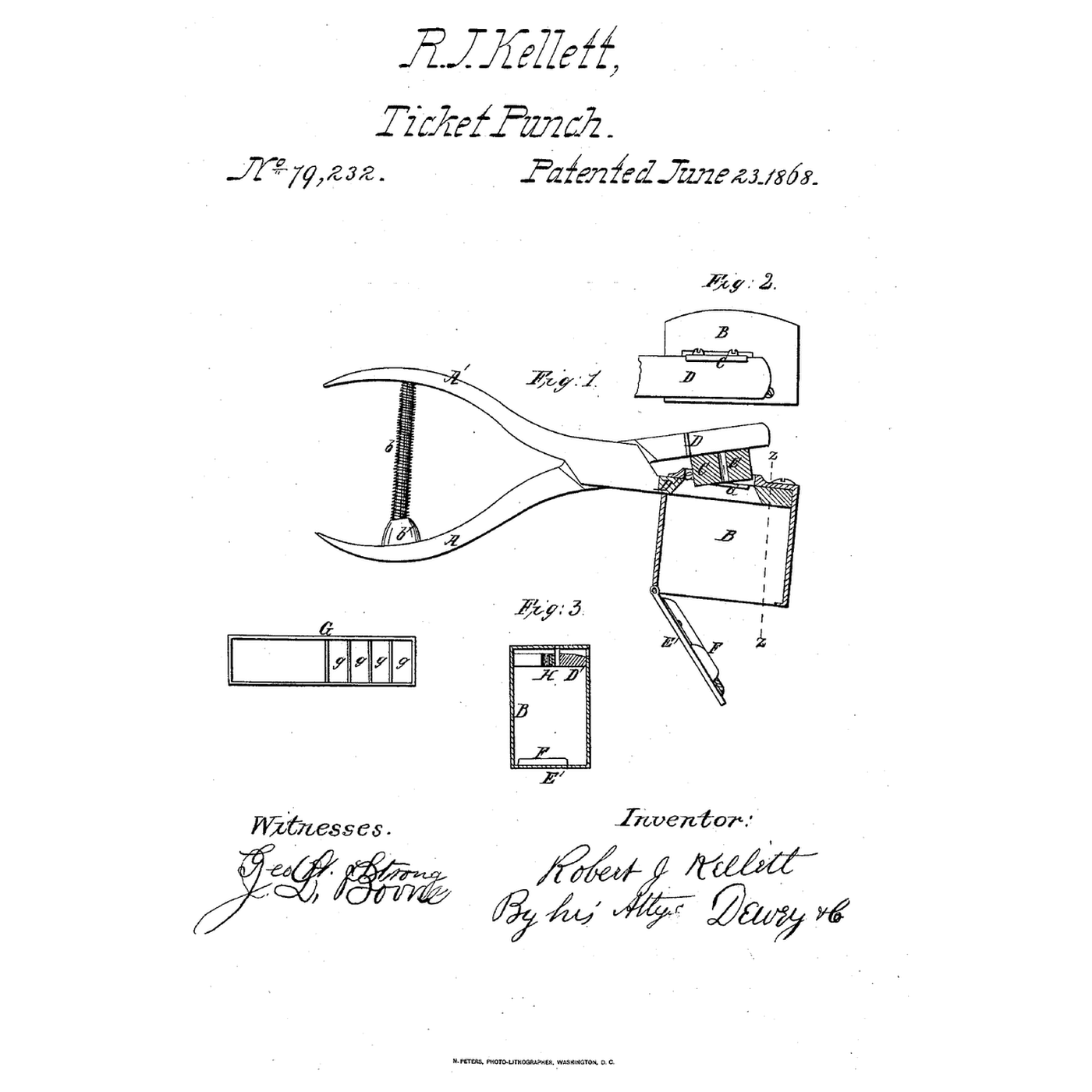
The Coupon-Stringing Ticket Punch: Every Coupon Holed for the Counting Wire
láti ọwọ́ Mark
Àwọn Irinṣẹ́ Iṣẹ́ Bébà
17
0
0
0
0
0

Blanking: The Punch, the Die, and the Gap Between Them
láti ọwọ́ Forge
Iṣẹ́ Irin
28
0
0
0
0
0
CC0 Àgbègbè Gbogbogbò
Blueprint yìí ti jáde lábẹ́ CC0. O lè ṣe àdàkọ, yí padà, pín, àti lò láìsí ìyọ̀ǹda.
Ṣàtìlẹ́yìn Olùṣẹ́dá nípa rírà àwọn ọjà nipasẹ̀ Blueprint wọn Ẹ̀san Olùṣẹ́dá tí àwọn Olùtajà gbé kalẹ̀, tàbí ṣẹ̀dá àtúnṣe tuntun ti Blueprint yìí kí o sì fi sínú Blueprint rẹ gẹ́gẹ́ bí ìsopọ̀ láti pín owó-wíwọlé.