IṢẸ́ ỌNÀ
ẸWÀ ÀTI ÌLERA
IṢẸ́ ỌWỌ́
ÀṢÀ ÀTI ÌTÀN
ÌṢERÉ
ÀYÍKÁ
OÚNJẸ ÀTI OHUN MÍMU
REVERSE ENGINEERING
SÁYẸ́ǸSÌ
ERÉ ÌDÁRAYÁ
ÌMỌ̀-Ẹ̀RỌ
ÀWỌN OHUN WÍWỌ̀

The Key and Corkscrew: Throw the Wire Fastener Off, Then Draw the Cork
A wire fastener that holds a cork down against the gas is hard to push onto the cork, and hard to push off, with the fingers alone; and the cork still has to be drawn afterwards.
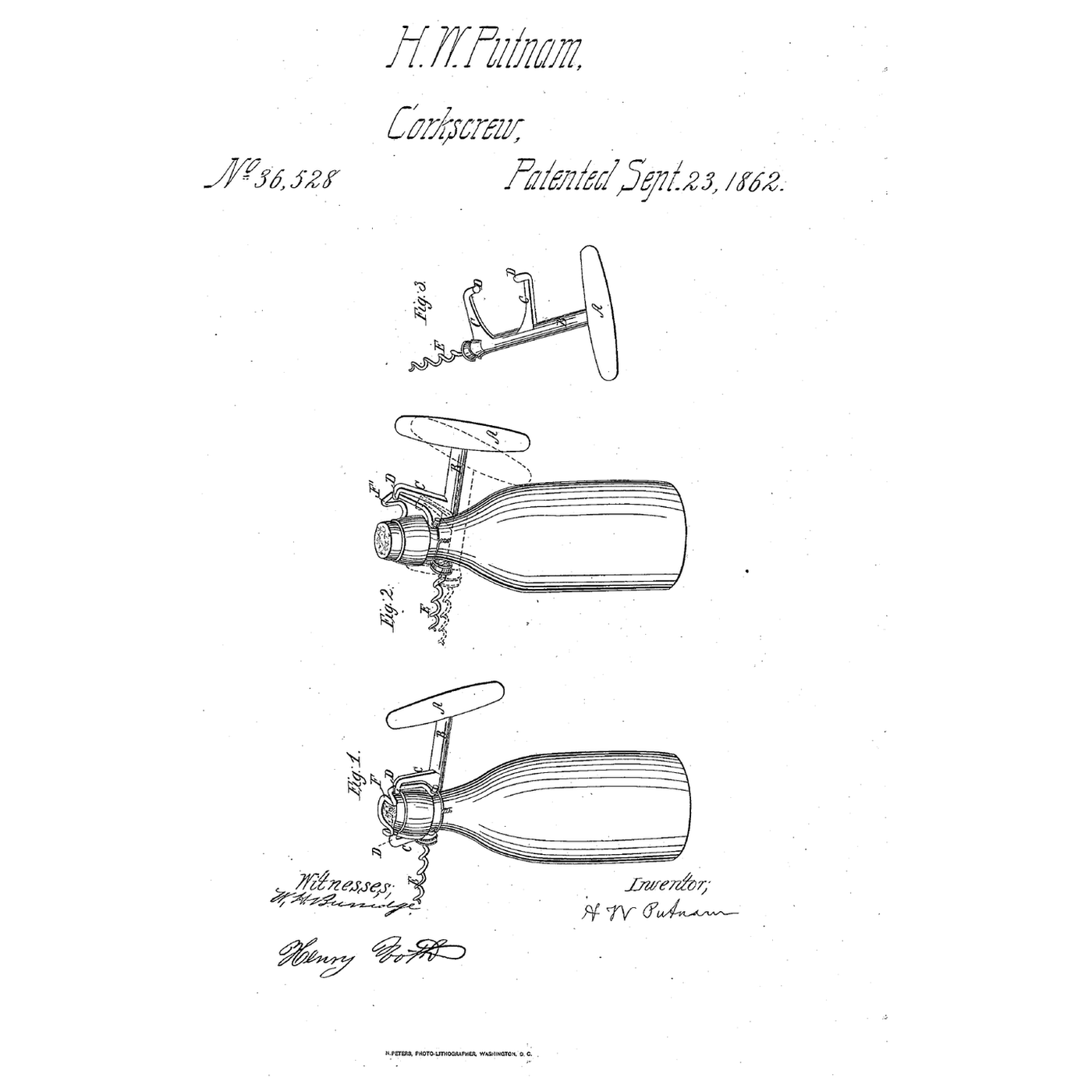
H. W. Putnam of Cleveland, Ohio, received US 36,528, dated 23 September 1862, for "a combined key and corkscrew in one instrument for securing and releasing my patent bottle cork-fastener and for drawing the cork": a handle and shaft with two arms at right angles whose ends turn inward as nibs, far enough apart for the bottle's neck to pass between them, and an ordinary corkscrew at the shaft's end. The neck is the fulcrum for the key.
This rung works out the force of the key about the neck, with a work check, then makes the key and corkscrew from rod and flat bar, fastens a corked bottle with a wire fastener and throws it off.
Àárín
About 4 hours
Ìlànà
1
1
The neck as the fulcrum
The neck as the fulcrum
Ń ṣí ìwé Jupyter…
2
2
Why the neck works as the fulcrum
Why the neck works as the fulcrum
The embedded blueprint works out the lever law. Putnam's key turns about the bottle's neck, so a short push on the handle moves the fastener with a larger force.
3
3
Read US 36,528
Read US 36,528
"Fig. 3 represents the combined key and corkscrew. A is the handle. B is the shaft or bar. C C represent arms projecting from the shaft B in lines parallel with each other and at right angles to the shaft. The ends of these arms are turned inward toward each other, forming the nibs D D. The arms are far enough apart to allow the neck of the bottle to pass between them, and the distance between the points of the nibs is equal to or greater than the thickness of the cork. In the end of the shaft B is placed an ordinary corkscrew, E."
"Now by turning the key a little forward it is released, and the screw can be used as an ordinary corkscrew for drawing the cork. In replacing to its former position (seen in Fig. 1) the instrument is changed to the opposite side of the neck of the bottle, as indicated by the dotted lines in Fig. 2. In both cases the neck of the bottle becomes the fulcrum for the key."
4
4
Make the key and throw a fastener off
Make the key and throw a fastener off
**Handle and shaft.** Cut 10 cm of hardwood handle stock and drill it across the middle. Cut 12 cm of 6 mm mild steel rod, pass one end through the handle and peen it over a washer.
**Arms and nibs.** Cut 20 cm of 20 × 3 mm mild steel flat bar and bend it into a U whose legs are the arms, wide enough apart for the bottle's neck to pass between them. Bend the last centimetre of each leg inward as a nib, with the nibs' points at least as far apart as the cork is wide. Silver-solder the U's base across the shaft near its far end, the arms at right angles to it.
**Corkscrew.** Wind 2 mm steel wire into an open helix round a 6 mm rod, file its end to a point, and silver-solder its straight end into a hole drilled in the shaft's end.
**Fastened bottle.** Pour chilled soda water into a clean beer bottle and press a cork in. Twist a wire ring tight round the neck below the lip and bend a wire bail, hinged on the ring, that swings over the top of the cork and holds it.
**Test.** Wearing safety glasses, pass the neck between the arms with the nibs over the bail, and turn the key a little forward: the bail is thrown back off the cork. Draw the cork with the corkscrew. Put the cork back and use the key from the other side of the neck to swing the bail on again.
Àwọn ohun èlò fún ìgbésẹ̀ yìí:
 Igi Líle Fún Ìdìmú1 ẹyọ
 Ọ̀pá Róbótó Irin Rírọ̀0.12 mítà
 Wáṣà Pẹrẹsẹ1 ẹyọ
 Ọ̀pá Pẹrẹsẹ Irin Pẹ́lẹ́0.2 mítà
 Okun waya irin0.4 mítà
 Ìdìpọ̀ wẹ́là fadaka (rírọ̀/àárín/líle)1 ẹyọ
 Ohun ìyọ́1 ẹyọ
 Ìgò ọtí dígí aláwọ̀ ambà1 ẹyọ
 Omi olóbùú (ìgò tí a sé)1 ẹyọ
 Àwọn kọ́ọ̀kì1 ẹyọ
 Okùn Irin Tí A Fi Sinkì Bò0.5 mítà
Àwọn irinṣẹ́ tí a nílò:
 Ayùn Irin
 Àwọn Ìfá (Ìfá Ọwọ́)
 Ìdìmú Tábìlì
 Ọ̀pá Iná Pùróféènì
 Òòlù
Òòlù Ẹ̀rọ Ìlùkòkò Aláìlókùn
 Àkójọ Orí Ìlùkòkò
 Ẹ̀mú Olórí Yíká
 Ẹmú Ẹnu Pẹrẹsẹ
 Ẹ̀mú ìgé okùn
 Gílásì Ààbò Tí Ó Mọ́
 Ìbọ̀wọ́ Iṣẹ́ Awọ
5
5
A key that slips, bends or will not throw the fastener
A key that slips, bends or will not throw the fastener
Key and corkscrew troubleshooting.
Flow
Loading...
6
6
History and honest limits
History and honest limits
**H. W. Putnam** of Cleveland, Cuyahoga County, Ohio, received US 36,528, dated 23 September 1862. The key was for his own patent bottle cork-fastener, shown at F embracing the top of the cork and at F′ thrown back. His claim is the arms C C and nibs D D combined with a corkscrew.
**Honest limits.** A hand-bent wire bail on a beer bottle of re-corked soda water stands in for his patent fastener, whose exact form this rung does not reproduce, and flat bar and rod for his key. The notebook ignores friction; its forces and lengths are examples. Your thrown-off fastener is the result.
Àwọn ohun-èlò
11- 1 ẹyọÀyè
- 0.12 mítàÀyè
- 1 ẹyọÀyè
- 0.2 mítàÀyè
- 0.4 mítàÀyè
- 1 ẹyọÀyè
- Àyè
- Àyè
- 1 ẹyọÀyè
- 0.5 mítàÀyè
Àwọn irinṣẹ́ tó nílò
12- Àyè
- Àyè
- Àyè
- 1 vendor sell this, none ship to you yetÀyè
Ìtọ́nisọ́nà yìí ń ṣe
Blueprint tó jọra
Àwọn blueprint wọ̀nyí pín ìmọ̀ — ọ̀nà, ohun-èlò tàbí ìlànà

The Frame-and-Crank Corkscrew: Once the Shoulder Stops the Screw, the Cork Climbs It
láti ọwọ́ Emma
Àwọn Ohun Mímu
23
0
0
0
0
0
The Gimlet Corkscrew: A Coarse Screw on a Solid Stem With a T Handle
láti ọwọ́ Forge
Iṣẹ́ Irin
28
0
0
0
0
0

The Law of the Lever — Archimedes' Balance of Weight and Distance
láti ọwọ́ Martin
Físíkì
60
0
0
0
1
0
CC0 Àgbègbè Gbogbogbò
Blueprint yìí ti jáde lábẹ́ CC0. O lè ṣe àdàkọ, yí padà, pín, àti lò láìsí ìyọ̀ǹda.
Ṣàtìlẹ́yìn Olùṣẹ́dá nípa rírà àwọn ọjà nipasẹ̀ Blueprint wọn Ẹ̀san Olùṣẹ́dá tí àwọn Olùtajà gbé kalẹ̀, tàbí ṣẹ̀dá àtúnṣe tuntun ti Blueprint yìí kí o sì fi sínú Blueprint rẹ gẹ́gẹ́ bí ìsopọ̀ láti pín owó-wíwọlé.