IṢẸ́ ỌNÀ
ẸWÀ ÀTI ÌLERA
IṢẸ́ ỌWỌ́
ÀṢÀ ÀTI ÌTÀN
ÌṢERÉ
ÀYÍKÁ
OÚNJẸ ÀTI OHUN MÍMU
REVERSE ENGINEERING
SÁYẸ́ǸSÌ
ERÉ ÌDÁRAYÁ
ÌMỌ̀-Ẹ̀RỌ
ÀWỌN OHUN WÍWỌ̀
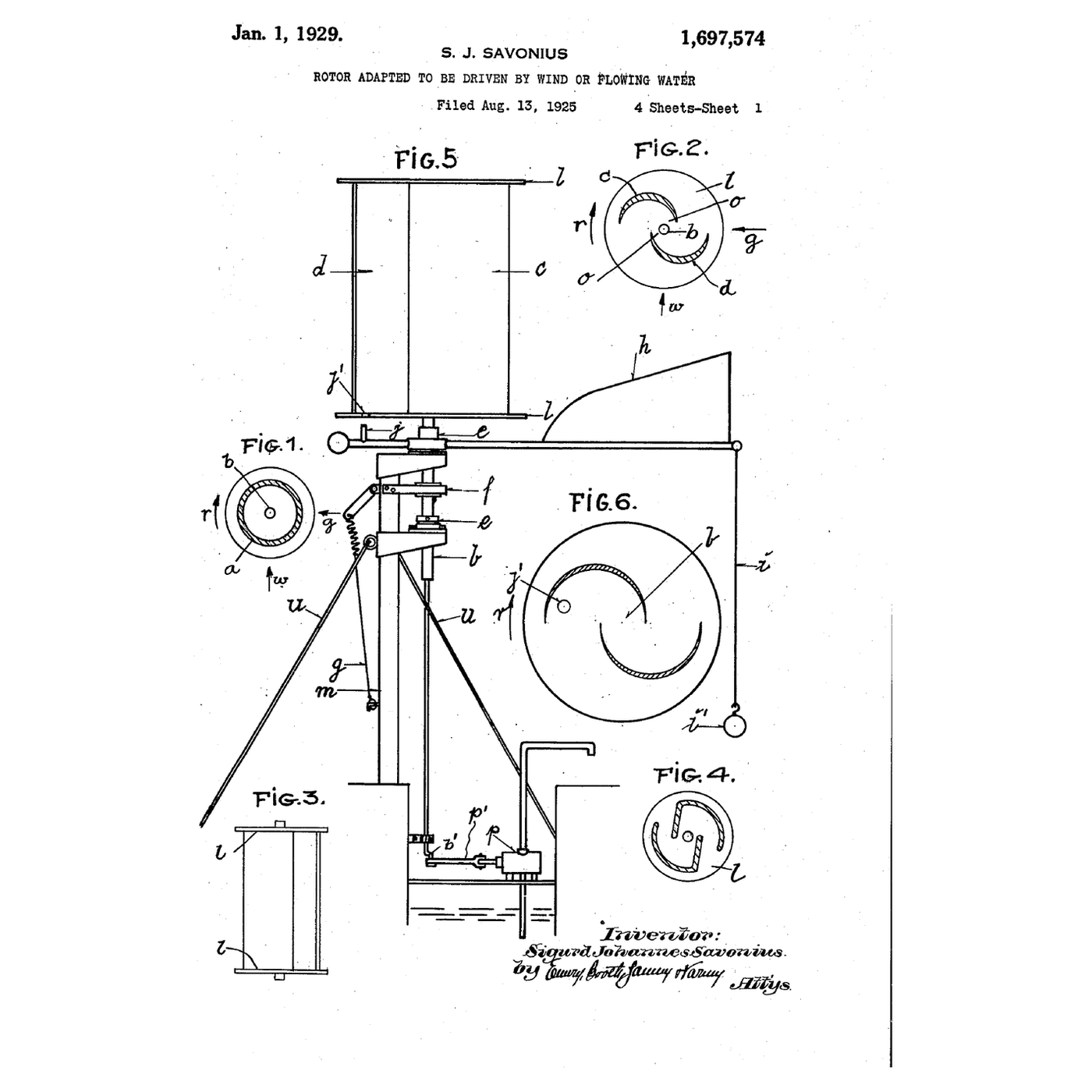
The Savonius Rotor: Two Hollow Vanes, Any Wind, Always Starts
Cut a cylinder in half lengthwise, slide the halves apart so they overlap, and stand them on a vertical shaft: that is the rotor Sigurd Savonius of Finland patented in 1924–29. The wind pushes harder on the hollow of one vane than on the back of the other, and air flowing through the overlap from one hollow into the other helps it along.
It turns in wind from any direction without steering, starts itself in the lightest breeze, and gives strong torque at low speed — for pumping water, ventilating, or driving a current meter. It is also slow and inefficient, because it is pushed by drag.
This rung works out the drag machine's ceiling and builds a Savonius rotor from a PVC pipe, measuring its torque with a string brake.
Olùbẹ̀rẹ̀
About 4 hours
Ìlànà
1
1
Read Savonius's overlap
Read Savonius's overlap
US 1,697,574, 'Rotor Adapted to be Driven by Wind or Flowing Water', Sigurd J. Savonius. The vanes are *"hollow-shaped"* and *"overlapping"*, so that the space between them forms an air passage *"from the hollow side of the vane d, to the hollow side of the other vane c"*. His text compares it with the rotating cylinder then being studied at the Aerodynamische Versuchsanstalt in Göttingen, which it cites.
The overlap is the detail that separates a Savonius rotor from two cups on a stick.
2
2
The drag machine's ceiling
The drag machine's ceiling
Ń ṣí ìwé Jupyter…
3
3
Build it from a PVC pipe
Build it from a PVC pipe
Cut a 300 mm length of 110 mm PVC pipe in half lengthwise with a saw. Cut two plywood end discs 240 mm across. Screw the two half-pipes between the discs, hollow faces opposite, each shifted towards the centre so they **overlap by about a fifth of a half-pipe's width**, leaving the air passage Savonius describes.
Run a threaded-rod shaft through the centre of both discs, held by nuts, and carry it vertically in two skateboard bearings in a plywood frame.
Àwọn ohun èlò fún ìgbésẹ̀ yìí:
 Páìpù PVC1 ẹyọ
 Àwo igi tí a lẹ̀ pọ̀1 ewé
 Ọ̀pá oníṣọ̀kan1 ẹyọ
 Bearing Skateboard2 ẹyọ
 Skurú ẹ̀rọ12 ẹyọ
Àwọn irinṣẹ́ tí a nílò:
 Ẹ̀rọ Ìlùkòkò Aláìlókùn
 Àkójọ Orí Ìlùkòkò
 Kọ́kọ́rọ́ tí a lè ṣàtúnṣe
 Ìdíwọ̀n
 Ohun ìgé páìpù
4
4
Measure torque with a string brake
Measure torque with a string brake
Wrap fishing line once round the shaft. Tie one end to the spring scale fixed to the frame, and hang a small weight on the other end, so the line rubs on the turning shaft as a brake. The braking torque is **(weight − scale reading) × shaft radius**.
Put the rotor in front of the box fan. Start with a light weight: the rotor spins fast. Add weight step by step, reading the speed with the tachometer and the scale each time, until it stalls. Power = torque × angular speed.
Turn the rotor to face the wind at a different angle: it does not care. Start the fan at its lowest setting with the rotor stopped: it starts by itself. Those two facts are why Savonius rotors exist.
Àwọn ohun èlò fún ìgbésẹ̀ yìí:
 Okùn ìpẹja (okùn kan ṣoṣo)1 ìyípo
 Ìwọ̀n1 ìtò
Àwọn irinṣẹ́ tí a nílò:
 Àbẹ̀bẹ̀ àpótí (ìwọ̀n tí ó ń yípadà)
 Òǹwọ̀n atẹ́gùn olówọ́
 Ìwọ̀n Ìyípo Dígítà
 Ẹ̀rọ Ìwọ̀n Agbára (Òṣùwọ̀n Ìsúnkì)
 Òṣùwọ̀n Kálípà Díjítà Ìnṣì 6
5
5
History and context
History and context
**US 1,697,574, 'Rotor Adapted to be Driven by Wind or Flowing Water', Sigurd J. Savonius; filed 13 August 1925 (Serial 49,985), claiming a Finnish filing of 12 December 1924; granted 1 January 1929.** The title names water as well as wind: the same rotor turns in a current.
**Honest limits.** Low efficiency — a drag machine cannot beat the notebook's ceiling by much. Heavy for its power, because the whole swept area is solid vane. Its torque pulses twice per turn, which is why many are built as two stages twisted 90° apart, or with helical vanes.
Àwọn ohun-èlò
7- 1 ẹyọÀyè
- 1 ewéÀyè
- 1 ẹyọÀyè
- Bearing Skateboardìdá 10%2 ẹyọÀyè
- 12 ẹyọÀyè
- 1 ìyípoÀyè
- 1 ìtòÀyè
Àwọn irinṣẹ́ tó nílò
10- 1 vendor sell this, none ship to you yetÀyè
- Àyè
- Ohun ìgé páìpùìdá 10%Àyè
Blueprint tó jọra
Àwọn blueprint wọ̀nyí pín ìmọ̀ — ọ̀nà, ohun-èlò tàbí ìlànà
The Betz Limit: Why No Rotor Takes More Than 16/27 of the Wind
láti ọwọ́ Volt
Agbára
13
0
0
0
0
0
Electricity From the Wind: The Cube Law and a Rotor on a Dynamo
láti ọwọ́ Volt
Agbára
19
0
0
0
0
0
Building a Persian Windmill — The First Machine Powered by Wind
láti ọwọ́ Emma
Ìmọ̀ Ẹ̀rọ
82
0
0
0
0
0
Robinson Cup Anemometer
láti ọwọ́ Karen
ÀYÍKÁ
36
0
0
0
0
0
CC0 Àgbègbè Gbogbogbò
Blueprint yìí ti jáde lábẹ́ CC0. O lè ṣe àdàkọ, yí padà, pín, àti lò láìsí ìyọ̀ǹda.
Ṣàtìlẹ́yìn Olùṣẹ́dá nípa rírà àwọn ọjà nipasẹ̀ Blueprint wọn Ẹ̀san Olùṣẹ́dá tí àwọn Olùtajà gbé kalẹ̀, tàbí ṣẹ̀dá àtúnṣe tuntun ti Blueprint yìí kí o sì fi sínú Blueprint rẹ gẹ́gẹ́ bí ìsopọ̀ láti pín owó-wíwọlé.