IṢẸ́ ỌNÀ
ẸWÀ ÀTI ÌLERA
IṢẸ́ ỌWỌ́
ÀṢÀ ÀTI ÌTÀN
ÌṢERÉ
ÀYÍKÁ
OÚNJẸ ÀTI OHUN MÍMU
REVERSE ENGINEERING
SÁYẸ́ǸSÌ
ERÉ ÌDÁRAYÁ
ÌMỌ̀-Ẹ̀RỌ
ÀWỌN OHUN WÍWỌ̀
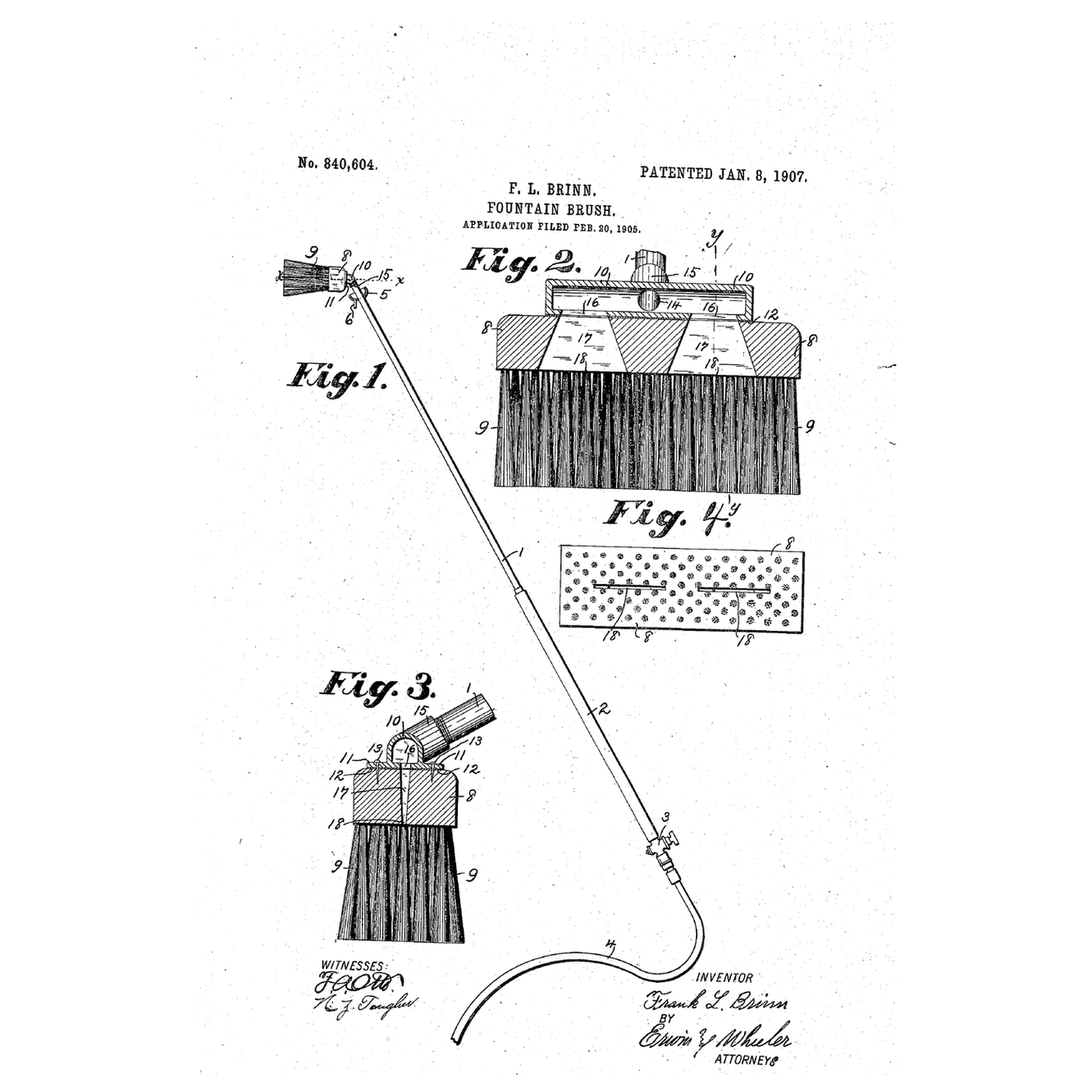

The Sheet-of-Water Fountain Brush: Tapered Slots Part the Bristles
Water dribbled onto the back of a brush stays in the bristles and never reaches the surface being washed.
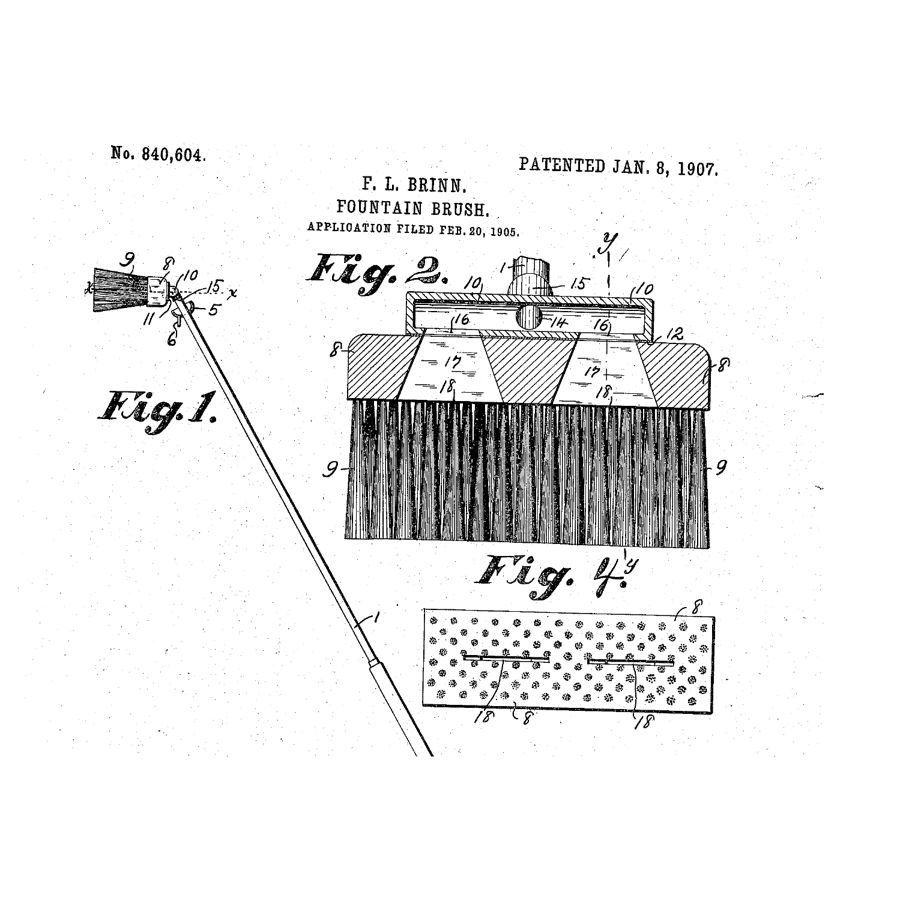
Frank L. Brinn of Milwaukee received US 840,604, patented 8 January 1907, for a fountain brush in which "the fluid may be delivered to the longitudinal central portion of the brush in a sheet, which when the fluid is turned on at full head will serve to separate the bristles and flush the surface to be washed": slots through the block narrow toward the bristles, fed from a cylinder on top through a tubular handle, with a cup on the handle to catch what runs down.
This rung works out how the taper speeds the sheet, then cuts the slots in a scrub brush, plumbs it and compares full flow with throttled flow.
Àárín
About 4 hours
Ìlànà
1
1
Sheet speed from the slot
Sheet speed from the slot
Ń ṣí ìwé Jupyter…
2
2
Water through a brush's back before it
Water through a brush's back before it
The embedded blueprint jets or soaks water through openings in a brush's back. Brinn shapes the openings into tapered slots so the water leaves as a sheet.
3
3
Read US 840,604
Read US 840,604
"By opening the valve at 3 to its full capacity a sheet of water will be discharged which will separate the bristles and effectively flush the surface to be washed, whether the bristles are in contact with such surface or not. By partially closing the valve at 3 the sheets of water escaping through the openings 18 are broken up by the bristles, and the water thus becomes distributed throughout the brush."
4
4
Cut the slots
Cut the slots
On the scrub brush's top mark two slots 60 × 8 mm, 90 mm apart on the centre line. Drill a row of holes in each and cut it through with the coping saw.
Àwọn ohun èlò fún ìgbésẹ̀ yìí:
 Búrọ́ọ̀ṣì ìfọ̀1 ẹyọ
Àwọn irinṣẹ́ tí a nílò:
 Ìdìmú Tábìlì
 Ẹ̀rọ Ìlùkòkò Aláìlókùn
 Àkójọ Orí Ìlùkòkò
 Ayùn Kópìngì
 Ààmì Tí Kò Ní Parẹ́
 Ìdíwọ̀n
5
5
Taper the slots
Taper the slots
Pare each slot with chisels so its long sides close to about 1.5 mm at the bristle face and its ends open out to 70 mm. Trim the bristles along the slot line.
Àwọn irinṣẹ́ tí a nílò:
 Ìdìpọ̀ àyà igi
 Òòlù
Òòlù Òṣùwọ̀n Kálípà Díjítà Ìnṣì 6
 Ọ̀bẹ Iṣẹ́ Ọwọ́
6
6
Make the manifold
Make the manifold
Cut 160 mm of 22 mm copper tube and cap both ends with fittings. File a 4 mm slot along its underside over both brush slots. Fit a tee in its middle for the handle.
Àwọn ohun èlò fún ìgbésẹ̀ yìí:
 Ọ̀pá bàbà1 ẹyọ
 Ohun ìsopọ̀ idẹ1 ẹyọ
Àwọn irinṣẹ́ tí a nílò:
 Ohun èlò ìgé òpó
 Àwọn Ìfá (Ìfá Ọwọ́)
 Kọ́kọ́rọ́ tí a lè ṣàtúnṣe
7
7
Seat the manifold
Seat the manifold
Bed the manifold on the brush in silicone over a rubber gasket and strap it down with an aluminium strip and four wood screws.
Àwọn ohun èlò fún ìgbésẹ̀ yìí:
 Ìdílẹ̀ Silikoni1 ẹyọ
 Àwo rọ́bà1 ẹyọ
 Àwo aluminiọ̀mù1 ẹyọ
 Ìsúrù igi #8 x 1"1 ẹyọ
Àwọn irinṣẹ́ tí a nílò:
 Ìlàǹkàn irin
 Ìṣù àwọn ohun ìyí skurúỌ̀bẹ Iṣẹ́ Ọwọ́
8
8
Handle, valve and drip cup
Handle, valve and drip cup
Fit 1.2 m of 15 mm copper tube to the tee, with a ball valve and hose connector at its top. Slide a small tin can, holed and sealed with silicone, onto the handle as a drip cup, and fit a short copper spout low on its side.
Àwọn ohun èlò fún ìgbésẹ̀ yìí:
Ọ̀pá bàbà1 ẹyọ Fáàlù bọ́ọ̀lù1 ẹyọOhun ìsopọ̀ idẹ1 ẹyọ
 Okùn PTFE ìdí ìṣàn1 ẹyọ
 Ìgò irin1 ẹyọÌdílẹ̀ Silikoni1 ẹyọ
Àwọn irinṣẹ́ tí a nílò:
Ohun èlò ìgé òpóKọ́kọ́rọ́ tí a lè ṣàtúnṣeẸ̀rọ Ìlùkòkò AláìlókùnÀkójọ Orí Ìlùkòkò9
9
The patent drawing
The patent drawing
US 840,604 drawing sheet, public domain (expired patent).
10
10
Full flow against throttled
Full flow against throttled
Connect the garden hose. With the valve fully open, hold the brush 2 cm off a board and watch the sheet part the bristles; then close it half and watch the water spread through them. Time a litre into the jug each way.
Àwọn ohun èlò fún ìgbésẹ̀ yìí:
 Òpó omi ọgbà1 ẹyọ
 Omi1 ẹyọ
Àwọn irinṣẹ́ tí a nílò:
 Ìgò ìwọ̀n
 Aago ÌdúróÌdíwọ̀n
11
11
A sheet that sprays, sputters or leaks
A sheet that sprays, sputters or leaks
Sheet-of-water fountain brush troubleshooting.
Flow
Loading...
12
12
History and honest limits
History and honest limits
**Frank L. Brinn**, a citizen of Canada residing in Milwaukee, filed US 840,604 on 20 February 1905; it was patented 8 January 1907. His cylinder is held to the block by a plate with packing and screws, its slots feeding the slot-apertures; the handle's end carries a rubber sheath and the valve; the cup, with its spout, collects the water instead of letting it run down the handle when the brush is raised.
**Honest limits.** A slotted copper tube stands in for his cylinder, and a tin can for his cup. The notebook treats the sheet as uniform. What you see on the board is the result.
Àwọn ohun-èlò
12- 1 ẹyọÀyè
- 1 ẹyọÀyè
- 1 ẹyọÀyè
- 2 ẹyọÀyè
- 1 ẹyọÀyè
- 1 ẹyọÀyè
- 1 ẹyọÀyè
- 1 ẹyọÀyè
- 1 ẹyọÀyè
- 1 ẹyọÀyè
- Òpó omi ọgbàìdá 10%1 ẹyọÀyè
- 1 ẹyọÀyè
Àwọn irinṣẹ́ tó nílò
17- Àyè
- 1 vendor sell this, none ship to you yetÀyè
- Àyè
- Àyè
- Àyè
- Àyè
- Àyè
- Àyè
Blueprint tó jọra
Àwọn blueprint wọ̀nyí pín ìmọ̀ — ọ̀nà, ohun-èlò tàbí ìlànà
The Tube-in-the-Back Fountain Brush: Turn the Tube and the Jets Become a Soak
láti ọwọ́ YourGrandma
Ìmọ̀ Ẹ̀rọ
31
0
0
0
0
0
The Long-Handled Fountain Brush: A Ring of Holes Wets the Bristles From the Ground
láti ọwọ́ Martin
Ìmọ̀ Ẹ̀rọ
17
0
0
0
0
0
The Hose and Its Clip: Why It Was Tight When You Fitted It
láti ọwọ́ Martin
Àwọn Irinṣẹ́
26
0
0
0
0
0
CC0 Àgbègbè Gbogbogbò
Blueprint yìí ti jáde lábẹ́ CC0. O lè ṣe àdàkọ, yí padà, pín, àti lò láìsí ìyọ̀ǹda.
Ṣàtìlẹ́yìn Olùṣẹ́dá nípa rírà àwọn ọjà nipasẹ̀ Blueprint wọn Ẹ̀san Olùṣẹ́dá tí àwọn Olùtajà gbé kalẹ̀, tàbí ṣẹ̀dá àtúnṣe tuntun ti Blueprint yìí kí o sì fi sínú Blueprint rẹ gẹ́gẹ́ bí ìsopọ̀ láti pín owó-wíwọlé.