IṢẸ́ ỌNÀ
ẸWÀ ÀTI ÌLERA
IṢẸ́ ỌWỌ́
ÀṢÀ ÀTI ÌTÀN
ÌṢERÉ
ÀYÍKÁ
OÚNJẸ ÀTI OHUN MÍMU
REVERSE ENGINEERING
SÁYẸ́ǸSÌ
ERÉ ÌDÁRAYÁ
ÌMỌ̀-Ẹ̀RỌ
ÀWỌN OHUN WÍWỌ̀
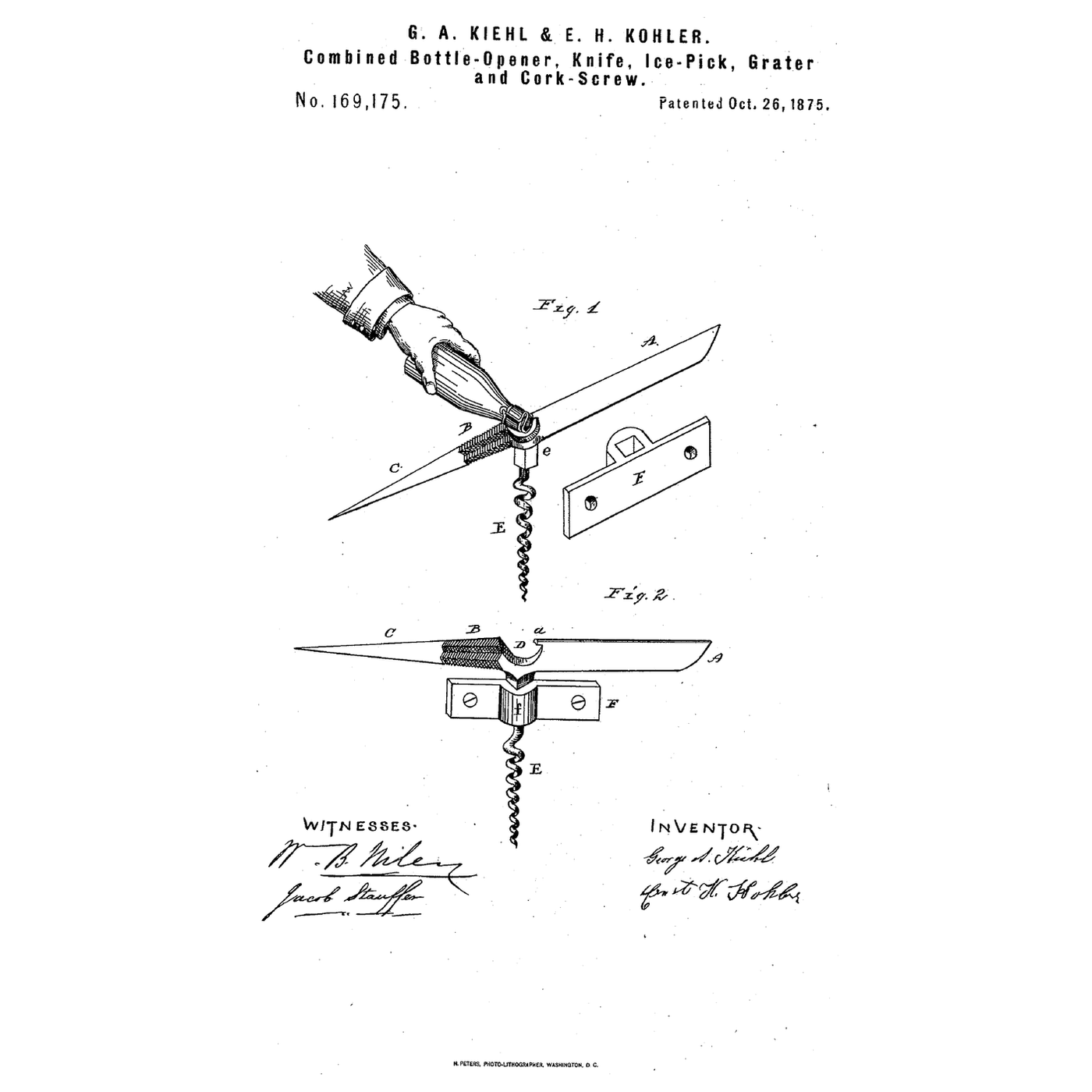


The Socket-Bracket Bar Tool: Bottle Opener, Knife, Ice Pick, Grater and Corkscrew in One
A bottling works fastened its corks with stout hinged wires, and a saloon keeper needed a way to release them, a knife for lemons, an ice pick, a nutmeg grater and a corkscrew, all within reach behind the counter.
George A. Kiehl and Ernst H. Kohler of Lancaster, Pennsylvania, received US 169,175, dated 26 October 1875, for a T-shaped tool meant "for removing the stout hinged wires for holding the corks in bottles containing soda and mineral waters, sarsaparilla, or the like, used in nearly all bottling establishments; at the same time to combine with it a knife for cutting lemons, an ice-pick, a nutmeg-grater, and a cork-screw, all in one implement". A projection on the heel of the knife catches the wire's fold, the bottle's mouth rests in the dished centre, and the bottle is turned as a lever; the corkscrew below stands in a bracket fixed to the counter.
This rung works out the force the bottle puts on the wire, with a work check, then makes the tool from flat bar with a bracket for the counter, and opens a wire-fastened bottle with it.
Ilọsíwájú
About 5 hours
Ìlànà
1
1
The bottle as the lever
The bottle as the lever
Ń ṣí ìwé Jupyter…
2
2
A counter opener before it
A counter opener before it
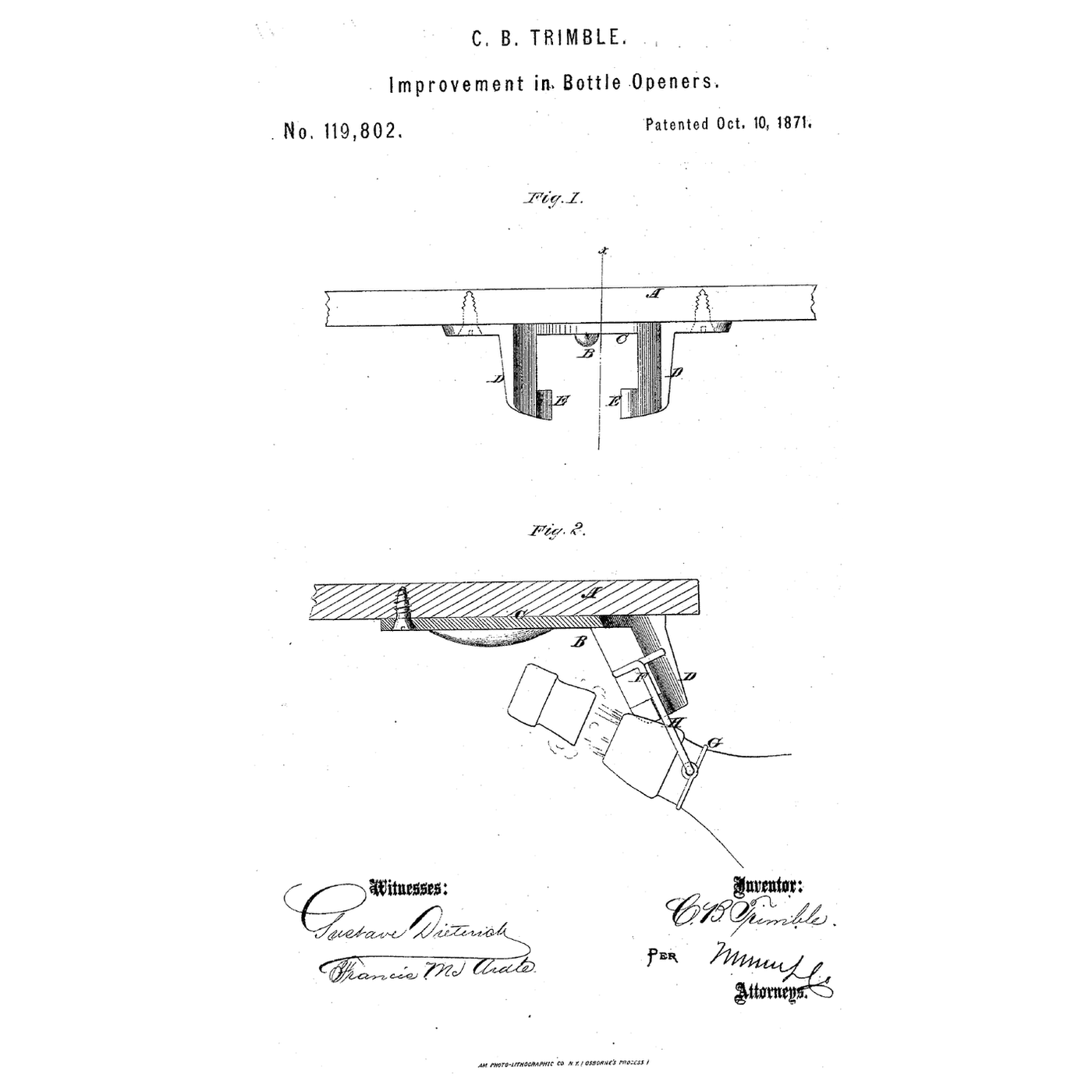
The embedded blueprint fixes a stirrup under the counter to push a wire yoke off. Kiehl and Kohler's tool stands in a bracket on the counter too, and adds a knife, an ice pick, a grater and a corkscrew.
3
3
Read US 169,175
Read US 169,175
"Most bottling establishments now employ the patent hinged wires for holding the cork firmly in place. This wire bail is bent into U form, so as to be swung up on the cork and forced over or partially into it, so as to require considerable force to release the cork by hand that it may be expelled by the carbonic gas confined with the liquid in the bottle."
"The operation consists in introducing the projection a on the heel of the knife A into the upper wire fold. The bottle itself forms the lever by which the stiff wire is pressed down from the cork; hence the dished or concave central part D is to receive the head or mouth of the bottle, with the cork and its appliances."
4
4
Make the tool and open a wire-fastened bottle
Make the tool and open a wire-fastened bottle
**Bar.** Cut 30 cm of 25 × 5 mm mild steel flat bar. Mark its middle. Heat the middle with the torch and hammer it over a hole in a hardwood block into a shallow dish that the bottle's mouth and cork sit in. At the dish's edge on the knife side, file a short hooked projection that will enter the fold of the bottle's wire.
**Knife.** On one arm, file a bevel along one edge and finish it on the sharpening stone for cutting lemons.
**Ice pick and grater.** File the other arm to a point. Near its root, cut rows of small raised teeth with the cold chisel, like a rasp, for grating nutmeg.
**Corkscrew and bracket.** Wind 2 mm spring steel wire into an open helix round a 6 mm rod and file its end to a point. Drill the dish's centre, pass the straight tail up through it and bend it flat over the dish, and epoxy a nut filed square round the shank below as the collar. Cut a square socket in a hardwood block that the collar fits; screw the block to the counter's edge so the tool stands in it without turning.
**Wire-fastened bottle.** Pour chilled soda water into a clean beer bottle, press a tapered cork in, twist a wire ring round the neck and bend a U-shaped bail from galvanised wire, hinged on the ring, that swings up over the cork.
**Test.** Wearing safety glasses, rest the mouth in the dish with the projection in the bail's fold and turn the bottle: the wire comes down off the cork. Cut a lemon, grate a nutmeg and chip some ice with the other parts.
Àwọn ohun èlò fún ìgbésẹ̀ yìí:
 Ọ̀pá Pẹrẹsẹ Irin Pẹ́lẹ́0.3 mítà
 Ìṣù Igi Líle2 ẹyọ
 Ìṣó igi2 ẹyọ
 Nọ́ọ̀tì Onígun Mẹ́fà1 ẹyọ
 Ìgò ọtí dígí aláwọ̀ ambà1 ẹyọ
 Omi olóbùú (ìgò tí a sé)1 ẹyọ
 Àwọn kọ́ọ̀kì1 ẹyọ
 Okùn Irin Tí A Fi Sinkì Bò0.5 mítà
 Lẹ́mọ́ọ̀nù1 ẹyọ
 Odindi nọ́tímẹ́ẹ̀gì1 ẹyọ
 Àwọn ìdìlé yìnyín1 ẹyọ
 Okùn irin kámánì0.3 mítà
 Ẹpọ́ksì Ẹ̀yà Méjì1 ẹyọ
Àwọn irinṣẹ́ tí a nílò:
 Ayùn Irin
 Ọ̀pá Iná Pùróféènì
 Ìdí Alágbẹ̀dẹ
 Òòlù
Òòlù Ìdìmú Tábìlì
 Àwọn Ìfá (Ìfá Ọwọ́)
 Òkúta Ìpọ́n
 Àyà irin tútù
 Ẹ̀rọ Ìlùkòkò Aláìlókùn
 Àkójọ Orí Ìlùkòkò
 Ẹ̀mú Olórí Yíká
 Ẹmú Ẹnu Pẹrẹsẹ
 Ẹ̀mú ìgé okùn
 Ìṣù àwọn ohun ìyí skurú
 Ìbọ̀wọ́ Iṣẹ́ Awọ
 Gílásì Ààbò Tí Ó Mọ́
5
5
A bar tool that slips, will not lift the wire or turns in its bracket
A bar tool that slips, will not lift the wire or turns in its bracket
Socket-bracket bar tool troubleshooting.
Flow
Loading...
6
6
History and honest limits
History and honest limits
**George A. Kiehl and Ernst H. Kohler** of Lancaster, Pennsylvania, filed US 169,175 on 25 August 1875; it is dated 26 October 1875. The tool was of steel or case-hardened malleable iron, the ice pick C was roughened at B like a rasp for grating nutmegs, and the corkscrew E had a square collar e so it would not turn in the socket bracket F. Their claim is the T-shaped implement with its concave centre, projection, knife, ice pick, grater and collared corkscrew.
**Honest limits.** Filed mild steel stands in for his steel or case-hardened iron, so the knife dulls quickly, and a hand-wired beer bottle of re-corked soda water stands in for a factory-wired bottle. The notebook ignores friction; its forces and lengths are examples. Your opening is the result.
Àwọn ohun-èlò
13- 0.3 mítàÀyè
- 2 ẹyọÀyè
- 2 ẹyọÀyè
- 1 ẹyọÀyè
- Àyè
- Àyè
- 1 ẹyọÀyè
- 0.5 mítàÀyè
- 1 ẹyọÀyè
- 1 ẹyọÀyè
- 1 ẹyọÀyè
- 0.3 mítàÀyè
- 1 ẹyọÀyè
Àwọn irinṣẹ́ tó nílò
16- Àyè
- Àyè
- Àyè
- Àyè
- 1 vendor sell this, none ship to you yetÀyè
Ìtọ́nisọ́nà yìí ń ṣe

Blueprint tó jọra
Àwọn blueprint wọ̀nyí pín ìmọ̀ — ọ̀nà, ohun-èlò tàbí ìlànà
The Counter-Stirrup Bottle Opener: Press the Bottle Up and the Yoke Comes Off
láti ọwọ́ YourGrandma
Iṣẹ́ Irin
24
0
0
0
0
0
The Ice Pick: A Chisel, a Point and a Sliding Weighted Handle
láti ọwọ́ Forge
Àwọn Irinṣẹ́ Irin
16
0
0
0
0
0
The Button Corkscrew: A Helix That Grips and a Disc That Stops It
láti ọwọ́ YourGrandma
OÚNJẸ ÀTI OHUN MÍMU
25
0
0
0
0
0

The Law of the Lever — Archimedes' Balance of Weight and Distance
láti ọwọ́ Martin
Físíkì
60
0
0
0
1
0
CC0 Àgbègbè Gbogbogbò
Blueprint yìí ti jáde lábẹ́ CC0. O lè ṣe àdàkọ, yí padà, pín, àti lò láìsí ìyọ̀ǹda.
Ṣàtìlẹ́yìn Olùṣẹ́dá nípa rírà àwọn ọjà nipasẹ̀ Blueprint wọn Ẹ̀san Olùṣẹ́dá tí àwọn Olùtajà gbé kalẹ̀, tàbí ṣẹ̀dá àtúnṣe tuntun ti Blueprint yìí kí o sì fi sínú Blueprint rẹ gẹ́gẹ́ bí ìsopọ̀ láti pín owó-wíwọlé.