IṢẸ́ ỌNÀ
ẸWÀ ÀTI ÌLERA
IṢẸ́ ỌWỌ́
ÀṢÀ ÀTI ÌTÀN
ÌṢERÉ
ÀYÍKÁ
OÚNJẸ ÀTI OHUN MÍMU
REVERSE ENGINEERING
SÁYẸ́ǸSÌ
ERÉ ÌDÁRAYÁ
ÌMỌ̀-Ẹ̀RỌ
ÀWỌN OHUN WÍWỌ̀
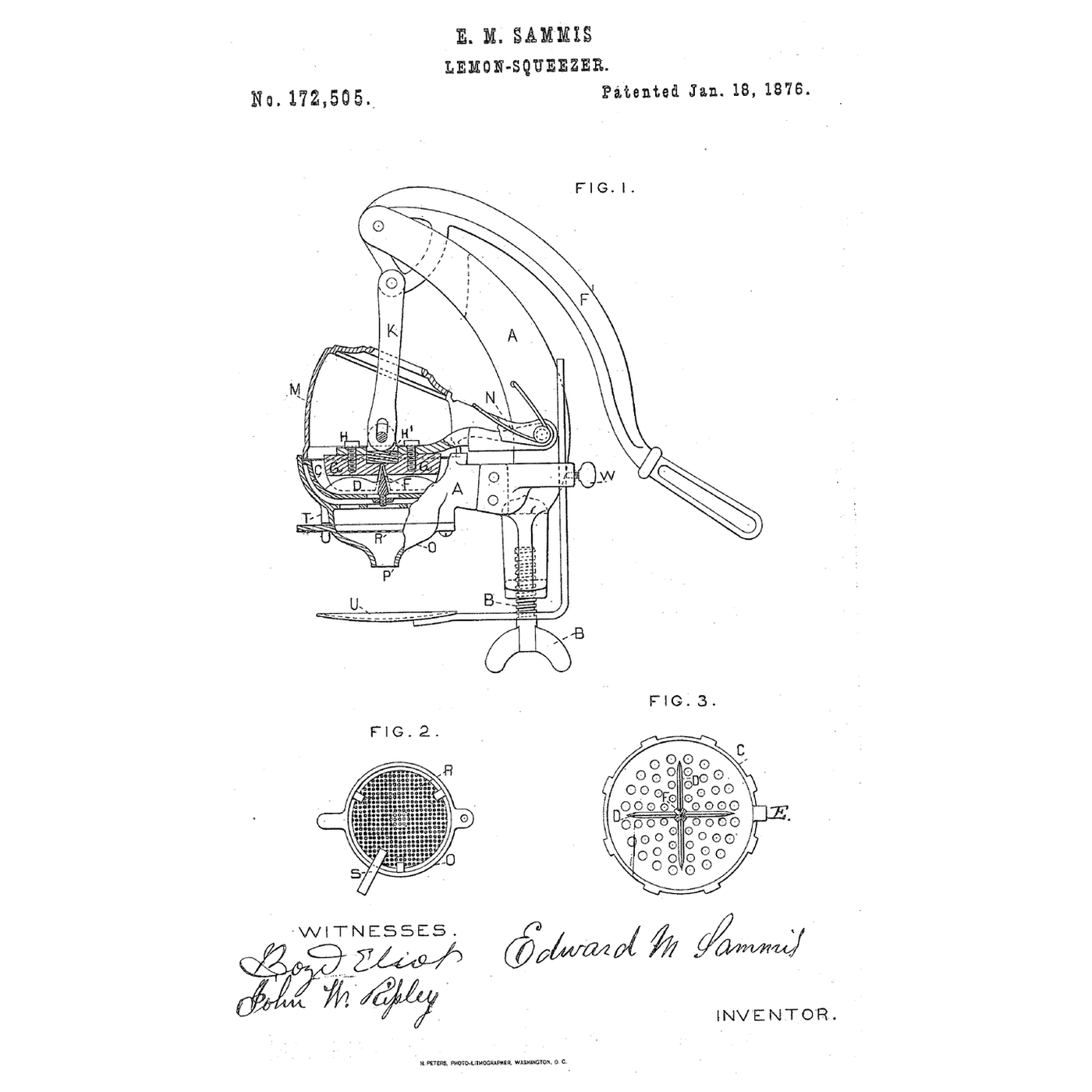


The Toggle-Lever Lemon Squeezer: Cutters, a Hood and a Jaw That Presses Harder as It Closes
A lemon pressed whole keeps juice in its rind, and a squeezer's jaw pushed by hand weakens just when the lemon is hardest to press.
Edward M. Sammis of New York received US 172,505, dated 18 January 1876, for a squeezer fixed to a shelf or table by a binding screw, with a cup whose curved cutters and centre point scarify the rind "in order that the juice may escape therefrom", a moving jaw driven by a link from a working lever "so that there is a compound motion that operates as a toggle-lever, by which the moving jaw is forced down with any desired force to squeeze the lemon", a hood that closes over the cup before the jaw presses, and a funnel with a second, finer strainer below.
This rung works out how the toggle's force rises as it straightens, with a work check, then builds the frame, jaw, link and lever, the cup with cutters and the hood, and squeezes whole lemons.
Ilọsíwájú
About 8 hours
Ìlànà
1
1
The toggle
The toggle
Ń ṣí ìwé Jupyter…
2
2
Sammis's earlier squeezer
Sammis's earlier squeezer
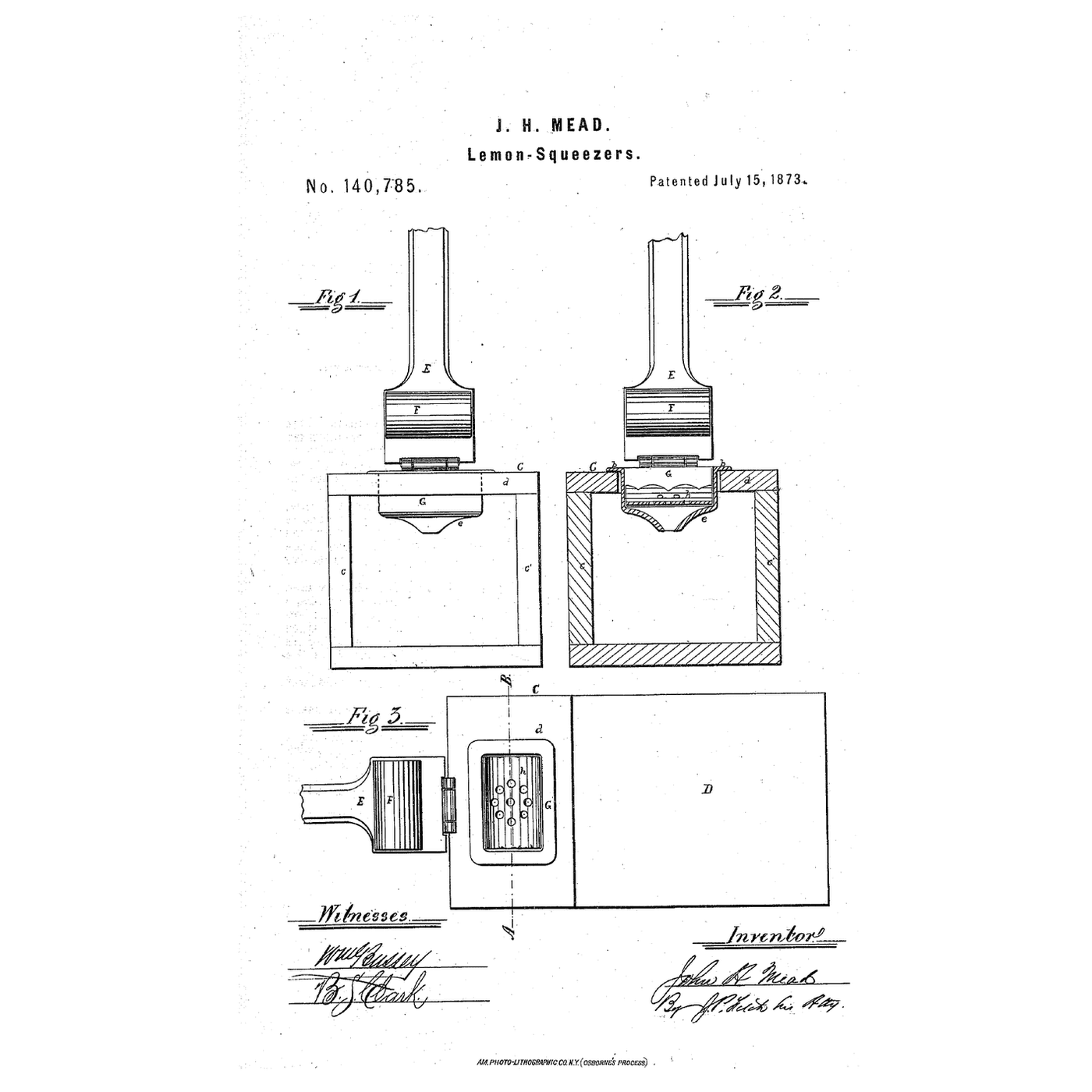
The embedded blueprint is Sammis's 1873 squeezer, cutting a whole lemon with one inclined knife. His 1876 squeezer scores the rind with cutters and presses with a toggle.
3
3
Read US 172,505
Read US 172,505
"Upon the back of said metal portion of the jaw is a link, as at K, one end of which is pivoted to the jaw, as shown at Fig. 1, and the other end is pivoted to a point on the working-lever F′, which is supported in a bracket-arm that is attached to the main frame. The relative position of the two attachments or pivots in the working-lever is such that the upper end of the connecting-link travels in the arc of a circle, and therefore there is a compound motion that operates as a toggle-lever, by which the moving jaw is forced down with any desired force to squeeze the lemon."
"The hood, being made much deeper than the jaw is thick, closes upon the cap before the jaw begins to compress the lemon to a sufficient degree to expel the juice from it, so that all the juice is thereby confined with the cup and passes through its perforated bottom, which also serves as a strainer to separate the coarser portions of the pulp and seeds from the juice."
4
4
Build the squeezer and press whole lemons
Build the squeezer and press whole lemons
**Frame.** Make an upright hardwood frame with a bracket at the top and a foot that clamps to the bench edge with a clamp, as Sammis's binding screw B.
**Cup and cutters.** Cut the bottom 4 cm off a tin can and punch its base all over. Solder two crossed stainless steel blades, edges up and curved, across the base, with a short pointed nail at the centre as F. Set the cup on a ledge in the frame.
**Jaw, link and lever.** Hinge a hardwood jaw, faced with a metal plate, to the frame beside the cup so it swings down onto it. Pivot a long working lever on the bracket, and join it to the jaw's back with a flat-bar link, placed so the link comes nearly straight as the jaw closes. Put a small rubber pad under the link's end on the jaw, as the spring H′.
**Hood.** Hinge a tin hood deeper than the jaw to the frame so it drops over the cup ahead of the jaw.
**Funnel.** Hang a funnel under the cup with a disc of fine mesh on its rim as the second strainer.
**Test.** Put a whole lemon on the cutters, pull the lever down, and weigh the juice. Watch the force rise near the end of the stroke.
Àwọn ohun èlò fún ìgbésẹ̀ yìí:
 Pátákó Igi Líle2 ẹyọ
 Ìṣù Igi Líle2 ẹyọ
 Ìṣó igi16 ẹyọ
 Ìgò irin2 ẹyọ
 Àwo irin tí kò ń yá1 ẹyọ
 Ìṣó1 ẹyọ
 Ohun ìdì paipu láìní òjé1 ẹyọ
 Ohun ìyọ́1 ẹyọ
 Ìdìmú ẹnu-ọ̀nà2 ẹyọ
 Ọ̀pá Pẹrẹsẹ Irin Pẹ́lẹ́0.4 mítà
 Àkójọ bọ́ọ̀lù onígun mẹ́fà1 ẹyọ
 Nọ́ọ̀tì Onígun Mẹ́fà3 ẹyọ
 Àwo rọ́bà1 ẹyọ
 Àwọ̀n okùn irin1 ẹyọ
 Lẹ́mọ́ọ̀nù3 ẹyọ
Àwọn irinṣẹ́ tí a nílò:
 Ayùn Ọwọ́
 Ìdìpọ̀ àyà igi
 Ẹ̀rọ Ìlùkòkò Aláìlókùn
 Àkójọ Orí Ìlùkòkò
 Ìlàǹkàn irin
 Òòlù
Òòlù Irin ìsúdì
 Ayùn Irin
 Àwọn Ìfá (Ìfá Ọwọ́)
 Àwọn clamp
 Ìṣù àwọn ohun ìyí skurú
 Kọ́kọ́rọ́ tí a lè ṣàtúnṣe
 Òṣùwọ̀n Díjítà Ilé Ìdáná
 Ìbọ̀wọ́ Iṣẹ́ Awọ
 Gílásì Ààbò Tí Ó Mọ́
5
5
A squeezer that jams, sprays or stops short
A squeezer that jams, sprays or stops short
Toggle-lever lemon squeezer troubleshooting.
Flow
Loading...
6
6
History and honest limits
History and honest limits
**Edward M. Sammis** of New York, New York, filed US 172,505 on 18 June 1875; it is dated 18 January 1876. His cup C fitted a recess in the frame by a projection E, the jaw G was preferably wood on a metal plate with an arm H pivoted to the frame, the hood M was lowered by a spring N, the funnel cup O swung aside on a pivot and carried a second strainer R of wire gauze, and a shelf U, adjustable by set screws W, held a vessel beneath. His claims cover the frame, cup, follower, arm and link with the lever; the follower's spring and link; the hood; and the shelf.
**Honest limits.** Hardwood, tin and flat bar stand in for his cast frame and parts. The notebook treats the linkage as a simple toggle; its push and angles are examples. Your juice is the result.
Àwọn ohun-èlò
15- 2 ẹyọÀyè
- 2 ẹyọÀyè
- 16 ẹyọÀyè
- 2 ẹyọÀyè
- 1 ẹyọÀyè
- 1 ẹyọÀyè
- Àyè
- 1 ẹyọÀyè
- 2 ẹyọÀyè
- 0.4 mítàÀyè
- Àyè
- 3 ẹyọÀyè
- 1 ẹyọÀyè
- 1 ẹyọÀyè
- 3 ẹyọÀyè
Àwọn irinṣẹ́ tó nílò
15- Àyè
- 1 vendor sell this, none ship to you yetÀyè
- Àyè
- Àyè
- 2 vendors sell this, none ship to you yetÀyè
- Àyè
- Àyè
Ìtọ́nisọ́nà yìí ń ṣe

Blueprint tó jọra
Àwọn blueprint wọ̀nyí pín ìmọ̀ — ọ̀nà, ohun-èlò tàbí ìlànà
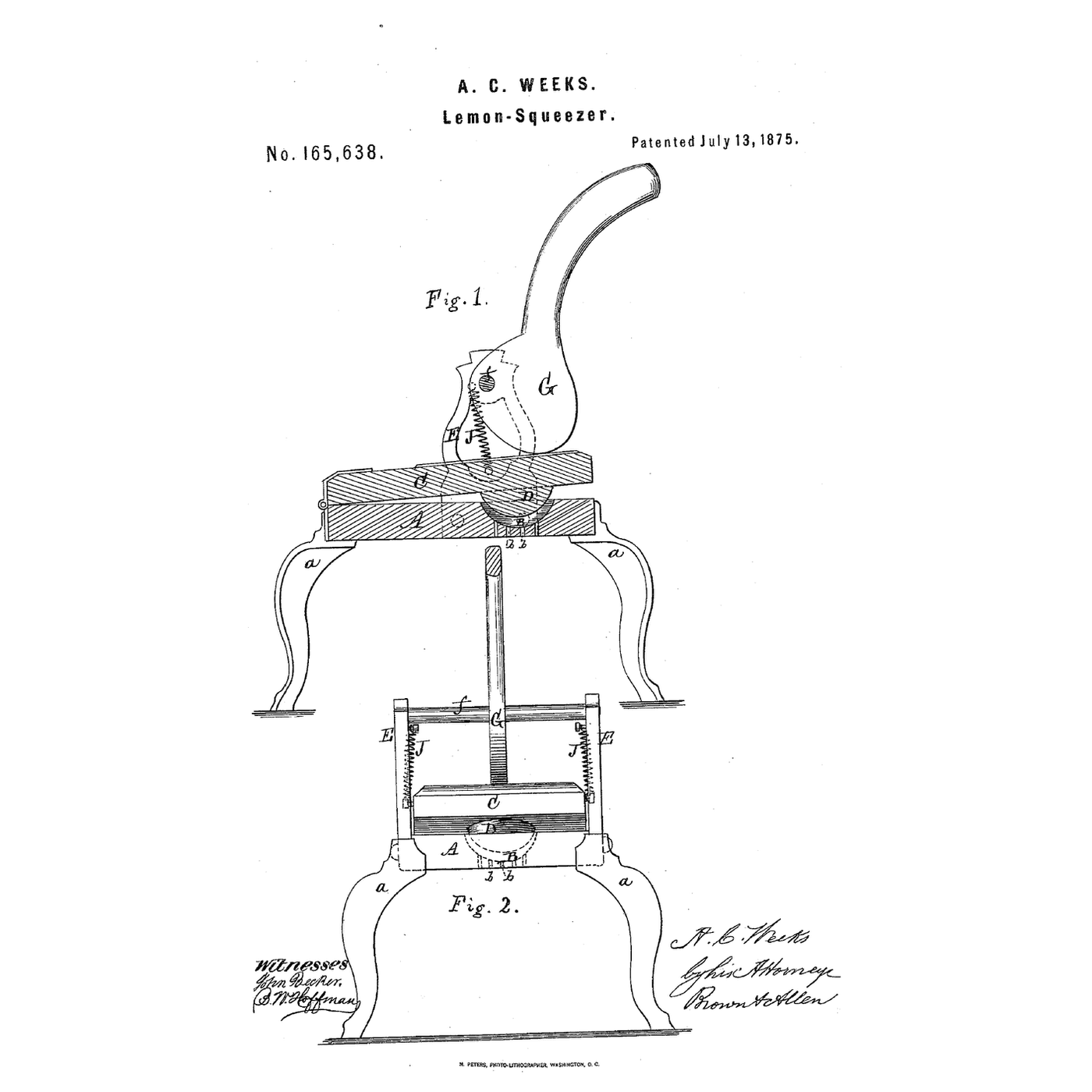
The Cam-Lever Lemon Squeezer: A Cam on a Shaft Presses the Plunger, Springs Lift It
láti ọwọ́ Martin
Àwọn Ohun Mímu
32
0
0
0
0
0
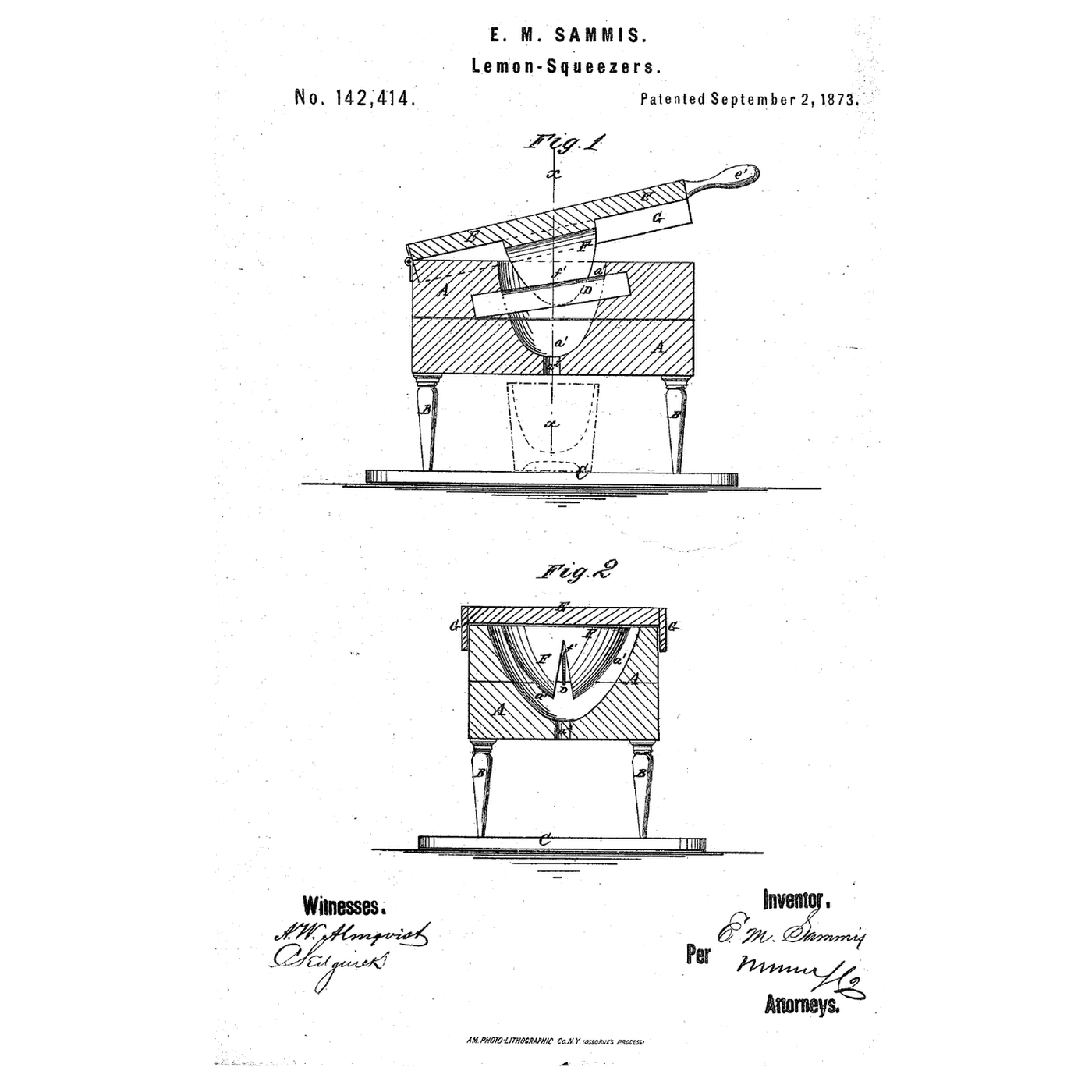
The Inclined-Knife Lemon Squeezer: Put In a Whole Lemon, Cut and Press in One Stroke
láti ọwọ́ Penny
Àwọn Ohun Mímu
33
0
0
0
0
0
The False-Bottom Lemon Press: A Hinged Lever Over a Die, and One Hole for the Juice
láti ọwọ́ TheChef
Iṣẹ́ Igi
18
0
0
0
0
0
CC0 Àgbègbè Gbogbogbò
Blueprint yìí ti jáde lábẹ́ CC0. O lè ṣe àdàkọ, yí padà, pín, àti lò láìsí ìyọ̀ǹda.
Ṣàtìlẹ́yìn Olùṣẹ́dá nípa rírà àwọn ọjà nipasẹ̀ Blueprint wọn Ẹ̀san Olùṣẹ́dá tí àwọn Olùtajà gbé kalẹ̀, tàbí ṣẹ̀dá àtúnṣe tuntun ti Blueprint yìí kí o sì fi sínú Blueprint rẹ gẹ́gẹ́ bí ìsopọ̀ láti pín owó-wíwọlé.