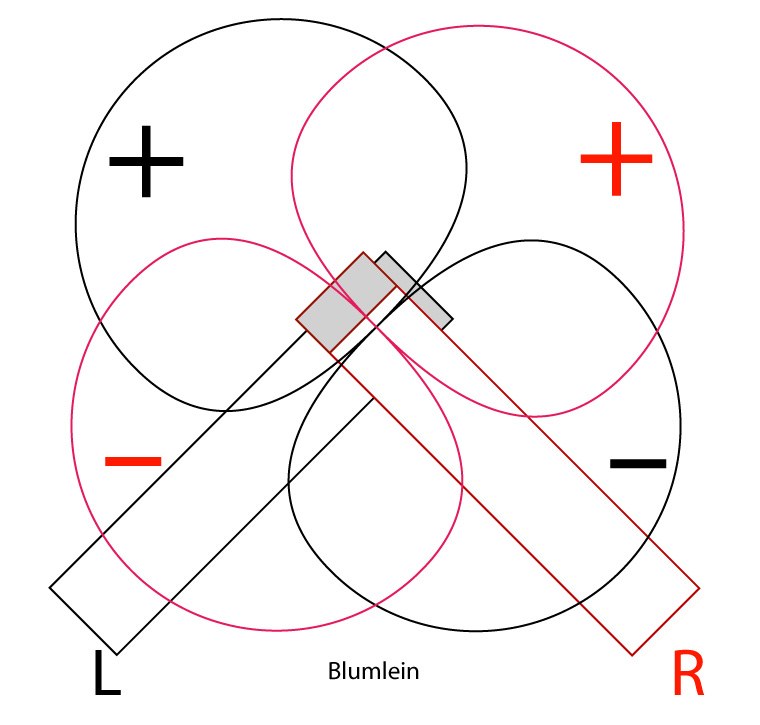


Blumlein Stereo
निर्देशनहरू
Set up a coincident crossed pair
Set up a coincident crossed pair
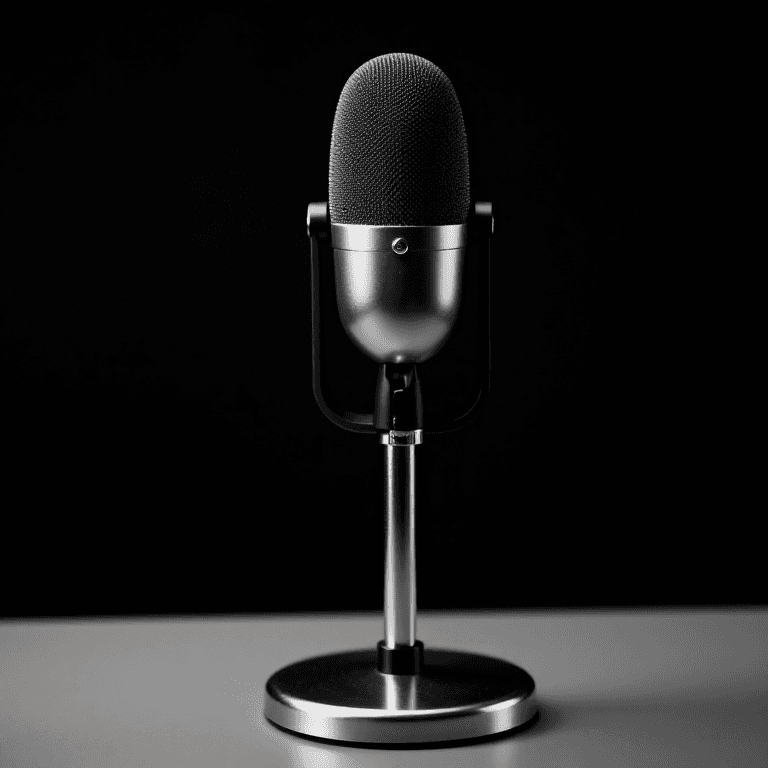
Two figure-of-eight microphones, same point in space, 90 degrees apart.
- Mount two figure-of-eight microphones with their capsules as close together as physically possible, one directly above the other.
- Angle them at 90 degrees to each other, so each points 45 degrees off the centre line.
- Feed one to the left channel and one to the right.
- Walk a sound source in an arc in front of them and listen on headphones.
Coincident is the crucial word. Because both capsules occupy nearly the same point, sound arrives at both at the same TIME — so the only difference between the channels is level, determined by each microphone's pattern. That gives a stereo image that survives being summed to mono, which spaced microphones do not. Blumlein understood this in 1931, before anyone had heard stereo reproduction.
Use the ribbon microphones from earlier in this batch. Their native figure-of-eight pattern is what makes this technique possible — it is not a coincidence that the ribbon and stereo arrive within a decade of each other.यस चरणका सामग्री:
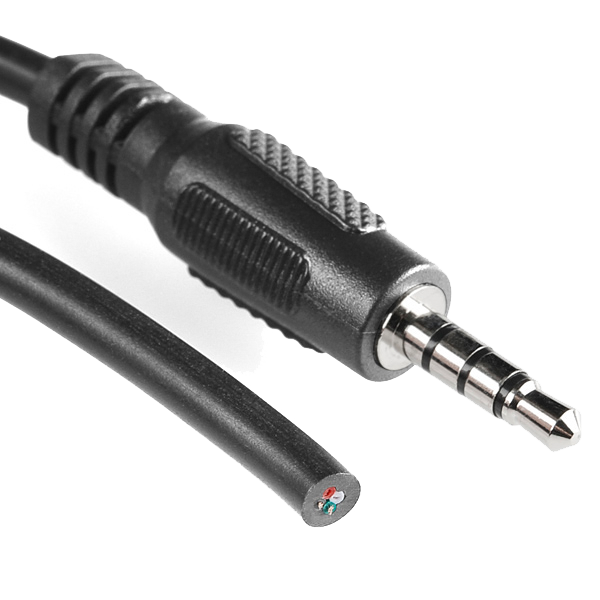 Audio Cable TRRS - 45cm (pigtail)1 टुक्रा
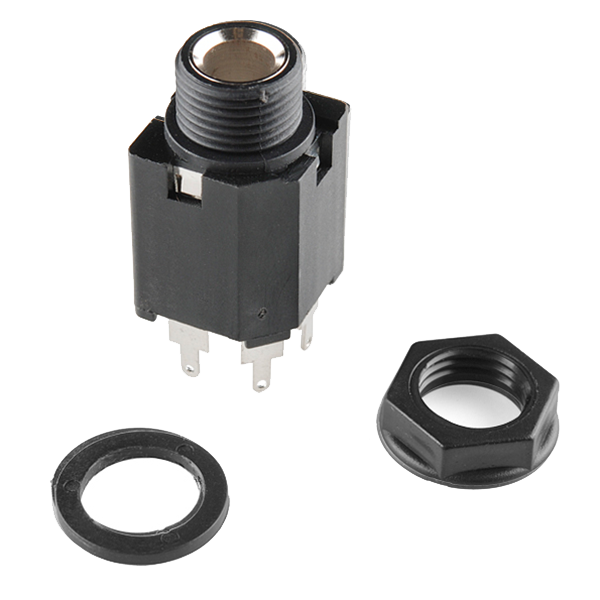 Audio Jack - 1/4 Stereo (vertical)1 टुक्रा
चाहिने औजार:
 डिजिटल तरङ्गदर्शी
 संयुक्त गुनिया
 अडियो इन्टरफेस (USB-C)
Measure how direction becomes level difference
Measure how direction becomes level difference
Turn the effect into numbers so the mechanism is unmistakable.
- Place a tone source directly ahead and record both channel levels — they should be equal.
- Move it 30 degrees left and record both again.
- Continue in steps to 90 degrees left, then repeat to the right.
- Tabulate left level, right level, and their difference against angle.
यस चरणका सामग्री:
 रेखाचित्र कागज1 pad
चाहिने औजार:
 DDS संकेत जेनेरेटरडिजिटल तरङ्गदर्शी
 प्रयोगशाला स्तरको डिजिटल बहुमापकसंयुक्त गुनिया
Encode two channels in one groove
Encode two channels in one groove
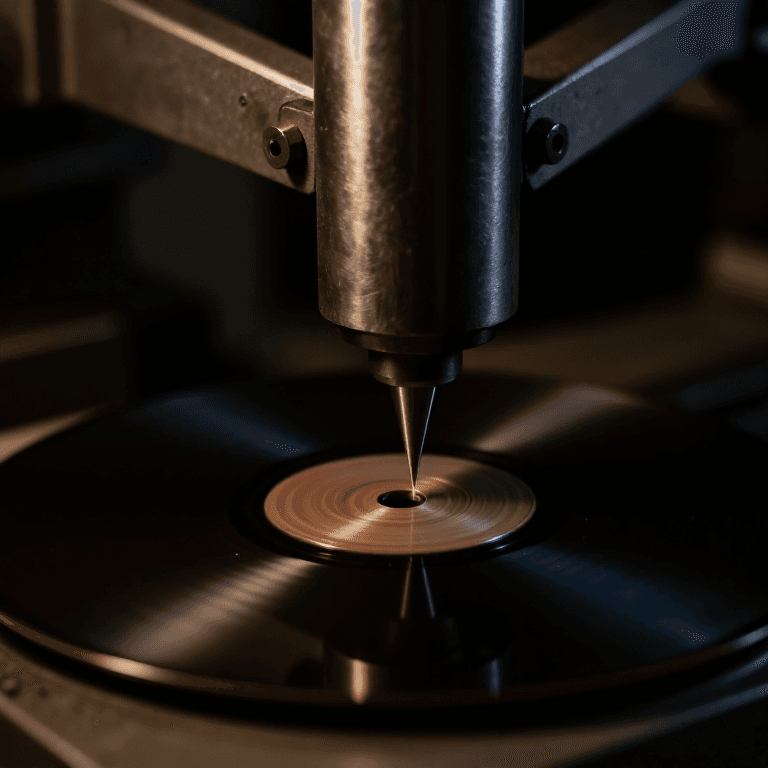
The stylus must move in two independent directions at once — this is Blumlein's other great idea.
- Model the groove as a V with two walls at 45 degrees to the surface.
- Let one channel move the stylus along one wall's normal, and the other along the other wall's.
- Confirm that the two directions are perpendicular, so neither channel affects the other.
- Work out what happens when both channels carry the same signal, and when they carry opposite signals.
Identical signals move the stylus purely laterally; opposite signals move it purely vertically. That is the beautiful part — a stereo record played with a mono lateral pickup reproduces the sum of the two channels correctly, so the format is backward compatible with every mono player already in existence. Blumlein designed that compatibility in from the start.
This 45/45 system is what all stereo records use. The alternative proposals of the 1950s — one channel lateral, one vertical — were rejected precisely because they lacked this symmetry, and treated the two channels unequally.यस चरणका सामग्री:
 एक्रिलिक पाता1 पानारेखाचित्र कागज1 pad
चाहिने औजार:
 डिजिटल क्यालिपर ६ इन्चसंयुक्त गुनियाडिजिटल तरङ्गदर्शी
Test the mono compatibility and the phase trap
Test the mono compatibility and the phase trap
Stereo that collapses badly to mono was a real commercial problem, so check it.
- Record a source with your Blumlein pair and listen in stereo.
- Sum the two channels electrically and listen in mono — the image collapses to the centre but nothing disappears.
- Now deliberately reverse the polarity of one channel and sum again.
- Listen to what happens to the centre.
चाहिने औजार:
डिजिटल तरङ्गदर्शीअडियो इन्टरफेस (USB-C)प्रयोगशाला स्तरको डिजिटल बहुमापकOne patent, an entire format, and history
One patent, an entire format, and history
Alan Dower Blumlein filed his stereo patent in 1931 at EMI, aged 28. Its 128 claims cover the crossed-pair recording technique, the 45/45 groove, stereo film sound, and the matrix arithmetic for converting between left/right and sum/difference representations. He made demonstration films with stereo soundtracks in 1935 that still exist. He was killed in 1942 testing airborne radar, aged 38, having also made fundamental contributions to television and radar.
The sum-and-difference idea in his patent outlived even the format. Encoding two channels as their sum and their difference rather than as left and right is exactly how FM stereo radio works — the sum goes out as the ordinary mono signal that any receiver can use, and the difference is carried separately for receivers that can decode it. The same trick reappears in television colour encoding and in audio compression. Blumlein was working out the general theory, not just a record format.
Why it took twenty-five years to ship. The patent was decades ahead of the industry: stereo discs needed better pickup cartridges, better vinyl, and consumers with two loudspeakers. Commercial stereo records arrived in 1958, twenty-seven years after the patent and sixteen years after Blumlein's death, using essentially his system unchanged.
Its honest limits: a coincident pair gives excellent image stability and a somewhat narrower, drier sound than spaced microphones; the figure-of-eight patterns pick up the room behind as much as the front, so it demands a good acoustic; and it captures no time-of-arrival cues, which some listeners find makes the image less enveloping. Engineers choose between coincident and spaced techniques exactly on those grounds.
सामग्री
4- Audio Cable TRRS - 45cm (pigtail)10% कमिसन1 टुक्रा$2.51
- Audio Jack - 1/4 Stereo (vertical)10% कमिसन1 टुक्रा$1.18
- 1 padप्लेसहोल्डर
- 1 पानाप्लेसहोल्डर
आवश्यक उपकरणहरू
6- 1 vendor sell this, none ship to you yetप्लेसहोल्डर
- प्लेसहोल्डर
- प्लेसहोल्डर
- प्लेसहोल्डर
- प्लेसहोल्डर
- प्लेसहोल्डर
सम्बन्धित ब्लुप्रिन्ट
यी ब्लुप्रिन्टहरूले ज्ञान साझा गर्छन् — प्रविधि, सामग्री वा सिद्धान्त


CC0 सार्वजनिक डोमेन
यो ब्लुप्रिन्ट CC0 अन्तर्गत जारी गरिएको छ। तपाईं अनुमति नसोधी प्रतिलिपि, परिमार्जन, वितरण र प्रयोग गर्न सक्नुहुन्छ।
ब्लुप्रिन्ट मार्फत उत्पादनहरू किनेर सिर्जनाकर्तालाई सहयोग गर्नुहोस् सिर्जनाकर्ता कमिसन विक्रेताले तोकेको, वा यो ब्लुप्रिन्टको नयाँ संस्करण बनाउनुहोस् र आम्दानी बाँड्न आफ्नो ब्लुप्रिन्टमा जडानको रूपमा समावेश गर्नुहोस्।