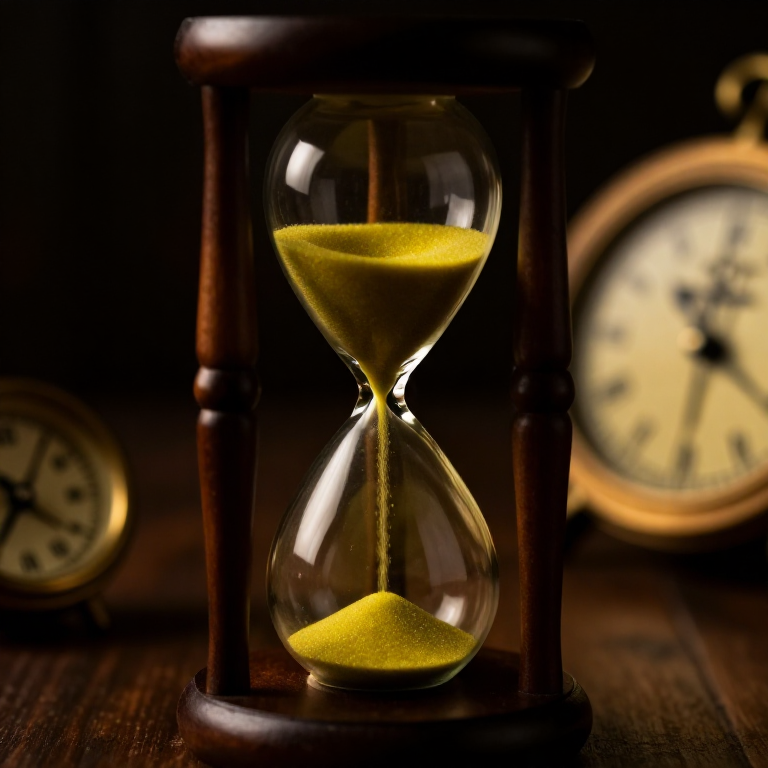


Building a Sand Hourglass — The Medieval Timekeeper That Worked at Sea
The hourglass (also called a sandglass or sand timer) appeared in European maritime use around 1300 AD — the earliest definitive reference is a 1338 fresco by Ambrogio Lorenzetti in Siena, Italy. While water clocks (clepsydra) had measured time for millennia, they failed at sea — the rocking of a ship sloshed the water and ruined the measurement. Sand, being granular, flows consistently regardless of motion, making the hourglass the first timekeeper reliable enough for ocean navigation.
The physics of an hourglass is deceptively complex. Sand flows through the narrow neck at a constant rate determined by four variables: the diameter of the neck opening, the grain size and shape of the sand, the angle of the glass walls, and the total volume of sand. Remarkably, unlike water (which flows faster when there is more pressure above), sand flow rate is nearly independent of the depth of sand above the neck — a property called the 'hourglass effect' that was not mathematically explained until 1895 by German physicist Osborne Reynolds.
Ships carried multiple hourglasses of different durations — a 30-minute glass for the watch system (8 turns = 4 hours = one watch), a 30-second glass for the chip log (measuring ship speed), and sometimes a 1-minute glass for timing cannon loading drills. The ship's boy was responsible for turning the glass at exactly the right moment and ringing the bell — a 14-year-old with a sandglass was the most precise clock aboard a vessel carrying hundreds of sailors across the Atlantic.
निर्देशनहरू
Blow two matching glass bulbs
Blow two matching glass bulbs
An hourglass consists of two glass bulbs connected by a narrow neck. The traditional method is to blow two identical bulbs from soda-lime glass on a blowpipe, each approximately 8-10 cm in diameter and 10-12 cm tall with a narrow opening at one end. The bulbs must be as identical as possible in volume — any difference means the timing will differ depending on which end is up.
Gather molten glass on a blowpipe, inflate a bubble, and shape it into a rounded flask by rolling on a marver (flat stone slab) and reheating in the furnace. Form the narrow neck by pulling and constricting the glass while it is still pliable. The opening at the neck should be approximately 8-12 mm in diameter — this will be trimmed and calibrated later. Make two bulbs and set them aside to anneal (cool slowly) overnight.
यस चरणका सामग्री:
 मसिनो बालुवा1 केजी
 न्याट्रोन200 ग्राम
चाहिने औजार:
 रासायनिक छिटाको चस्मा
Prepare and calibrate the sand
Prepare and calibrate the sand
The sand must be uniform in grain size, perfectly dry, and free of dust or organic material. River sand or crushed marble is sieved through progressively finer meshes to select grains of a uniform size — typically 0.1-0.3 mm diameter for a standard hourglass. Grains that are too large will jam in the neck; grains that are too fine will clump from static electricity or moisture.
Wash the sieved sand in clean water to remove dust and fine particles, then dry it thoroughly in an oven or in the sun. Some medieval glassmakers roasted the sand with a small amount of lead oxide to make the grains perfectly round and smooth-flowing — the lead coating reduced inter-grain friction and prevented clumping. The sand must be absolutely bone-dry before filling — any moisture causes the grains to stick together and flow irregularly.
यस चरणका सामग्री:
मसिनो बालुवा500 ग्रामचाहिने औजार:
 बाँसको चाल्नो
Form and calibrate the neck orifice
Form and calibrate the neck orifice
The neck orifice diameter controls the flow rate — and therefore the duration of the hourglass. A wider neck empties faster; a narrower neck empties slower. For a 30-minute glass (the standard maritime watch timer), the orifice is typically 1.5-2.5 mm in diameter — surprisingly small for the volume of sand it must pass.
Insert a thin metal disc (a washer or drilled plate) into the junction between the two bulbs with a precisely drilled hole of the target diameter. This disc is more controllable than trying to form a perfect glass orifice. Fill one bulb with the calibrated sand, join the bulbs with the disc between them, and time the flow with a reference clock. Adjust the orifice diameter (by filing the disc hole larger, or replacing with a disc with a smaller hole) until the sand runs for exactly the target duration.
Join the two bulbs
Join the two bulbs
Once calibrated, permanently join the two bulbs at their narrow necks. The traditional method is to heat both neck openings in a glass furnace until they soften, then press them together while rotating — the glass fuses into a continuous seal with the orifice disc trapped inside. The joint must be airtight — any air leakage will disturb the sand flow (air must enter the upper bulb to replace the sand that flows out, creating a pressure differential that drives consistent flow).
An alternative medieval method uses a binding of thread and pitch around the junction of two separate bulbs — simpler to construct but less airtight and durable. The fused glass joint is superior and was the standard for precision instruments like ship's watches.
यस चरणका सामग्री:
 डल्ले कोइला5 केजी
चाहिने औजार:
 खलाती
खलातीBuild the protective frame
Build the protective frame
Mount the completed glass assembly in a protective wooden frame — two flat discs (top and bottom) connected by 3-4 turned wooden pillars. The glass is held between the discs with cork or leather cushions to absorb shock. The frame serves three purposes: it protects the fragile glass from breakage, it provides a flat base for the hourglass to stand upright, and it allows the glass to be flipped quickly and precisely when the sand runs out.
Ship's hourglasses were mounted in gimballed brackets (similar to compass mounts) to keep them level regardless of the ship's roll. The frame was often marked with incised lines or brass plates indicating the duration — '30 minutes', '1 hour', or simply 'one watch' — and the ship's name and date of calibration.
यस चरणका सामग्री:
 कडा काठको ढिक्का2 टुक्रा
चाहिने औजार:
 हाते आरा
Final timing verification
Final timing verification
Verify the completed hourglass against a reliable reference — a sundial at noon, a church bell schedule, or another calibrated timepiece. Run the glass through at least 5 complete cycles (top to bottom) and average the times. A well-made hourglass should be consistent to within 1-2% between runs — a 30-minute glass should not vary by more than 20-30 seconds.
If the timing is off, the glass must be disassembled, the sand quantity adjusted (more sand = longer duration), and the orifice rechecked. Medieval ships carried spare hourglasses calibrated against each other — if one was dropped and cracked, the replacement was ready. The hourglass remained the primary timekeeping instrument aboard ships until the marine chronometer was perfected by John Harrison in 1761 — over 400 years of service as the clock that kept the world's navies and merchant fleets running on schedule.
सामग्री
4- 500 ग्रामप्लेसहोल्डर
- 200 ग्रामप्लेसहोल्डर
- 5 केजीप्लेसहोल्डर
- 2 टुक्राप्लेसहोल्डर
जोडिएका खाकाका सामग्री

सम्बन्धित ब्लुप्रिन्ट
यी ब्लुप्रिन्टहरूले ज्ञान साझा गर्छन् — प्रविधि, सामग्री वा सिद्धान्त



CC0 सार्वजनिक डोमेन
यो ब्लुप्रिन्ट CC0 अन्तर्गत जारी गरिएको छ। तपाईं अनुमति नसोधी प्रतिलिपि, परिमार्जन, वितरण र प्रयोग गर्न सक्नुहुन्छ।
ब्लुप्रिन्ट मार्फत उत्पादनहरू किनेर सिर्जनाकर्तालाई सहयोग गर्नुहोस् सिर्जनाकर्ता कमिसन विक्रेताले तोकेको, वा यो ब्लुप्रिन्टको नयाँ संस्करण बनाउनुहोस् र आम्दानी बाँड्न आफ्नो ब्लुप्रिन्टमा जडानको रूपमा समावेश गर्नुहोस्।