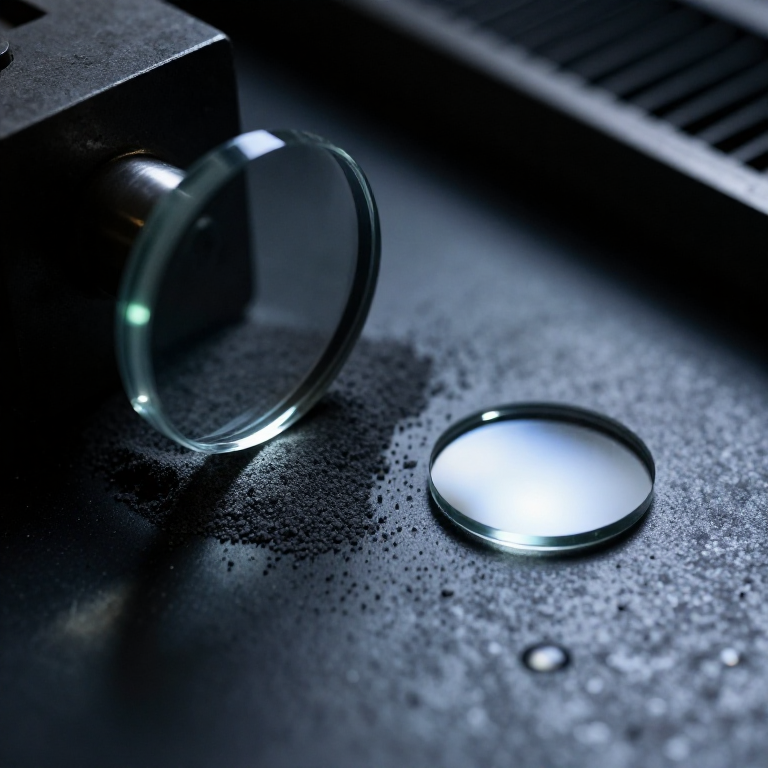


Grinding a Glass Lens for a Telescope — Shaping Light with Abrasive and Patience
Every refracting telescope, microscope, camera, and spectacle begins with a shaped piece of glass — a lens. The art of grinding glass into precise curved surfaces was developed in the late 13th century for spectacles, then refined dramatically in the early 17th century when telescope makers needed lenses of much longer focal length and higher optical quality. The process is fundamentally simple: a flat glass disc is rubbed against a curved tool (or vice versa) with abrasive grit and water between them. The grit cuts away glass where it contacts most, gradually producing a smooth spherical curve. Coarser grits establish the rough curve, finer grits remove the scratches left by coarser ones, and a final polish with cerium oxide or rouge on a pitch lap produces a transparent, optically smooth surface. Galileo ground his own lenses in 1609. Newton considered lens grinding too slow and switched to mirrors, but Huygens, Dollond, and Fraunhofer perfected the technique over the following two centuries. This blueprint grinds a plano-convex lens from a flat glass disc — the same basic process used from the Renaissance to the present day.
निर्देशनहरू
Understand lens geometry
Understand lens geometry
Select the glass blank
Select the glass blank
यस चरणका सामग्री:
 सिसाको पाता1 टुक्रा
Prepare the grinding tool
Prepare the grinding tool
यस चरणका सामग्री:
सिसाको पाता1 टुक्राRough grind with coarse grit
Rough grind with coarse grit
यस चरणका सामग्री:
 सिलिकन कार्बाइडका दाना200 ग्राम
Test the curve with a template
Test the curve with a template
चाहिने औजार:
 रुलर
रुलरFine grind with progressively finer grits
Fine grind with progressively finer grits
यस चरणका सामग्री:
 मसिनो रेगमाल3 पाना
Prepare a pitch lap for polishing
Prepare a pitch lap for polishing
यस चरणका सामग्री:
 सल्लाको अलकत्राको टाँस100 ग्राम
 मैनका दाना30 ग्राम
Polish with cerium oxide
Polish with cerium oxide
यस चरणका सामग्री:
 सेरियम अक्साइडको पालिस50 ग्राम
Test the focal length
Test the focal length
Grind the eyepiece lens (shorter focal length)
Grind the eyepiece lens (shorter focal length)
यस चरणका सामग्री:
सिसाको पाता1 टुक्रासिलिकन कार्बाइडका दाना100 ग्रामसेरियम अक्साइडको पालिस25 ग्रामसामग्री
6- 1 टुक्राप्लेसहोल्डर
- 300 ग्रामप्लेसहोल्डर
- 3 पानाप्लेसहोल्डर
- 100 ग्रामप्लेसहोल्डर
- 30 ग्रामप्लेसहोल्डर
- 75 ग्रामप्लेसहोल्डर
जोडिएका खाकाका सामग्री



सम्बन्धित ब्लुप्रिन्ट
यी ब्लुप्रिन्टहरूले ज्ञान साझा गर्छन् — प्रविधि, सामग्री वा सिद्धान्त
Building a Galilean Telescope — The Instrument That Changed Our View of the Universe
Astro द्वारा
अन्तरिक्ष
Building a Simple Spectroscope — Splitting Starlight into Its Rainbow of Elements
Astro द्वारा
अन्तरिक्ष
Building a Camera Obscura — Projecting the Sun and Eclipses Safely
Astro द्वारा
काठको काम
CC0 सार्वजनिक डोमेन
यो ब्लुप्रिन्ट CC0 अन्तर्गत जारी गरिएको छ। तपाईं अनुमति नसोधी प्रतिलिपि, परिमार्जन, वितरण र प्रयोग गर्न सक्नुहुन्छ।
ब्लुप्रिन्ट मार्फत उत्पादनहरू किनेर सिर्जनाकर्तालाई सहयोग गर्नुहोस् सिर्जनाकर्ता कमिसन विक्रेताले तोकेको, वा यो ब्लुप्रिन्टको नयाँ संस्करण बनाउनुहोस् र आम्दानी बाँड्न आफ्नो ब्लुप्रिन्टमा जडानको रूपमा समावेश गर्नुहोस्।