कला
सुन्दरता र कल्याण
हस्तकला
संस्कृति र इतिहास
मनोरञ्जन
वातावरण
खाना र पेय
रिभर्स इन्जिनियरिङ
विज्ञान
खेलकुद
प्रविधि
पहिर्न मिल्ने
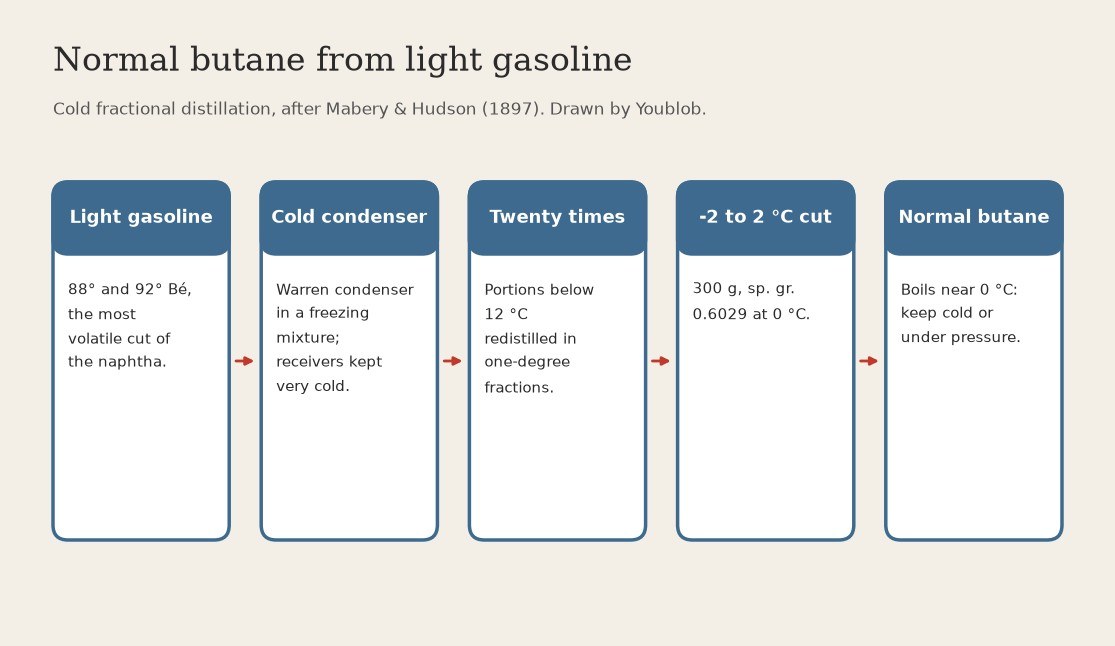


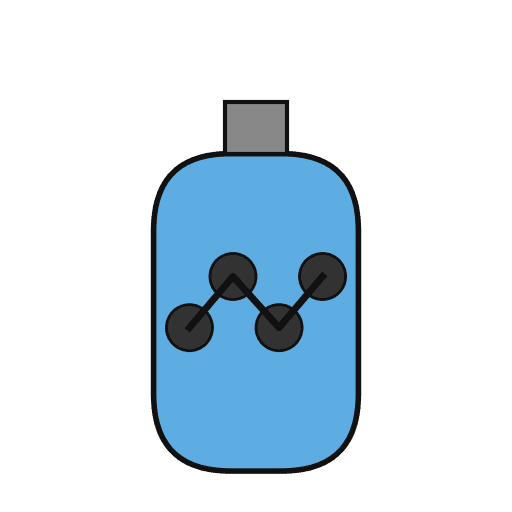
Normal Butane: the 0 °C Cut of the Lightest Gasoline, Distilled Twenty Times in the Cold (Mabery & Hudson 1897)
The lightest gasoline still holds butane, a gas that boils at about 0 °C. Distil it again and again through a condenser packed in a freezing mixture, and the butane gathers as a cut between -2 and 2 °C.
Result: 300 grams within -2 to 2 °C, specific gravity 0.6029 at 0 °C, vapour density 2.07 (2.01 calculated for butane). Very little came over below -10 °C.
Note: Mabery & Hudson named this cut isobutane. By the boiling points in Ipatieff & Pines, US 2,318,226 (normal butane +0.5 °C, isobutane -10.5 °C), a cut at 0 °C is normal butane, and it is built here as such.
Source: Mabery & Hudson, Proc. Amer. Acad. 32 (1897), pp. 101-111. Not given: the freezing mixture, how the butane was stored. Extremely flammable: no flame near. Picture drawn by Youblob.
विशेषज्ञ
3 months
निर्देशनहरू
1
1
Take the lightest gasoline
Take the lightest gasoline
Start from the most volatile gasoline you can get. Mabery & Hudson used 88° and 92° Baumé gasoline, the second distillate of Pennsylvania and Ohio naphtha, collected at the refinery in lots of 45 litres while the air was below 0 °F. 250 litres were worked in all.
यस चरणका सामग्री:
 पेट्रोल250 लिटर
चाहिने औजार:
 काँचको आसवन फ्लास्क
2
2
Distil through a condenser in a freezing mixture
Distil through a condenser in a freezing mixture
Distil from a flask through a Warren condenser filled with a freezing mixture, and keep every receiver very cold to avoid loss. The paper does not give the mixture. Ours: crushed ice and salt.
चाहिने औजार:
काँचको आसवन फ्लास्क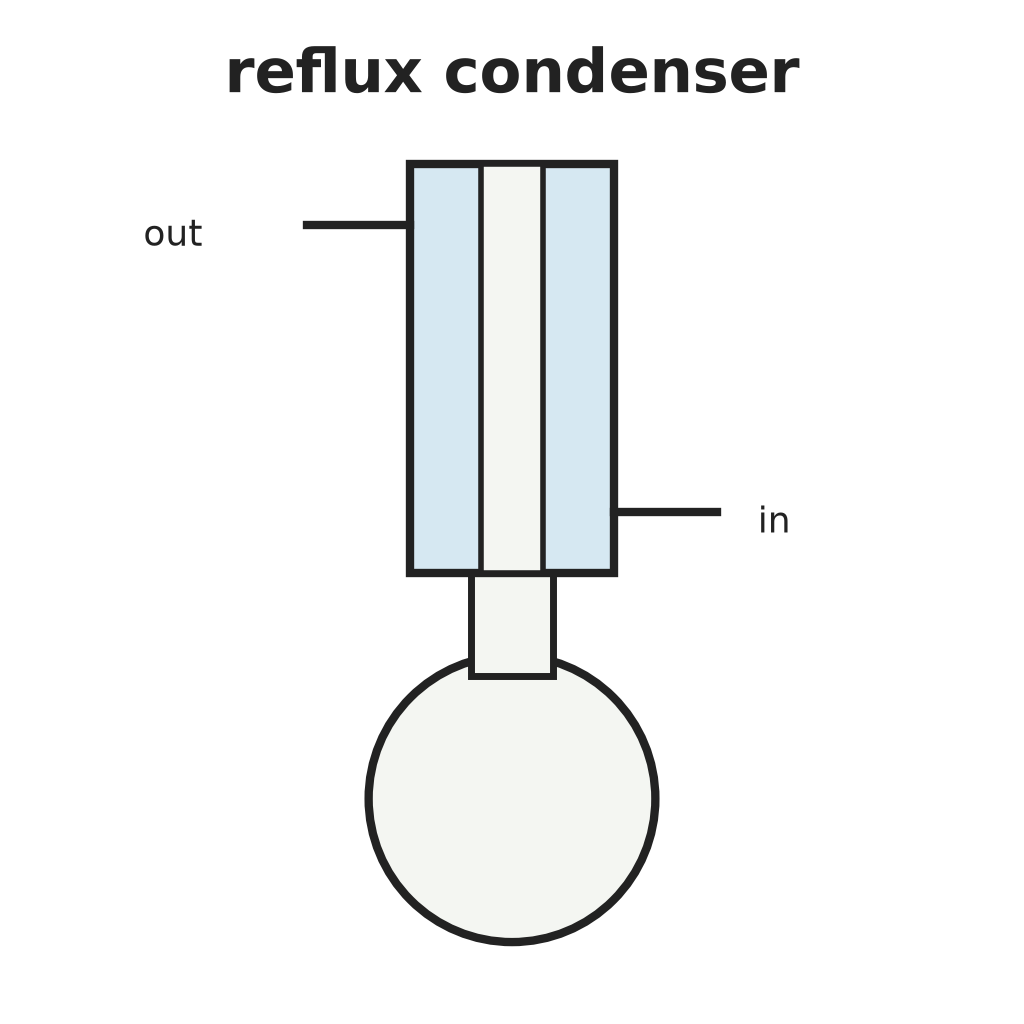 रिफ्लक्स कन्डेन्सर
 कुटेको बरफ
 नुन
 प्रयोगशाला तापमापक
3
3
Let the lightest portions boil from room heat
Let the lightest portions boil from room heat
The portions from -20 to -10 °C boil from the heat of the surrounding air alone. Regulate them by cooling the still, not by heating it.
चाहिने औजार:
काँचको आसवन फ्लास्ककुटेको बरफनुनप्रयोगशाला तापमापक4
4
Redistil everything below 12 °C twenty times
Redistil everything below 12 °C twenty times
Collect in single-degree fractions and distil the portions below 12 °C again, twenty times over. By the twentieth run almost nothing stays between 5 and 20 °C, and the butane gathers between -2 and 2 °C.
चाहिने औजार:
काँचको आसवन फ्लास्करिफ्लक्स कन्डेन्सरकुटेको बरफनुनप्रयोगशाला तापमापक5
5
Keep the -2 to 2 °C cut
Keep the -2 to 2 °C cut
This is the butane: 300 grams in Mabery & Hudson's run, specific gravity 0.6029 at 0 °C. It boils at about 0 °C, so it must be kept cold or under pressure. Ours: condense it into a pressure gas cylinder.
चाहिने औजार:
 चापयुक्त ग्यासको सिलिन्डरप्रयोगशाला तापमापक
यो खाकाले बनाउँछ
सम्बन्धित ब्लुप्रिन्ट
यी ब्लुप्रिन्टहरूले ज्ञान साझा गर्छन् — प्रविधि, सामग्री वा सिद्धान्त
CC0 सार्वजनिक डोमेन
यो ब्लुप्रिन्ट CC0 अन्तर्गत जारी गरिएको छ। तपाईं अनुमति नसोधी प्रतिलिपि, परिमार्जन, वितरण र प्रयोग गर्न सक्नुहुन्छ।
ब्लुप्रिन्ट मार्फत उत्पादनहरू किनेर सिर्जनाकर्तालाई सहयोग गर्नुहोस् सिर्जनाकर्ता कमिसन विक्रेताले तोकेको, वा यो ब्लुप्रिन्टको नयाँ संस्करण बनाउनुहोस् र आम्दानी बाँड्न आफ्नो ब्लुप्रिन्टमा जडानको रूपमा समावेश गर्नुहोस्।