Współpraca
SZTUKA
Piękno i dobre samopoczucie
RZEMIOSŁO
KULTURA I HISTORIA
ROZRYWKA
ŚRODOWISKO
JEDZENIE I NAPOJE
INŻYNIERIA ODWROTNA
NAUKI
LEKKOATLETYKA
TECHNOLOGIA
URZĄDZENIA DO NOSZENIA
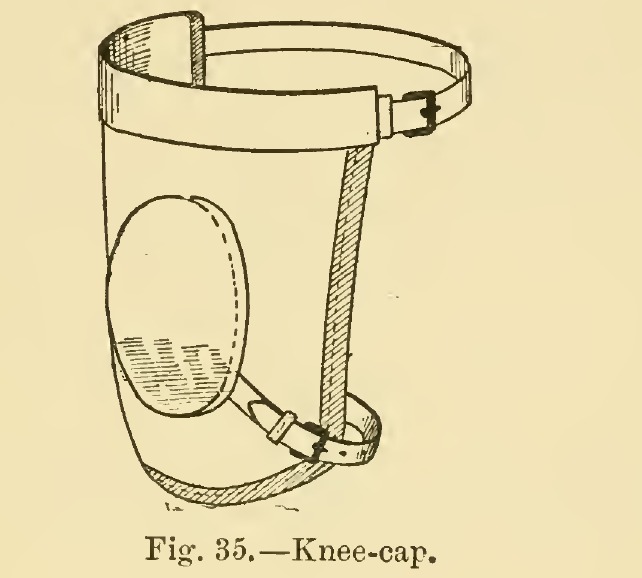


Horse Knee-Cap: Cupped Leather Block, Cloth Shield and Flock-Stuffed Chamois Roll (Hasluck, Saddlery, 1904)
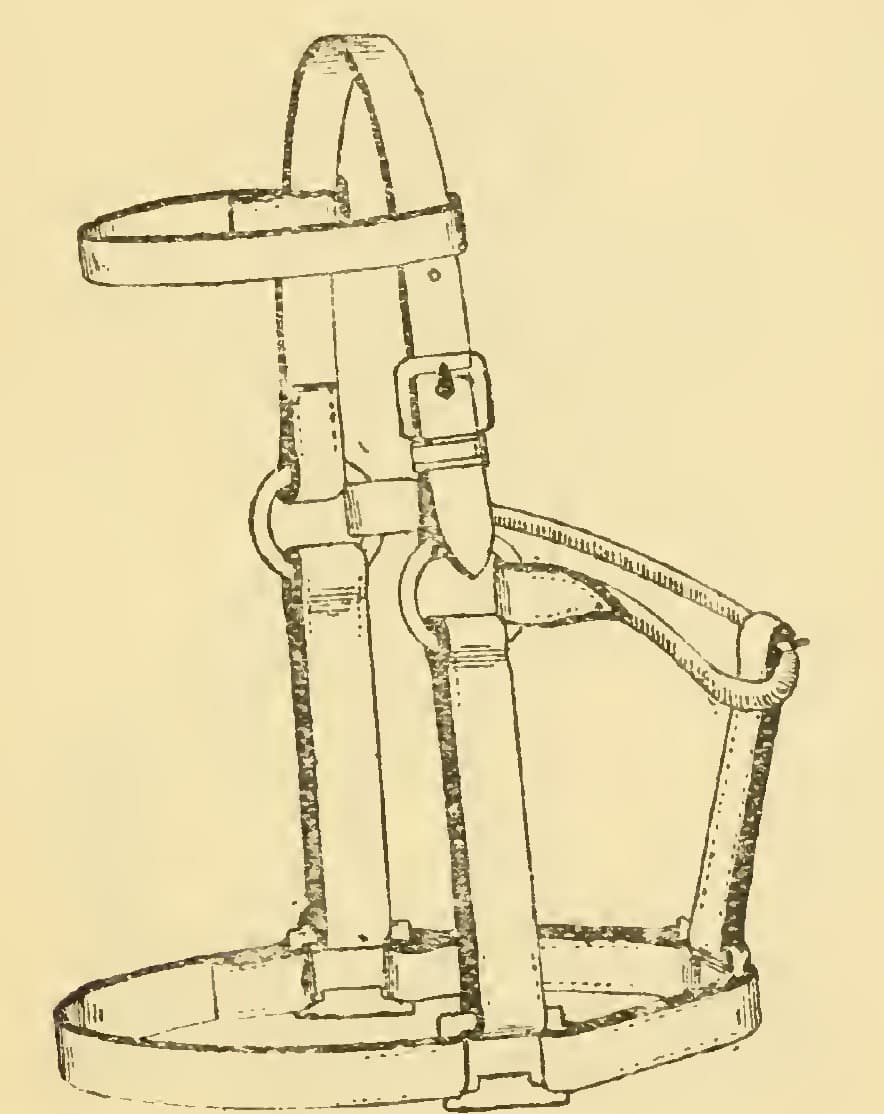
A knee-cap protects a horse's knee from knocks and falls. This one is from Paul N. Hasluck's Saddlery (1904): a leather block beaten into a cup, set on a cloth or leather shield, a flock-stuffed chamois roll along the top strap, and a strap below the knee. Every size is his.
He notes it is often better to buy the pads, but shows how to make them.
Średniozaawansowany
About 1 day
Instrukcje
1
1
Cutting list
Cutting list
Wczytywanie notatnika Jupyter…
2
2
Read Saddlery, ch. X
Read Saddlery, ch. X
"Knee-caps are of felt, fawn rugging, kersey cloth, union, buff leather, black rubber, etc."
3
3
Beat the knee block
Beat the knee block
With no press, damp some half-curried leather and beat it, as a shoemaker beats boot soles, until it takes a hollow cup shape. Let it dry, then cut it to a wide oval about 5 in by 4 in.
Materiały do tego kroku:
 Skóra garbowana roślinnie1 sztuka
 Woda słodka1 sztuka
Potrzebne narzędzia:
 Młotek
 Żelazo na kolana
 Nóż do skóry
4
4
Cut and bind the shield
Cut and bind the shield
Make the cloth, kersey or leather about 8 in at the top and 9 in deep, and round the bottom. Bind all of it except the straight top with patent binding or cloth; buff leather need not be bound.
Materiały do tego kroku:
 Arkusz filcu wełnianego1 sztuka
 Pasek obszycia krawędzi1 sztuka
 Nić lniana1 sztuka
 Wosk pszczeli1 sztuka
Potrzebne narzędzia:
 Nożyczki
 Miara zwijana
 Szydło
 Dwie igły rymarskie
5
5
Fit the block
Fit the block
Put the leather block on the centre with a piece of shaped cardboard under it, paste the two together and press the cloth down into the hollow. Stitch the block to the cloth about 1-1/4 in from the top and 1-1/2 in from the bottom.
Materiały do tego kroku:
 Tektura klejona1 sztuka
 Klej pszenny1 sztukaNić lniana1 sztukaWosk pszczeli1 sztuka
Potrzebne narzędzia:
Nóż do skórySzydłoDwie igły rymarskie6
6
Make the top strap
Make the top strap
Cut a piece of leather 1-1/8 in wide and 1 in longer at each end than the cloth at the top. Make a hole at each end 1 in from the point for a 5/8 in strap. Put a chape, buckle and loop in the hole at one end and a 5/8 in strap 9 in long in the other, and stitch both firmly.
Materiały do tego kroku:
 Skóra uprzężowa1 sztuka
 Klamra mosiężna z kolcem1 sztukaNić lniana1 sztukaWosk pszczeli1 sztuka
Potrzebne narzędzia:
Nóż do skóry Dziurkacz do skórySzydłoDwie igły rymarskie
7
7
Make the padded roll
Make the padded roll
Cut chamois the same length and width as the strap. With it hanging down in front of the knee-cap and the three edges together, stitch it all along through the top leather and the cloth. Turn the chamois over the top towards the bottom and stitch it along the bottom side of the top strap, rather slack. Make two rows of stitches across the centre, leaving an opening of about 1-1/2 in exactly in the centre. Stuff both parts of the roll from each end with flock, then close the ends by stitching chamois and top leather together.
Materiały do tego kroku:
 Ircha1 sztuka
 Wypełnienie wełniane1 sztukaNić lniana1 sztukaWosk pszczeli1 sztuka
Potrzebne narzędzia:
NożyczkiSzydłoDwie igły rymarskie8
8
Fit the bottom strap
Fit the bottom strap
Put a 5/8 in chape buckle and loop at the bottom of the block pad, slanting slightly downwards, with a strap 10 in long on the opposite side. For a pair, reverse the buckles so each is on the outside.
Materiały do tego kroku:
Skóra uprzężowa1 sztukaKlamra mosiężna z kolcem1 sztukaNić lniana1 sztukaWosk pszczeli1 sztukaPotrzebne narzędzia:
Nóż do skórySzydłoDwie igły rymarskie9
9
Troubleshooting
Troubleshooting
Knee-cap troubleshooting.
Flow
Loading...
10
10
History and honest limits
History and honest limits
From **Saddlery**, edited by Paul N. Hasluck, David McKay, 1904 (archive.org saddlery00hasl), chapter X, "Knee-caps and Miscellaneous Articles", pp. 81-84, Figs. 33-35; every fraction was read on the scan. He also suggests a better block cut with a tongue up under the top strap, and a fastening with two squares and a 5/8 in rubber ring; those are not shown here. The thread, the tools and the metric figures are ours.
Materiały
12- 1 sztukaZastępnik
- 1 sztukaZastępnik
- 1 sztukaZastępnik
- 1 sztukaZastępnik
- 5 sztukZastępnik
- 5 sztukZastępnik
- 1 sztukaZastępnik
- 1 sztukaZastępnik
- 2 sztukZastępnik
- 1 sztukaZastępnik
- 1 sztukaZastępnik
- 1 sztukaZastępnik
Według tego planu powstaje
Powiązane blueprinty
Te blueprinty dzielą się wiedzą — technikami, materiałami lub zasadami
CC0 Domena publiczna
Ten plan jest udostępniany na licencji CC0. Możesz go swobodnie kopiować, modyfikować, rozpowszechniać i wykorzystywać do dowolnych celów, bez konieczności uzyskiwania zgody.
Wesprzyj Makera kupując produkty przez jego plan, za co zarabia Prowizja Makera ustalony przez sprzedawców, lub stwórz nową iterację tego planu i dołącz go jako połączenie w swoim własnym planie, aby dzielić się przychodami.