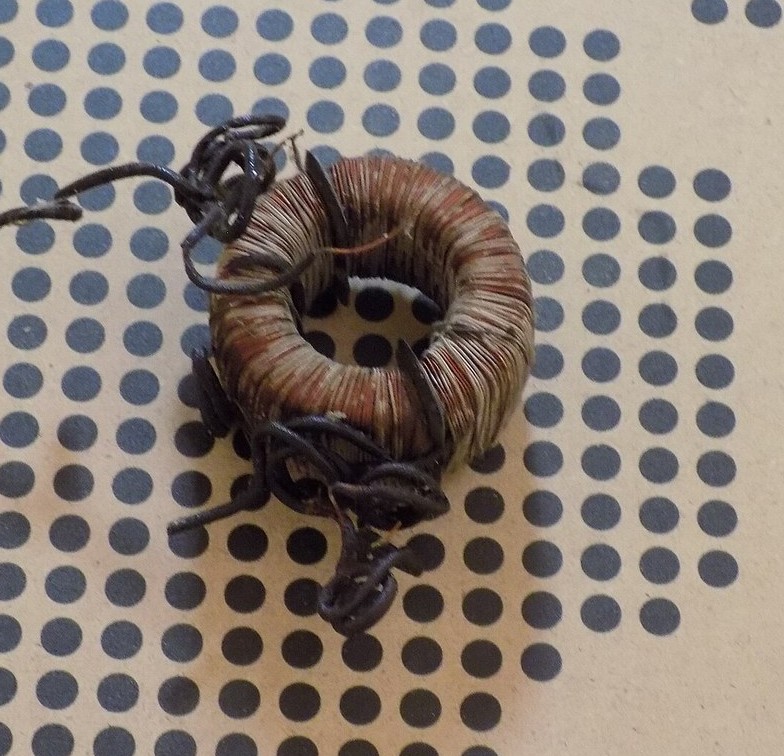


The Loading Coil
The submarine cable blueprint ends on a defeat: a long line smears its pulses, and shouting louder does not help. Telephony inherited the same wall. Speech carries a whole band of frequencies, a long line delays and attenuates each of them differently, and what arrives is not quiet — it is unintelligible. Beyond a few hundred kilometres a telephone call turned to mush.
The instinct is to remove something: less resistance, less capacitance, better copper. The answer turned out to be to ADD something, which is why nobody found it by intuition.
A line has four properties per unit length — resistance, inductance, capacitance and leakage. Oliver Heaviside showed mathematically that distortion vanishes when they stand in a particular relation. Real cable has far too little inductance for that balance. So deliberately add inductance, in lumps, with coils inserted at regular intervals, until the line satisfies the condition.
The result is a line that attenuates all the speech frequencies nearly equally and delays them nearly equally. It is quieter than an unloaded line at low frequencies — you give up some loudness — and what you buy is that everything arrives in the same shape it left.
Fidelity bought by adding a component that makes the signal weaker. That is the whole idea, and it extended the telephone across a continent.
Instrukcje
Show that a long line treats frequencies differently
Show that a long line treats frequencies differently
Build an artificial line: a ladder of series resistors with capacitors to a common return, twenty sections or more. Drive it with a signal generator and measure the output amplitude across the audio range.
Expect low frequencies to pass well and high frequencies to be strongly attenuated.
Now measure the delay at several frequencies too.
Expect delay to vary with frequency.
Write down both faults separately, because they are different crimes: unequal amplitude changes the tone, unequal delay scrambles the shape. Speech survives the first and is destroyed by the second.
Materiały do tego kroku:
 Drut miedziany emaliowany50 m
 Zestaw oporników 1/4 W1 zestaw
Potrzebne narzędzia:
 Oscyloskop analogowy
 Multimetr analogowy
Hear the difference between quiet and unintelligible
Hear the difference between quiet and unintelligible
Send speech through the artificial line and listen. Then send speech through a simple attenuator that reduces every frequency equally by the same overall amount, and listen again.
Expect the attenuated speech to be quiet but perfectly clear, and the line-distorted speech to be muffled and hard to follow at the same loudness.
This is the measurement that reframes the whole problem. The enemy is not loss. It is UNEQUAL loss and unequal delay. A telephone engineer who chases volume is solving the wrong equation, and for about twenty years the industry did exactly that.
Add inductance and watch the response flatten
Add inductance and watch the response flatten
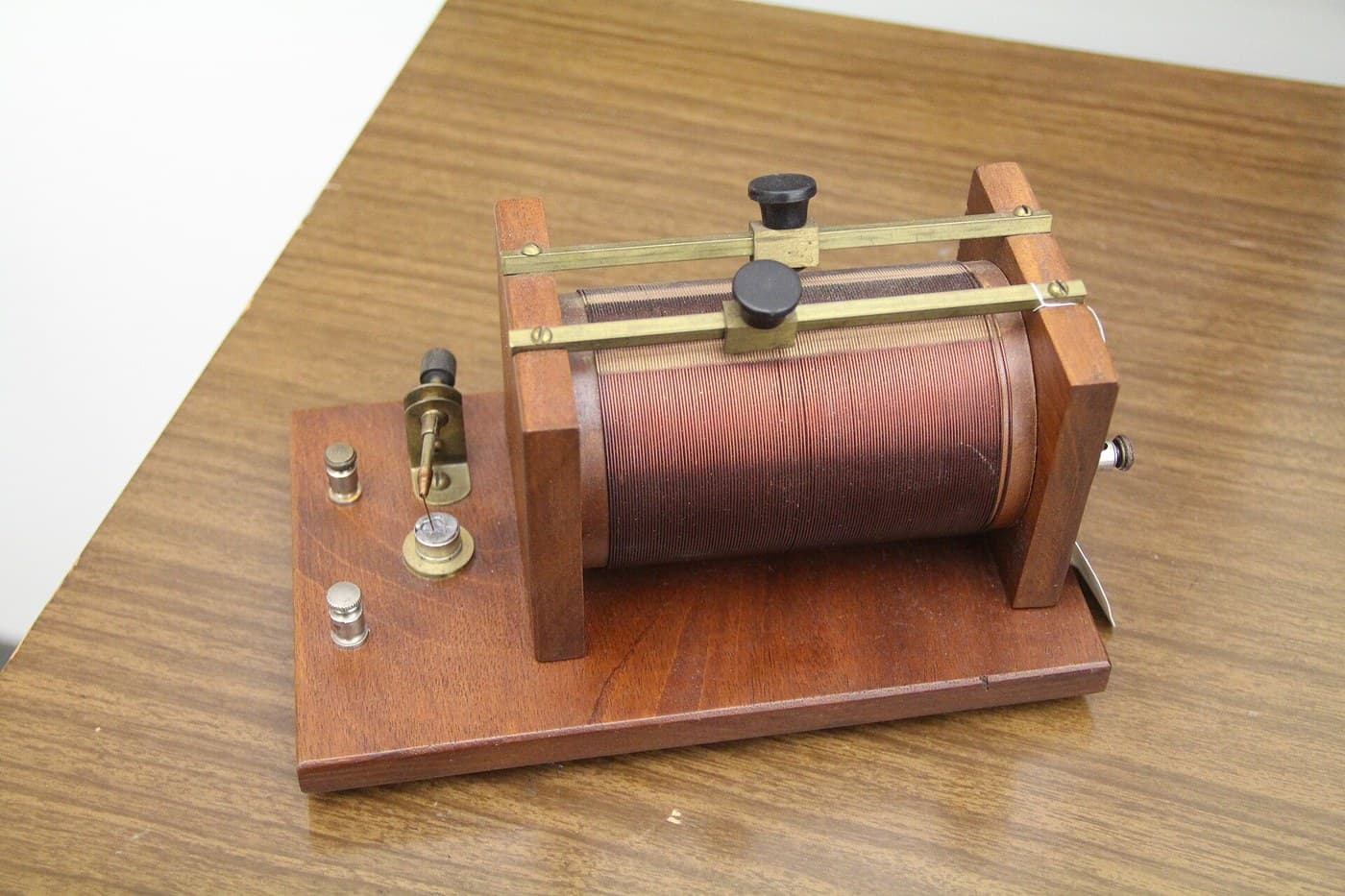
Wind identical coils and insert one in series at every section boundary of your ladder — every second section, then every section — and repeat the frequency sweep each time.
Expect the response to become markedly flatter across the speech band, and the delay to become much more nearly equal at all frequencies.
Also expect the overall level to drop.
Do not treat that drop as a failure. You have traded amplitude, which an amplifier can restore, for shape, which nothing available in 1900 could restore. Trade away the recoverable to protect the unrecoverable.
Find the cutoff you have just built
Find the cutoff you have just built
Keep sweeping upward, past the speech band, on the loaded line.
Expect to meet a frequency above which transmission collapses abruptly — a cutoff that the unloaded line did not have.
Now move the coils closer together and find the cutoff again.
Expect closer spacing to push the cutoff higher.
Lumped loading is an approximation to a continuously distributed property, and it behaves like the real thing only for wavelengths long compared with the coil spacing. Every sampled approximation has a frequency above which it stops being an approximation and starts being a filter — the same arithmetic as the scanning-line spacing in the Pantelegraph blueprint.
Measure what it bought in range
Measure what it bought in range
Take unloaded and loaded lines of the same construction and extend each — more sections — until speech through it is no longer intelligible to a listener who does not know the sentences.
Record the length at which each fails.
Expect the loaded line to remain usable much further, despite being quieter at every length.
That is the entire commercial case, and it is a strange one to have to argue: we will make your line weaker, and it will reach further. Intelligibility, not amplitude, is the quantity the customer is actually buying.
History & Context
History & Context
The mathematics came first, and its author got the least. Oliver Heaviside analysed the transmission line in the 1880s and derived the condition under which a line is distortionless, showing that most real lines have far too little inductance and that adding it would help. He was a self-taught recluse who published in obscure places and was largely ignored by the telephone industry of his day. The Heaviside condition is the whole physics of this blueprint, and he made no money from it.
Two people then turned it into hardware, and fought. Michael Pupin filed on 14 December 1899 and was granted US 652,230, 'Art of reducing attenuation of electrical waves and apparatus therefor', on 19 June 1900. George Campbell, working at AT&T, filed on 5 March 1900 — later — though his experimental and theoretical work appears to have been earlier. An interference proceeding began in August 1900; the Patent Office ruled in Pupin's favour in 1904. AT&T, needing certainty more than it needed to be right, bought rights to Pupin's patent so that it controlled both.
The effect on the map was immediate. Loading extended practical telephone range several-fold and made long-distance service commercially possible years before the vacuum-tube repeater existed. New York to Denver ran on loaded lines. When the tube repeater did arrive it complemented loading rather than replacing it, and loading coils stayed on subscriber lines for most of the twentieth century.
Then the same coils became an obstacle. A loaded line is superb for speech and has a hard cutoff just above it — which is precisely the wrong shape for a digital subscriber line trying to use the megahertz above the voice band. Late-twentieth-century broadband rollouts spent real money finding and REMOVING loading coils installed by earlier engineers who had optimised, correctly, for a different service. An optimisation is an assumption about what the channel is for, and assumptions expire.
Honest limits. It reduces overall level, so it needs amplification to be useful at length. It imposes a cutoff frequency, so the line becomes unsuitable for anything wideband. The coils must be installed at accurate intervals along a physical route, which is expensive and permanent. Loading suits one service and obstructs another. And the whole scheme is a fix for a property of copper pairs — it has no descendant in fibre, where the problem it solves does not arise.
Materiały
2- Zastępnik
- 1 zestawZastępnik
Wymagane narzędzia
2- Zastępnik
- Zastępnik
Materiały z połączonych planów


Powiązane blueprinty
Te blueprinty dzielą się wiedzą — technikami, materiałami lub zasadami

CC0 Domena publiczna
Ten plan jest udostępniany na licencji CC0. Możesz go swobodnie kopiować, modyfikować, rozpowszechniać i wykorzystywać do dowolnych celów, bez konieczności uzyskiwania zgody.
Wesprzyj Makera kupując produkty przez jego plan, za co zarabia Prowizja Makera ustalony przez sprzedawców, lub stwórz nową iterację tego planu i dołącz go jako połączenie w swoim własnym planie, aby dzielić się przychodami.