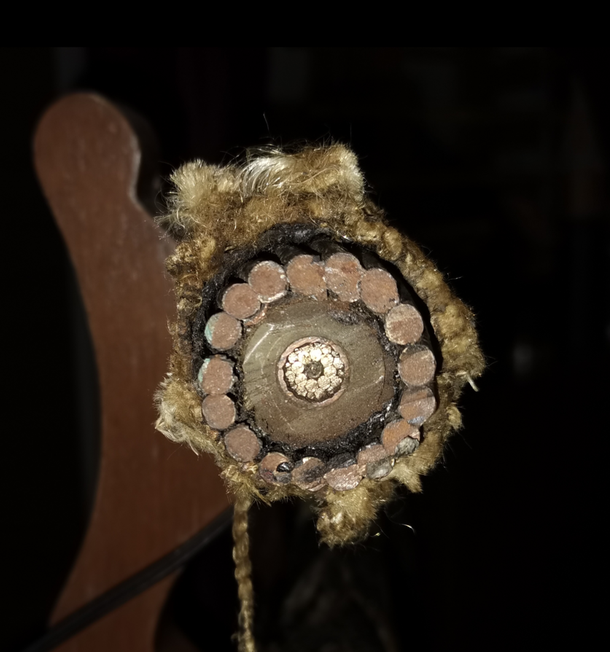


The Submarine Telegraph Cable
Laying a wire across an ocean sounds like a problem of ships and money. It is really a problem of two materials and one piece of physics that nobody expected.
The insulation. Rubber perishes and gutta-percha does not — a latex from a Malayan tree that is hard at ordinary temperatures, softens in hot water so it can be moulded round a conductor, and then stays put for decades in cold salt water. Almost no other material available in 1850 would do it, and the whole enterprise waited on a tree.
The armour. A cable must survive being paid out of a moving ship into four kilometres of water. It is not the sea that breaks it, it is the laying: the weight of the hanging length, and any snatch as the ship rolls. So the core is wrapped in iron wires that carry the tension, and the conductor carries only the signal.
Then the surprise. A long insulated conductor in conductive seawater is a capacitor — kilometres of it, distributed along the whole length. Send a sharp pulse and it does not arrive sharp; the capacitance has to charge through the wire's resistance, so the pulse arrives as a slow smeared hump. Send them faster and consecutive humps overlap into unreadability.
The line does not merely weaken the signal. It smears it in time — and that, not distance, is what sets how fast an ocean cable can talk.
Instrukcje
Find an insulator that survives cold salt water
Find an insulator that survives cold salt water
Coat identical wires with several candidate materials — wax, varnish, natural rubber, a thermoplastic — and leave them submerged in strong brine, checking leakage to the water with a meter every day for a week.
Expect most to fail progressively rather than suddenly: the reading creeps rather than jumps.
That creep is the honest signal. A cable does not stop working when its insulation fails; it gets quietly worse until it is useless, at a depth where nobody can look at it.
Test insulation by watching a number drift over time, never by a single pass/fail measurement.
Materiały do tego kroku:
 Drut miedziany emaliowany10 m
 Drut stalowy ocynkowany3 m
Potrzebne narzędzia:
 Multimetr analogowy
Let the armour take the load, not the conductor
Let the armour take the load, not the conductor
Make two specimens: an insulated wire alone, and the same wire with several steel wires laid helically around it. Hang increasing weight from each until failure.
Expect the armoured one to carry far more, and — more importantly — expect the plain one's conductor to stretch and thin before it breaks.
Then measure resistance under load. A stretched conductor's resistance rises before anything visibly fails.
This is the design rule: separate the member that carries force from the member that carries signal. The same reasoning puts a steel core in an overhead power line and aramid yarn in a fibre-optic cable.
Discover that the cable is a capacitor
Discover that the cable is a capacitor
Submerge a long insulated wire in brine, with the water as the second electrode, and measure the capacitance between wire and water. Then repeat with twice the length.
Expect capacitance to be proportional to length, and to be surprisingly large.
Now charge it and disconnect it, and find that it holds charge.
Say what the cable now is: not a wire, but a resistance and a capacitance smeared along every metre. Nobody designed that in. It is an unavoidable consequence of putting a conductor near a conductive ocean, and it is the thing that nearly killed the enterprise.
Watch a square pulse arrive as a hump
Watch a square pulse arrive as a hump
Send a short square pulse into your submerged line and observe the far end on an oscilloscope.
Expect it to emerge rounded, delayed and spread out — and expect the spreading to grow sharply with length.
Now send pulses faster and faster until consecutive ones merge into an unreadable ripple. Record that rate.
That figure is the cable's speed limit, and note what sets it: not attenuation, but dispersion in time. A signal you can still detect but can no longer tell apart from its neighbour is just as lost as one that never arrived.
Recover the message by detecting sensitively instead of shouting
Recover the message by detecting sensitively instead of shouting
Take the smeared output and try two approaches. First, raise the sending voltage. Second, leave the voltage low and detect with the most sensitive instrument you have.
Expect raising the voltage to help hardly at all — a bigger hump is still a hump, and it still overlaps its neighbour — while sensitive detection lets you read a much weaker but still distinct signal.
This is the counter-intuitive lesson the first Atlantic cable had to learn the hard way. When the problem is smearing, power is the wrong lever. Detect gently, slow down, and shape what you send.
History & Context
History & Context
The first Atlantic cable worked for three weeks and then died — of impatience. The 1858 cable carried messages between Britain and North America and then failed. The immediate cause was the use of very high voltage from an induction coil in an attempt to force a readable signal through, which broke down insulation already damaged by rough handling. The engineering error and the conceptual error were the same one: treating a smearing problem as a weakness problem.
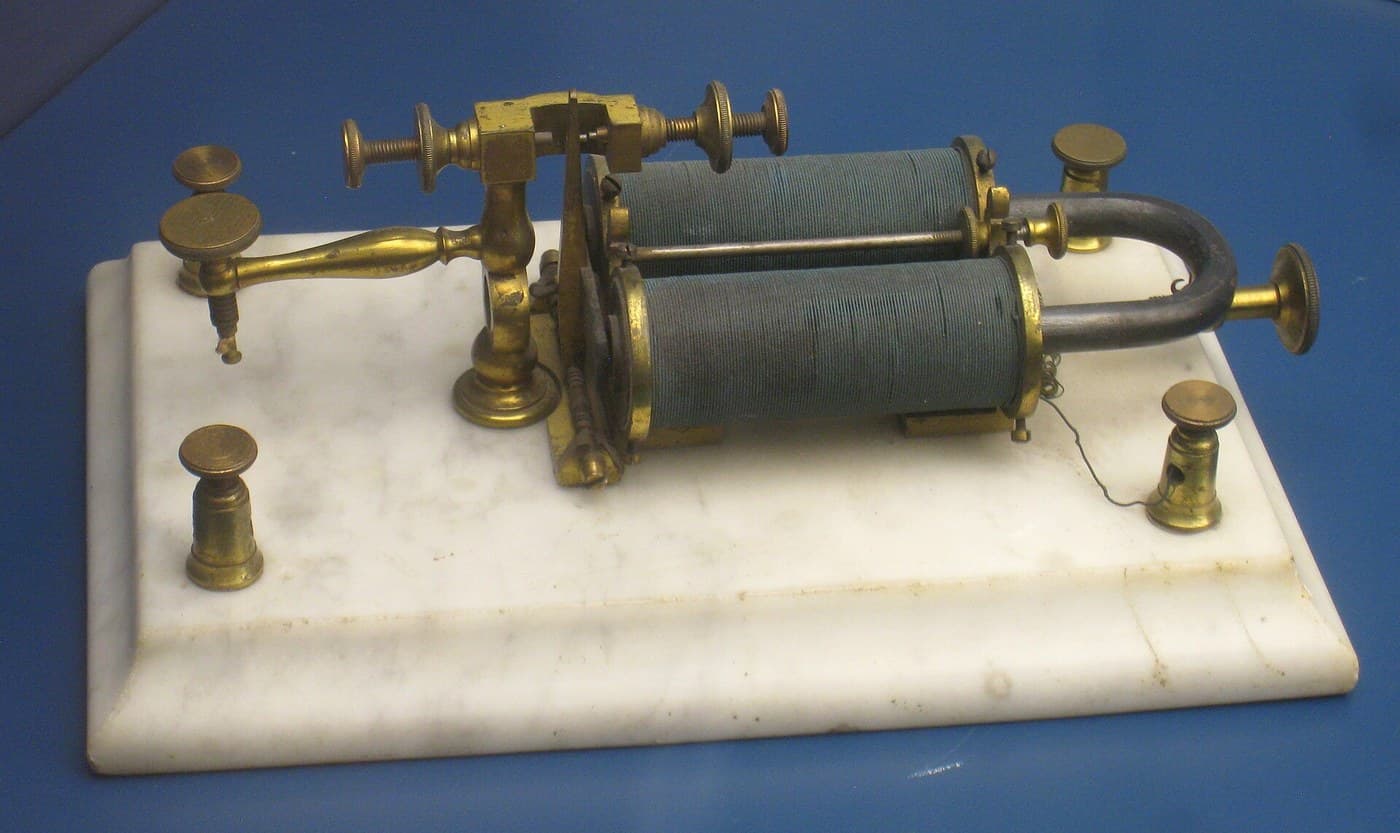
William Thomson — later Lord Kelvin — supplied both the theory and the instrument. His analysis of the cable as distributed resistance and capacitance predicted that signalling rate falls with the SQUARE of length, which told everyone that a longer cable must be run slower, not louder. His mirror galvanometer, which threw a spot of light from a tiny mirror on a suspended magnet, could read currents far too small for any mechanical instrument. The permanently successful cable was laid in 1866 by the Great Eastern, and the 1865 cable, lost mid-ocean the year before, was grappled up and completed too.
A tree was a strategic material. Gutta-percha came from a small number of species in southeast Asia, was harvested destructively, and by the end of the century the stands were severely depleted. An entire global communications system rested on a botanical supply chain — the same shape of dependency as rubber for tyres, or particular minerals for batteries now. Ask what the irreplaceable material is; that is usually where the fragility lives.
It changed what 'news' meant. Before 1866 a message to America travelled at the speed of a ship, roughly ten days. After, it was minutes. Markets on two continents began to move together, diplomacy stopped being conducted by ambassadors with weeks of discretion, and the phrase 'the world got smaller' was coined about this and not about aviation. The Loading Coil blueprint is the sequel: the smearing found here is exactly what Heaviside's mathematics and Pupin's coils later learned to cancel.
Honest limits. Very low data rate — the early Atlantic cables managed a handful of words per minute. Enormously expensive to make, lay and repair, and a fault is somewhere under kilometres of water. Gutta-percha is a natural product of variable quality and finite supply. The line is a shared single channel, so its capacity is a hard political and commercial constraint, not just a technical one. And nothing about it is repairable by the user in any sense — this is the first communications technology that only a nation or a consortium could own.
Materiały
6- Zastępnik
- Zastępnik
- 1 arkuszZastępnik
- 5 litrówZastępnik
- 1 butelkaZastępnik
- Zastępnik
Wymagane narzędzia
2- Zastępnik
- Zastępnik
Materiały z połączonych planów
Powiązane blueprinty
Te blueprinty dzielą się wiedzą — technikami, materiałami lub zasadami

CC0 Domena publiczna
Ten plan jest udostępniany na licencji CC0. Możesz go swobodnie kopiować, modyfikować, rozpowszechniać i wykorzystywać do dowolnych celów, bez konieczności uzyskiwania zgody.
Wesprzyj Makera kupując produkty przez jego plan, za co zarabia Prowizja Makera ustalony przez sprzedawców, lub stwórz nową iterację tego planu i dołącz go jako połączenie w swoim własnym planie, aby dzielić się przychodami.