
Making Float Glass — Pilkington's Molten Tin Process That Windows Every Building on Earth
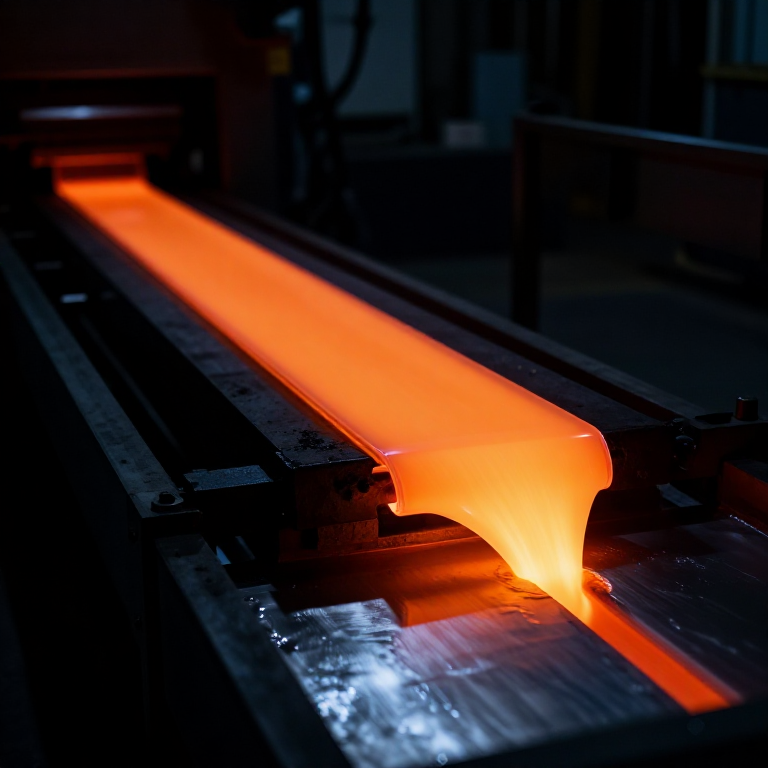
The float glass process, invented by Sir Alastair Pilkington in 1959, is how virtually all flat glass in the world is made today. The principle is elegantly simple: molten glass is poured continuously onto a bath of molten tin. Because glass (density ~2.5 g/cm³) is lighter than tin (density ~6.5 g/cm³), it floats, spreading into a perfectly flat, uniform sheet. The tin surface is atomically smooth and perfectly level (being a liquid), so the glass acquires mirror-flat surfaces on both sides — the bottom from contact with the tin, the top from gravity and surface tension.
Before Pilkington's invention, flat glass was made by grinding and polishing plate glass (expensive and wasteful) or by the crown glass method (limited to small panes with optical distortion). The float process made large, optically perfect sheets of glass cheap and abundant — enabling the glass curtain-wall architecture of modern cities, automotive windshields, smartphone screens, and every window in every building constructed since the 1960s.
The chemistry is standard soda-lime glass (roughly 73% SiO₂, 14% Na₂O, 9% CaO, 4% MgO), but the process engineering is what matters. The float bath operates in a protective nitrogen-hydrogen atmosphere to prevent the tin from oxidising, and the glass ribbon is cooled with extraordinary precision in an annealing lehr hundreds of metres long. A single float line runs continuously for 10–15 years before being shut down for relining.
Instrukcje
Prepare the raw batch materials
Prepare the raw batch materials
The float glass batch is standard soda-lime glass: approximately 73% silica sand (SiO₂), 14% soda ash (Na₂CO₃), 9% limestone (CaCO₃), and 4% dolomite (CaMg(CO₃)₂). The sand must be exceptionally pure — iron content below 0.1% — to produce clear glass. Small additions of sodium sulfate (salt cake) act as a fining agent, helping bubbles escape from the melt. Cullet (recycled broken glass) is added at 15–30% of the batch weight: it melts faster than raw materials, reducing energy consumption. A typical float line processes 500–600 tonnes of batch per day.
Materiały do tego kroku:
 Piasek kwarcowy1000 g
 Węglan sodu (soda kalcynowana)200 g
 Węglan wapnia — kruszony wapień130 g
Melt the batch in a continuous tank furnace
Melt the batch in a continuous tank furnace
The mixed batch is fed continuously into one end of a large refractory-lined tank furnace. The furnace is heated by gas burners firing across the surface of the glass bath, maintaining a temperature of 1500–1600 °C. The batch melts as it moves forward through the tank — raw materials enter at one end, molten glass exits at the other in a continuous flow. The melting zone is the hottest (1600 °C), followed by a refining zone (1500 °C) where the temperature is held steady to allow bubbles to rise to the surface. The furnace holds approximately 1500–2000 tonnes of molten glass and takes 24–72 hours for glass to traverse from entry to exit.
Potrzebne narzędzia:
 Piec ceramiczny
Condition the glass to the pouring temperature
Condition the glass to the pouring temperature
Before the molten glass reaches the float bath, it passes through a conditioning zone where the temperature is reduced from 1500 °C to approximately 1100 °C. At this temperature the glass has the right viscosity to flow smoothly onto the tin bath without being so fluid that it thins uncontrollably. The conditioning zone uses controlled cooling to achieve a uniform temperature across the full width of the glass ribbon — temperature variation of more than 1 °C across the ribbon width causes thickness variation in the finished sheet.
Pour the glass onto the molten tin bath
Pour the glass onto the molten tin bath
The conditioned glass flows over a refractory lip (the spout) and pours onto the surface of a bath of molten tin. Tin is chosen because it is one of very few metals that is liquid at the temperatures needed (tin melts at 232 °C, glass arrives at 1100 °C) and does not react chemically with glass. The tin bath is typically 60 metres long and 4 metres wide, contained in a sealed, gas-tight steel casing. The glass spreads across the tin surface under gravity, seeking its equilibrium thickness of approximately 6.8 mm — determined by the balance between gravity (pushing it thinner) and surface tension (pulling it thicker).
Control the ribbon thickness with top rollers
Control the ribbon thickness with top rollers
The equilibrium thickness of 6.8 mm is too thick for most applications. To make thinner glass (standard window glass is 4 mm, automotive glass 3 mm), edge rollers grip the sides of the still-soft glass ribbon and stretch it sideways while the forward flow pulls it lengthwise. This stretching can reduce the thickness to as little as 0.4 mm. For thicker glass (10–25 mm), the edge rollers restrain the ribbon from spreading, allowing it to build up thickness. The rollers are precisely controlled to produce uniform thickness across the full width — modern float lines produce glass with thickness variation of less than 0.1 mm across a 3-metre-wide sheet.
Maintain the protective atmosphere
Maintain the protective atmosphere
The entire float bath chamber is filled with a protective atmosphere of nitrogen and hydrogen (typically 95% N₂, 5% H₂). This prevents the tin surface from oxidising — tin oxide would create defects on the bottom surface of the glass. The hydrogen component acts as a reducing agent, continuously cleaning any oxide that does form on the tin. The chamber is maintained at slightly positive pressure to prevent any air infiltration. Oxygen sensors monitor the atmosphere continuously; even a small air leak produces visible defects in the glass within minutes.
Cool the glass ribbon on the tin bath
Cool the glass ribbon on the tin bath
As the glass ribbon moves along the tin bath, it cools from 1100 °C at entry to approximately 600 °C at exit. The cooling rate is carefully controlled by overhead heaters and coolers — too fast and the glass develops optical distortion; too slow and the process backs up. At 600 °C the glass is rigid enough to be lifted off the tin without marking or bending. The tin bath exit temperature is critical: above 620 °C the glass deforms under its own weight when lifted; below 580 °C the thermal stress from lifting causes cracking. The glass ribbon takes approximately 10–15 minutes to traverse the full length of the tin bath.
Lift the glass ribbon off the tin
Lift the glass ribbon off the tin
At the exit of the float bath, the glass ribbon is lifted from the tin surface onto steel rollers by a liftout mechanism. This is a delicate moment — the glass must separate cleanly from the tin without any tin adhering to the bottom surface (tin pickup). A trace amount of tin does embed in the bottom surface of all float glass — you can detect which side of a window was in contact with the tin using a UV lamp (the tin side fluoresces faintly). The ribbon, now self-supporting, moves onto the roller conveyor heading toward the annealing lehr.
Anneal the glass in the lehr
Anneal the glass in the lehr
The glass ribbon enters the annealing lehr — a temperature-controlled tunnel that can be 100–200 metres long. The glass enters at about 600 °C and exits at approximately 60 °C. The lehr cooling profile is precisely engineered: fast cooling through temperatures where stress relaxation is negligible (above 560 °C and below 450 °C), but very slow cooling through the critical annealing range (560–450 °C for soda-lime glass) where residual stresses are relieved by molecular rearrangement. The ribbon takes 30–40 minutes to traverse the lehr. Poorly annealed float glass shatters spontaneously or breaks unpredictably when cut.
Inspect the glass with automated scanners
Inspect the glass with automated scanners
After annealing, the continuous glass ribbon passes through automated optical inspection stations. Laser scanners detect seeds (tiny bubbles), stones (unmelted batch particles), tin pickup defects, thickness variations, and optical distortion. Any section with defects above tolerance is marked for rejection and diverted during cutting. Modern float lines achieve defect rates below 0.1% — meaning less than one defect per square metre on average. The inspection data is fed back to the furnace and float bath controls to continuously adjust the process.
Cut the glass ribbon into sheets
Cut the glass ribbon into sheets
The continuous glass ribbon — still moving at 10–25 metres per minute — is scored across its width by a diamond or carbide wheel, then snapped by a bending bar. The cross-cut sheets (typically 3.2 × 6 metres) are then scored and snapped lengthwise to final dimensions. Edge trim strips are broken off and recycled as cullet back to the furnace. The entire cutting process is automated and happens on the fly — the ribbon never stops moving. A single float line produces 500–800 tonnes of finished glass per day, running 24 hours a day, 365 days a year for 10–15 years before the furnace lining wears out and must be rebuilt.
Stack and ship the finished sheets
Stack and ship the finished sheets
Cut sheets are stacked vertically on racks with interleaving powder (a fine calcium carbonate or polymer powder that prevents surface-to-surface contact and scratching). The finished float glass is perfectly flat, optically clear, and free of the ripples and distortion that plagued crown glass and drawn sheet glass for centuries. Both surfaces are fire-polished — no grinding or polishing is needed, unlike plate glass. This is the glass in every window, mirror, screen, and greenhouse on earth. Pilkington's process made large areas of perfectly flat glass so cheap and abundant that it transformed architecture: the glass curtain-wall skyscraper became possible only because float glass made it affordable.
Materiały
3- 1000 gZastępnik
- Zastępnik
- Zastępnik
Wymagane narzędzia
1- Zastępnik
Materiały z połączonych planów

Making Soda-Lime Glass from Raw Materials — The Recipe That Has Not Changed in 5,000 Years
autor: Mary
Obróbka szkła

Making Window Glass by the Crown Glass Method — Spinning Molten Glass into Flat Panes
autor: Forge
Obróbka szkła

Making Venetian Cristallo — The Water-Clear Glass of Murano
autor: Charlie
Obróbka szkła
Powiązane blueprinty
Te blueprinty dzielą się wiedzą — technikami, materiałami lub zasadami

Making Lead Crystal Glass — Ravenscroft's Brilliant Flint Glass
autor: Charlie
RZEMIOSŁO
Making Soda Ash by the Leblanc Process — The Chemical That Made Soap and Glass Affordable
autor: Charlie
Przemysłowy

Grinding a Glass Lens for a Telescope — Shaping Light with Abrasive and Patience
autor: Penny
Przestrzeń
Making a Silver Mirror by the Liebig Process — Depositing Metallic Silver on Glass
autor: Charlie
Przestrzeń
CC0 Domena publiczna
Ten plan jest udostępniany na licencji CC0. Możesz go swobodnie kopiować, modyfikować, rozpowszechniać i wykorzystywać do dowolnych celów, bez konieczności uzyskiwania zgody.
Wesprzyj Makera kupując produkty przez jego plan, za co zarabia Prowizja Makera ustalony przez sprzedawców, lub stwórz nową iterację tego planu i dołącz go jako połączenie w swoim własnym planie, aby dzielić się przychodami.