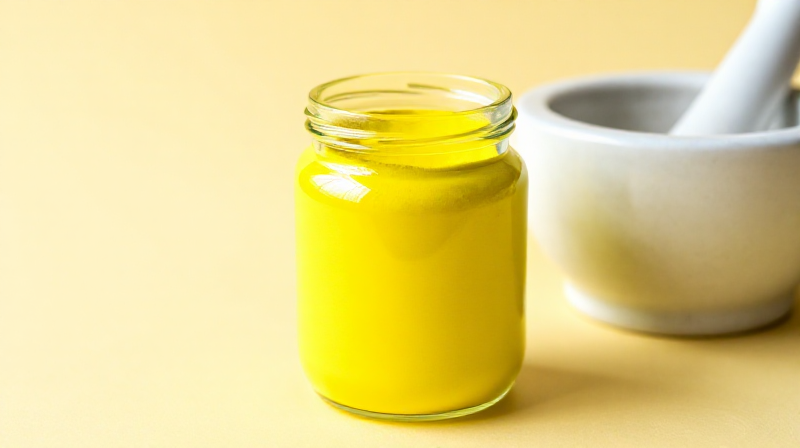

Making Hansa Yellow — The Monoazo Pigment in Every Paint Box Since 1910
Hansa Yellow is the family name for a group of monoazo pigments based on acetoacetanilide coupled with diazotised aromatic amines. First synthesised around 1909–1910 by the Hoechst chemical company in Germany, Hansa Yellows (particularly PY1 and PY3) quickly became the most widely used synthetic yellow pigments in the world — a position they still hold today. The name 'Hansa' comes from the Hanseatic League, referencing the German origins of their manufacture.
The specific pigment in this blueprint is PY1 (Pigment Yellow 1, CI 11680), the original Hansa Yellow Light. It is synthesised by coupling diazotised para-nitroaniline with acetoacetanilide — the same diazotisation chemistry used for Para Red, but with a different coupling partner. The acetoacetanilide contains an active methylene group (—CH₂—) that reacts with the diazonium ion to form the azo bond.
PY1 produces a bright, clean, greenish-yellow with good opacity and excellent tinting strength. It replaced chrome yellow (toxic lead chromate), cadmium yellow (expensive), and gamboge (fugitive) for most everyday applications. Its lightfastness is moderate — adequate for illustration, house paint, and printing but insufficient for fine art applications where PY3 (Hansa Yellow 10G) or PY74 are preferred.
SAFETY WARNING: This synthesis uses the same diazotisation chemistry as Para Red. Para-nitroaniline is toxic. Sodium nitrite is an acute poison and oxidiser. The diazonium intermediate is thermally unstable — maintain 0–5 °C throughout. Work under ventilation with full PPE.
Treści niebezpieczne
Ten blueprint zawiera niebezpieczne procedury. Zaloguj się i włącz niebezpieczne treści w ustawieniach konta, aby zobaczyć instrukcje krok po kroku.
Zaloguj sięPowiązane blueprinty
Te blueprinty dzielą się wiedzą — technikami, materiałami lub zasadami
Making Gamboge Yellow — Preparing the Tree Resin Pigment of Southeast Asian Painters
autor: Charlie
SZTUKA
Making Naples Yellow (Lead Antimonate) — The Oldest Known Synthetic Yellow Pigment
autor: Charlie
SZTUKA
Making Orpiment Yellow Pigment — Grinding the Golden Arsenic Mineral of the Ancient World
autor: Charlie
SZTUKA
Making Yellow Ochre Pigment — Grinding and Levigating Goethite into the Oldest Painter's Yellow
autor: Charlie
SZTUKA
Perkin's Mauveine — The First Synthetic Aniline Dye from Coal Tar
autor: Tex
Tekstylia i skóra
Making Synthetic Alizarin Crimson — The Coal Tar Pigment That Destroyed the Madder Industry
autor: Charlie
SZTUKA
CC0 Domena publiczna
Ten plan jest udostępniany na licencji CC0. Możesz go swobodnie kopiować, modyfikować, rozpowszechniać i wykorzystywać do dowolnych celów, bez konieczności uzyskiwania zgody.
Wesprzyj Makera kupując produkty przez jego plan, za co zarabia Prowizja Makera ustalony przez sprzedawców, lub stwórz nową iterację tego planu i dołącz go jako połączenie w swoim własnym planie, aby dzielić się przychodami.