SZTUKA
Piękno i dobre samopoczucie
RZEMIOSŁO
KULTURA I HISTORIA
ROZRYWKA
ŚRODOWISKO
JEDZENIE I NAPOJE
INŻYNIERIA ODWROTNA
NAUKI
LEKKOATLETYKA
TECHNOLOGIA
URZĄDZENIA DO NOSZENIA

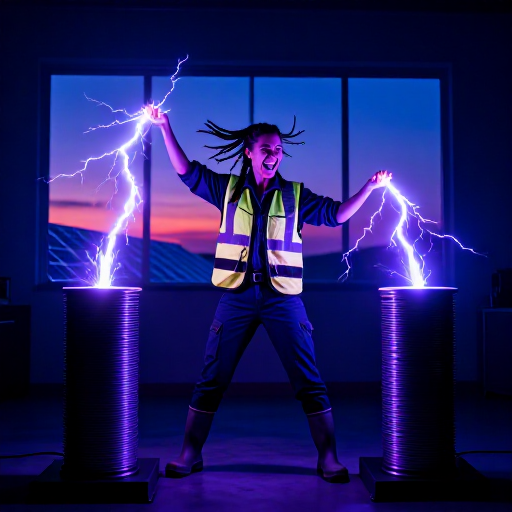

The Arc Lamp: Burning Carbons and Keeping the Gap
Two carbon rods, touched and drawn apart with a current flowing, make an arc of intense white light. The arc lamp lit streets, lighthouses and factories from the 1870s — but an arc burns its carbons away, and its gap must be kept right or it goes out.
Paul Jablochkoff's 'candle' of 1876–77 did away with any regulator: two carbons stand side by side, separated by a strip of insulating material, and burn down together like a candle. Charles Brush's lamps used a series electromagnet and a clutch to feed the upper carbon down as it burned; his 1879 patent adds two sets of carbons so one lamp could burn all night.
This rung works out why an arc needs a ballast and a regulator, from Hertha Ayrton's arc equation, and builds the regulator's feedback loop at 12 V. **Do not build an arc lamp** — its ultraviolet light burns eyes and skin.
Średniozaawansowany
About 2 hours
Instrukcje
1
1
Read the two patents
Read the two patents
**US 190,864, 'Improvement in Carbons for Electric Lights', Paul Jablochkoff, Paris, dated 15 May 1877.** The carbons are placed *"vertically and parallel"* at a short distance apart, the space filled with an insulating substance that burns away with them — the aim, in his words, the *"suppression of any mechanical regulator"*. In service the candles were run on alternating current, so that both carbons burned at the same rate.
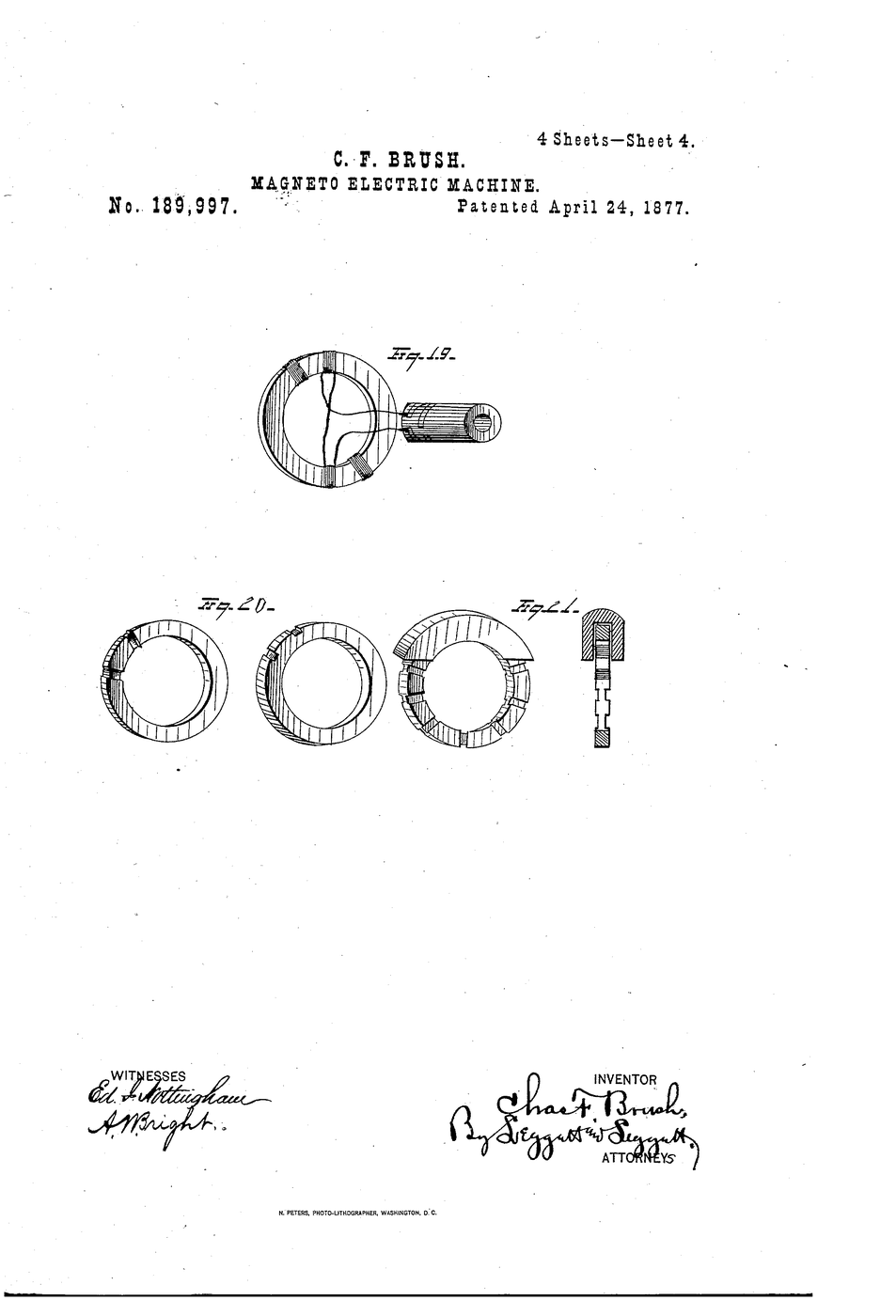
**US 219,208, 'Electric-Lamp', Charles F. Brush, Cleveland, Ohio, dated 2 September 1879.** A lamp *"having two or more sets of carbons"*, with a lifting device arranged so that *"the carbons of the two sets"* separate one after the other: when the first pair has burned away, the arc passes to the next, doubling the hours a lamp can burn without attention.
2
2
The regulator's cycle
The regulator's cycle
Przestrzeń Blockly
Loading Blockly workspace...
3
3
Why a ballast, and why a regulator
Why a ballast, and why a regulator
Wczytywanie notatnika Jupyter…
4
4
Build the regulator — without the arc
Build the regulator — without the arc
The regulator can be built and tested safely at 12 V with no arc at all. Mount a small push-pull solenoid vertically on a plywood stand, its plunger pointing down, and fix a short graphite rod (cut from a graphite block) to the bottom of the plunger. Below it, fix a second graphite rod to the base so the two just touch when the plunger hangs free — that is the lamp 'off'.
Wire the 12 V battery, a 10 W power resistor, the solenoid coil and the two rods all in SERIES. Close the circuit: current flows through the touching rods, the solenoid pulls the upper rod up, the contact opens, the current stops, the plunger drops and touches again. It buzzes: that is the regulator's feedback loop hunting, with nothing to hold it steady. Add a light spring or a small weight to the plunger and a drop of oil as a damper, and the buzzing slows and settles — the job Brush's clutch and dashpot did.
Keep it at 12 V. Do not try to draw an arc from mains or a welder: the light burns eyes.
Materiały do tego kroku:
 Elektromagnes liniowy1 sztuka
 Blok grafitowy1 sztuka
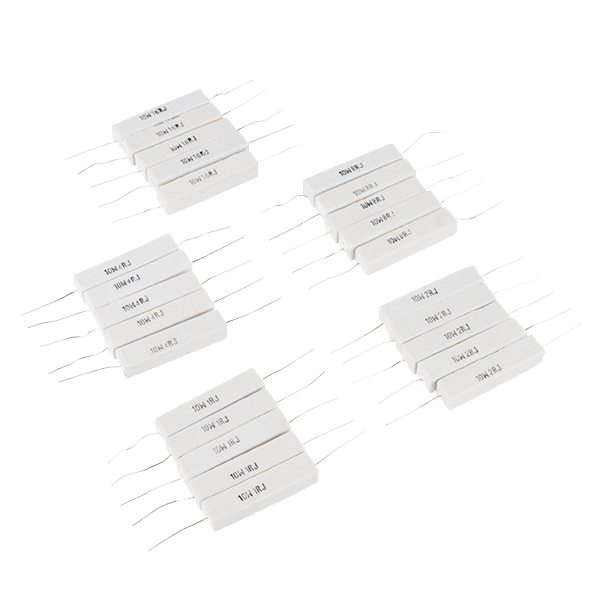 Power Resistor Kit - 10W (25 pack)1 opakowanie
 Płyta sklejkowa1 arkusz
 Przewody pomiarowe z krokodylkami1 zestaw
Potrzebne narzędzia:
 Akumulator głębokiego rozładowania 12 V
 Multimetr
 Okulary ochronne bezbarwne
5
5
History and context
History and context
Humphry Davy demonstrated the carbon arc early in the nineteenth century; it became practical only with the dynamo. Jablochkoff's candles lit the Avenue de l'Opéra in Paris in 1878, and Brush's series arc systems lit American city streets from 1879. **Hertha Ayrton**'s book *The Electric Arc* (1902) gave the equation the notebook uses.
**Honest limits.** Arc lamps are dazzling, hiss, flicker, need their carbons replaced daily and emit dangerous ultraviolet; they gave way to the incandescent lamp (the next rung) indoors and survived only where intense light was needed — searchlights, cinema projectors.
Materiały
5- od$4.97
- 1 sztukaZastępnik
- Power Resistor Kit - 10W (25 pack)10% prowizji1 opakowanie$5.64
- 1 arkuszZastępnik
- Zastępnik
Wymagane narzędzia
3- Akumulator głębokiego rozładowania 12 V10% prowizjiZastępnik
- Zastępnik
- Zastępnik
Szacowany koszt
To, co kupił twórca. Materiały bez ceny kupujesz tam, gdzie je znajdziesz.
Powiązane blueprinty
Te blueprinty dzielą się wiedzą — technikami, materiałami lub zasadami



CC0 Domena publiczna
Ten plan jest udostępniany na licencji CC0. Możesz go swobodnie kopiować, modyfikować, rozpowszechniać i wykorzystywać do dowolnych celów, bez konieczności uzyskiwania zgody.
Wesprzyj Makera kupując produkty przez jego plan, za co zarabia Prowizja Makera ustalony przez sprzedawców, lub stwórz nową iterację tego planu i dołącz go jako połączenie w swoim własnym planie, aby dzielić się przychodami.