Collaboration
ART
BEAUTY & WELLNESS
CRAFT
CULTURE & HISTORY
ENTERTAINMENT
ENVIRONMENT
FOOD & DRINKS
REVERSE ENGINEERING
SCIENCES
SPORTS
TECHNOLOGY
WEARABLES
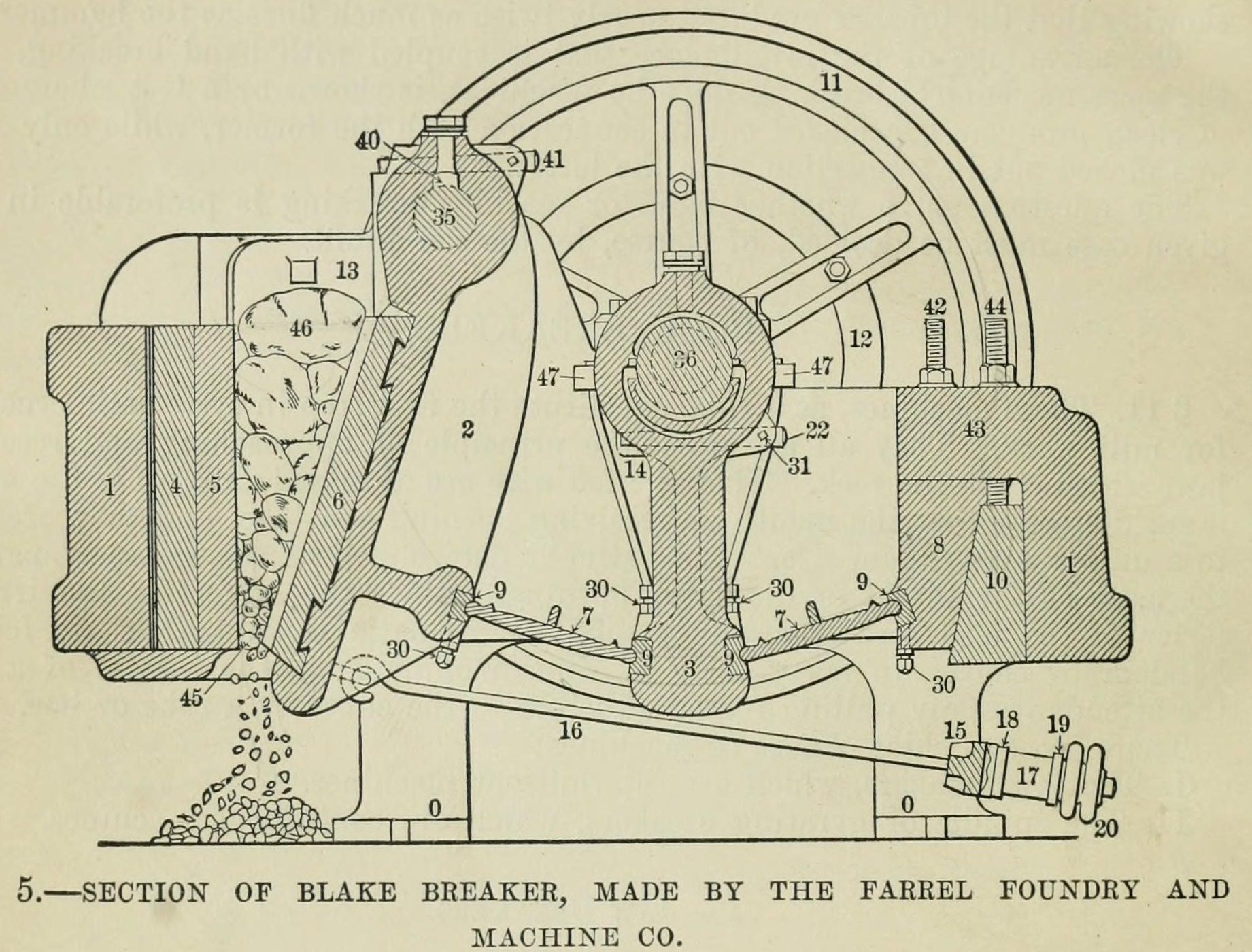


Blake Jaw Breaker: Eccentric, Pitman and Two Toggles Swing a Steel Jaw Against a Fixed Chilled Plate (Richards, Ore Dressing, 1903)
Eli Whitney Blake's jaw breaker (patented 1858), the standard first crusher of the ore mill, as Robert Richards described it: a ribbed cast frame on four legs, a fixed jaw bedded in zinc, a steel swing jaw hung from a shaft at the top, and an eccentric that lifts a pitman to straighten two toggles and push the jaw shut; rubber springs pull it back. A wedge sets the gap; a heavy flywheel carries it through each half-turn of crushing.
Advanced
Weeks (castings and machining)
Instructions
1
1
Sizes and power
Sizes and power
Loading Jupyter Notebook...
2
2
Read Richards
Read Richards
"As the eccentric lifts the pitman, it straightens out the toggles, lengthening the distance between their outer ends. This forces the swing jaw to approach the fixed jaw, crushing the rock."
3
3
Frame and fixed jaw
Frame and fixed jaw
Cast the frame of strong, ribbed cast iron or cast steel, with four legs bolted down, bearing boxes on top for the swing-jaw shaft and the eccentric shaft, and a horizontal web at the rear for the toggle block and wedge. Bed the fixed jaw against the frame end with 1/4 in. (6 mm) of zinc, and hold its jaw plate with two wedge-shaped cheek plates driven into recesses in the frame.
Materials for this step:
 Iron Castings1 piece
 Zinc Ingot1 piece
 Hex Bolt Assortment1 piece
Tools needed:
 Foundry Ladle
 Block and Tackle
 Hammer
4
4
Swing jaw
Swing jaw
Make the swing jaw of steel, fixed to its shaft by a gib and key bolt, with its jaw plate held by dovetails, a steel toggle bearing at the back and an eye near the bottom for the spring rod. Jaw plates: chilled cast iron with lengthwise 90° corrugations.
Materials for this step:
Iron Castings1 piece Steel Shaft1 piece
Tools needed:
 Metal Lathe
 Spanner Set
5
5
Pitman, toggles and wedge
Pitman, toggles and wedge
Hang a strong steel pitman from the eccentric shaft on babbitt bearings taken up by a key. Fit two toggles: one between the toggle block and the pitman, one between the pitman and the swing jaw, all four toggle bearings steel, held by set screws. Set the toggle block on its bolt against the wedge, which an adjusting bolt raises or lowers.
Materials for this step:
Steel Shaft1 piece Unknown Metal1 pieceIron Castings1 piece
Tools needed:
Metal LatheSpanner Set6
6
Springs, flywheel and drive
Springs, flywheel and drive
Fit two spring rods from the swing jaw through rubber springs held in compression against a spring bar. Key a heavy flywheel to the eccentric shaft and bolt the drive pulley to it; plug all oil holes against grit and shield the boxes and toggles with the half hopper. Drive it by belt (Table 5: 275 rev./min).
Materials for this step:
 Natural Rubber Sheet1 pieceIron Castings1 piece
 Pulley1 piece
 Drive Belt1 pieceHex Bolt Assortment1 piece
Tools needed:
Spanner SetMetal Lathe7
7
Run and adjust
Run and adjust
Feed rock by hand, shovel or chute into the mouth. As the jaw plates wear and the product gets coarse, raise the wedge by its nut; when that is used up, fit longer toggles that keep the pitman vertical; then turn the jaw plates end for end; last, fit new plates.
Tools needed:
Spanner Set8
8
Troubleshooting
Troubleshooting
Jaw breaker troubleshooting.
Flow
Loading...
9
9
History and honest limits
History and honest limits
From Robert H. Richards, *Ore Dressing* vol. I (1903), Chapter II, §§ 11-14, pp. 13-17, Figs. 5-8 and Table 5 (checked on the archive.org scan oredressing01richuoft; p. 15 from its text layer). Blake's first 1858 form gave the most movement at the mouth; he soon reversed it so the bottom of the jaw moves most. Richards describes a bought Farrel or Fraser & Chalmers machine: building it from castings and metric figures are ours, and the babbitt alloy has no head yet.
Materials
8- 1 piecePlaceholder
- 1 piecePlaceholder
- 2 piecesPlaceholder
- 1 piecePlaceholder
- 1 piecePlaceholder
- 1 piecePlaceholder
- 1 piecePlaceholder
- 1 piecePlaceholder
This blueprint makes
Related Blueprints
These blueprints share knowledge with this one — techniques, materials, or principles that connect them in the learning graph.
CC0 Public Domain
This blueprint is released under CC0. You are free to copy, modify, distribute, and use this work for any purpose, without asking permission.
Support the Maker by purchasing products through their Blueprint where they earn a Maker Commission set by Vendors, or create a new iteration of this Blueprint and include it as a connection in your own Blueprint to share revenue.