Collaboration
ART
BEAUTY & WELLNESS
CRAFT
CULTURE & HISTORY
ENTERTAINMENT
ENVIRONMENT
FOOD & DRINKS
REVERSE ENGINEERING
SCIENCES
SPORTS
TECHNOLOGY
WEARABLES
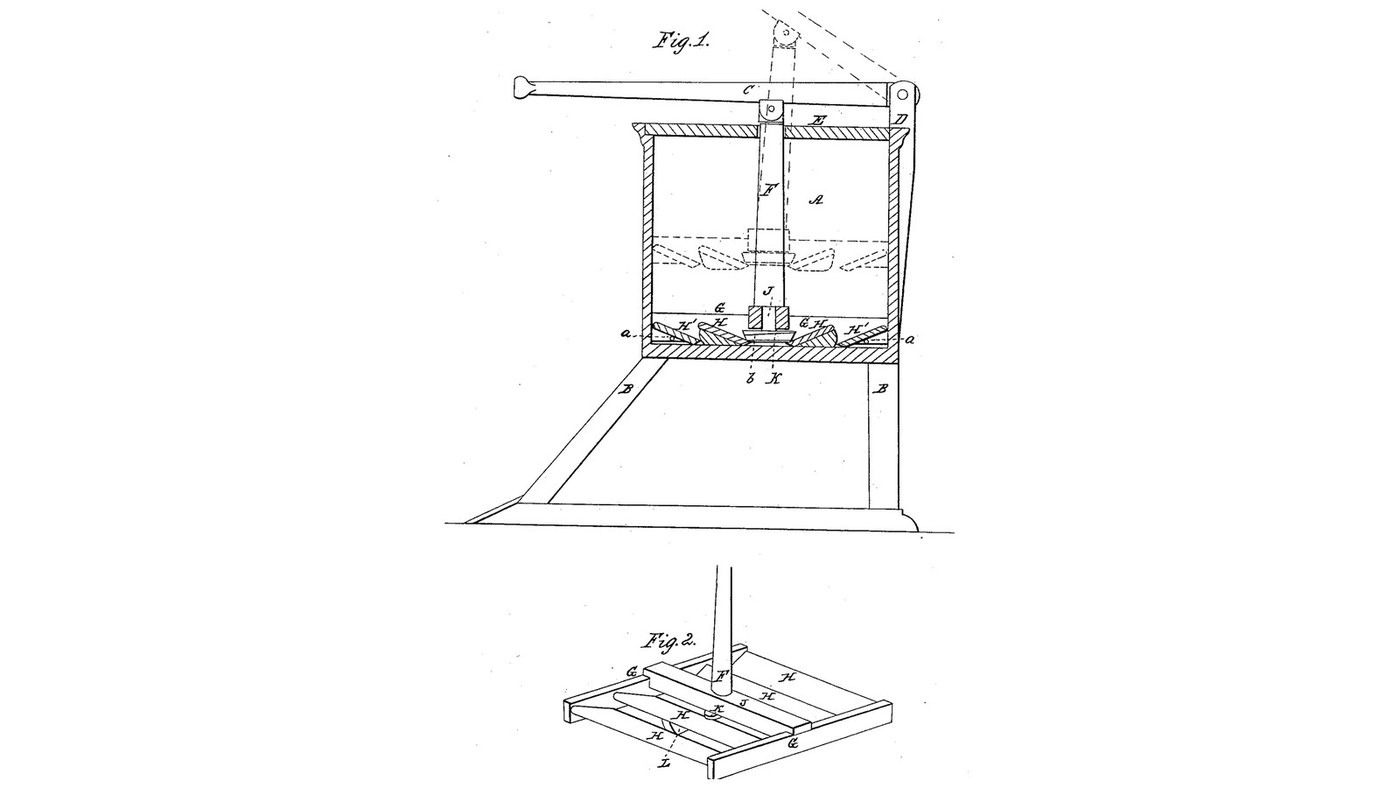

Button-Set Hinged-Slat Dasher Churn: Slats Deflect the Cream, a Button on the Rod Holds Them Open or Lets Them Shut
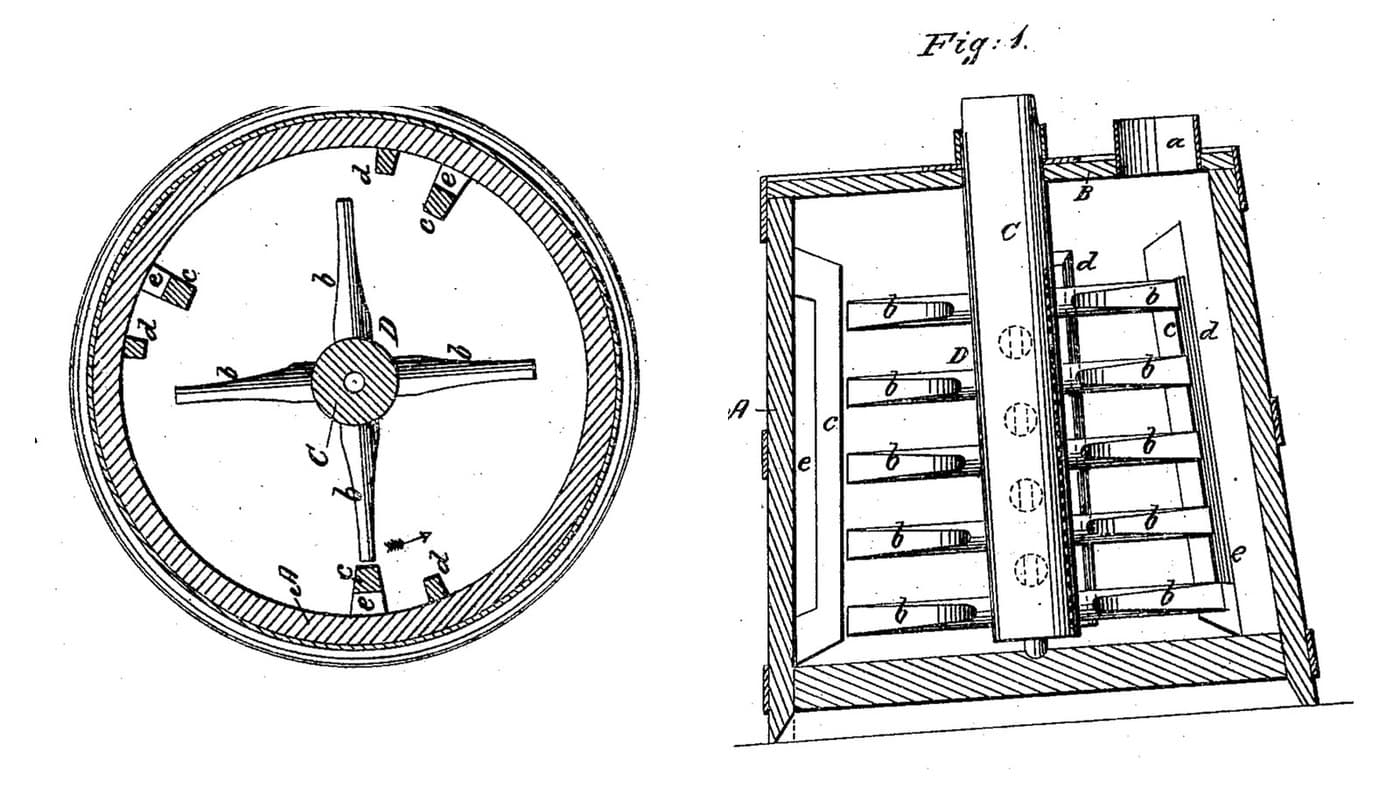
S. N. Campbell of Elgin, Illinois, received US 25,804, dated 18 October 1859, for a churn. A lever pivoted on a post works a dasher that fits the box closely. Its hinged slats hang open as deflectors: drawn up, the dasher throws the cream down and to the sides; pushed down, it forces the cream up towards a cross piece in the middle. A button with two inclined surfaces on the rod's foot holds the slats open, or, turned half round, lets them shut on the down stroke, to suit the cream.
The patent gives no sizes and does not say where the slats are hinged or how the button bears on them: those and every size here are ours.
Intermediate
About 2 days, plus printing
Instructions
1
1
The button: holding the slats open, or letting them shut
The button: holding the slats open, or letting them shut
Loading Jupyter Notebook...
2
2
An up-and-down dasher fitting a box closely, three weeks before
An up-and-down dasher fitting a box closely, three weeks before
Austin's middle dasher is a plain plate. Campbell's has hinged slats that deflect the cream, held open or let shut by a button on the rod.
3
3
Read US 25,804
Read US 25,804
"This dasher is constructed with movable slats H, H, which, when open, rest upon stop pins a, and serve the office of deflectors, and as the dasher is drawn up the cream is thrown below the slats and to the sides of the churn and as the dasher is pressed down the cream will be forced up and toward the center of the churn, and against a cross piece J, secured to the center of the dasher."
4
4
Print the button K
Print the button K
A disc 72 mm across and 6 mm thick with two inclined surfaces 60 mm long, one each side, both rising 7.5 mm towards the same end. PETG, 0.2 mm layers, 100 % infill.
5
5
Box A, stand B, post D, lid E and lever C
Box A, stand B, post D, lid E and lever C
From 20 mm hardwood make a box 400 x 300 mm and 380 mm deep inside, on four legs 50 mm square and 300 mm long. Screw a post 50 x 40 mm, 860 mm long, up the middle of the back. Cut a lid with a 32 mm hole in its middle. Bolt a lever 30 x 30 mm, 640 mm long, to the post's top so it reaches over the lid's middle to the front. Fill the box with water overnight so it swells tight, then empty it.
Materials for this step:
 Hardwood Board3 pieces
 Softwood Timber 70x70mm1 piece
 Wood Glue1 piece
 Wood Screws30 pieces
 Hex Bolt Assortment2 pieces
 Nylon Insert Lock Nut2 pieces
 Flat Washer4 pieces
Tools needed:
 Table Saw
 Hand Saw
 Cordless Drill
 Drill Bit Set
 Spade Bit Set
 Bar Clamp
 Try Square
 Tape Measure
 Water
 Adjustable Spanner
6
6
Dasher G and its slats
Dasher G and its slats
Make two end bars 296 x 40 x 20 mm and join them with the cross piece J, 396 x 40 x 30 mm, bored 31 mm in its middle. Cut two inner slats H 380 x 63 x 12 mm, each with a tab 20 x 9 mm on its inner edge 10 to 30 mm from the middle, and two outer slats H' 380 x 52 x 12 mm. Bore each along its length for a 6 mm stainless hinge pin, H 3 mm in from its inner edge and H' 4 mm in, and hang them between the end bars on pins 392 mm long, H 32 mm and H' 98 mm each side of the middle. Fix 6 mm stop pins, 20 mm long, into the end bars under the slats: 80 mm out and 27 mm below the hinges for H, 130 mm out and 21.5 mm below for H'. Glue posts 20 x 10 x 19 mm on the slats, 120 mm each side of the middle, 40 mm out from each hinge, and join each pair with a piece L 76 x 20 x 6 mm on pins.
Materials for this step:
Hardwood Board2 pieces Stainless Steel Rod2 piecesWood Glue1 piece
 Split Pin12 piecesFlat Washer12 pieces
Tools needed:
Table SawCordless DrillDrill Bit Set Hacksaw
 Files (Hand File)
 SandpaperTape MeasureBar Clamp
7
7
Rod F and button K
Rod F and button K
Turn a hardwood rod F 30 mm across and 440 mm long, with a cross handle at its top to turn it. Pass it down through J and glue the button on its foot, below J, so that in one position its inclined surfaces lie under the slats' tabs and hold the slats open on their pins. Join its top to the lever with a pin in a slot. Set the dasher in the box and the lid on.
Materials for this step:
 Hardwood Dowels1 pieceWood Glue1 pieceStainless Steel Rod1 pieceSplit Pin2 pieces
 PETG Filament1 piece
Tools needed:
 FDM 3D PrinterCordless DrillDrill Bit SetHacksaw
8
8
The build in 3D
The build in 3D
FreeCAD model of this build, one side and one end left off: the box on its stand, the post and lever, the rod, and the dasher with the cross piece J, the hinged slats H and H' on their stop pins, the pieces L and the button K under the tabs. Checked at three heights, with the slats held open and with them shut.
9
9
Churn
Churn
Pour about 20 litres of heavy cream at about 15 °C into the box, checked with the thermometer, and put the lid on. Work the lever up and down, timing it. For thin cream keep the button holding the slats open; if the cream thickens, turn the rod half round so the slats shut on each down stroke. When the butter comes, lift the dasher out, drain the buttermilk, wash the butter in cold water until it runs clear, salt and weigh it.
Materials for this step:
 Heavy Cream20 l
 Coarse Sea Salt1 pieceWater1 piece
Tools needed:
 Leave-In Probe Thermometer
 Stopwatch
 Digital Kitchen Scale
 Stainless Steel Mixing Bowl (Large)
10
10
Troubleshooting
Troubleshooting
Hinged-slat dasher troubleshooting.
Flow
Loading...
11
11
History and honest limits
History and honest limits
**S. N. Campbell** of Elgin, Kane County, Illinois, US 25,804, 18 October 1859, "Churn". He claimed "the arrangement and combination of the button K, dasher rod F, movable slats H, H', pieces L, and bar J". The patent gives no sizes and does not say where the slats are hinged, how the button's surfaces bear on them, or how the pieces L join H' to H: the hinge lines, the tabs, the button's surfaces, the links and every size here are our reading.
Materials
14- 3 piecesPlaceholder
- 1 piecePlaceholder
- 3 piecesPlaceholder
- 30 piecesPlaceholder
- 2 piecesPlaceholder
- 2 piecesPlaceholder
- 16 piecesPlaceholder
- 2 piecesPlaceholder
- 14 piecesPlaceholder
- 1 piecePlaceholder
- 1 piecePlaceholder
- 20 lPlaceholder
- 1 piecePlaceholder
- 1 piecePlaceholder
Tools Required
18- 1 vendor sell this, none ship to you yetPlaceholder
- Placeholder
- 1 vendor sell this, none ship to you yetPlaceholder
- Placeholder
- Placeholder
- Placeholder
- Placeholder
- 1 vendor sell this, none ship to you yetPlaceholder
- Placeholder
- Placeholder
- Placeholder
- Placeholder
- Placeholder
- Placeholder
- Placeholder
- Placeholder
- Placeholder
- Placeholder
Design Files
2This blueprint makes


Related Blueprints
These blueprints share knowledge with this one — techniques, materials, or principles that connect them in the learning graph.
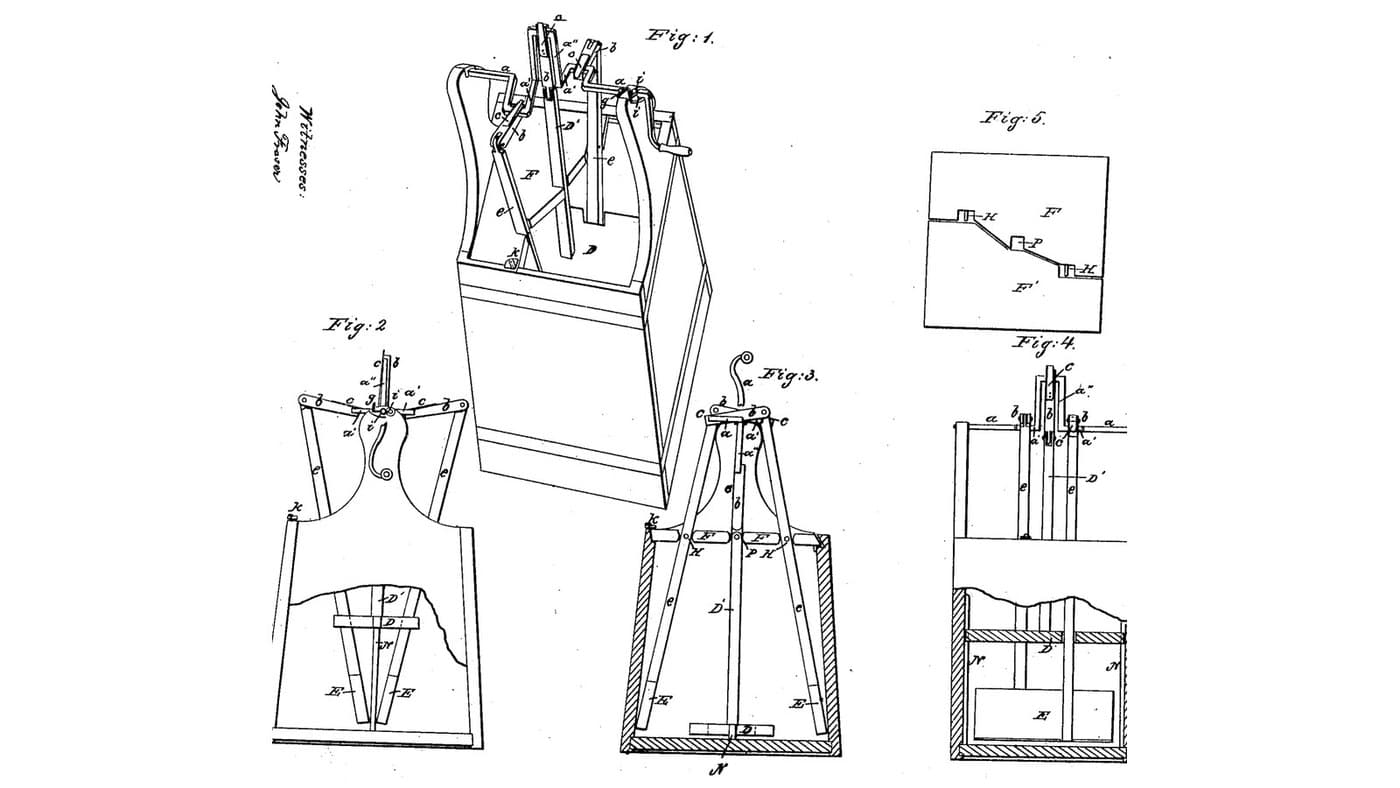
Three-Crank Churn: One Dasher Strokes Up and Down While Two Side Dashers Swing In and Out
by Buttercup
Woodworking
1
0
0
0
0
0
Brake-and-Ledge Bar Dasher Churn: Slotted Brakes Break the Current, Ledges Turn It Back to the Dasher
by Buttercup
Woodworking
1
0
0
0
0
0

Churning Butter from Cream — The 5,000-Year-Old Fat Separation
by TheChef
CRAFT
60
0
0
0
0
0
CC0 Public Domain
This blueprint is released under CC0. You are free to copy, modify, distribute, and use this work for any purpose, without asking permission.
Support the Maker by purchasing products through their Blueprint where they earn a Maker Commission set by Vendors, or create a new iteration of this Blueprint and include it as a connection in your own Blueprint to share revenue.