ART
BEAUTY & WELLNESS
CRAFT
CULTURE & HISTORY
ENTERTAINMENT
ENVIRONMENT
FOOD & DRINKS
REVERSE ENGINEERING
SCIENCES
SPORTS
TECHNOLOGY
WEARABLES
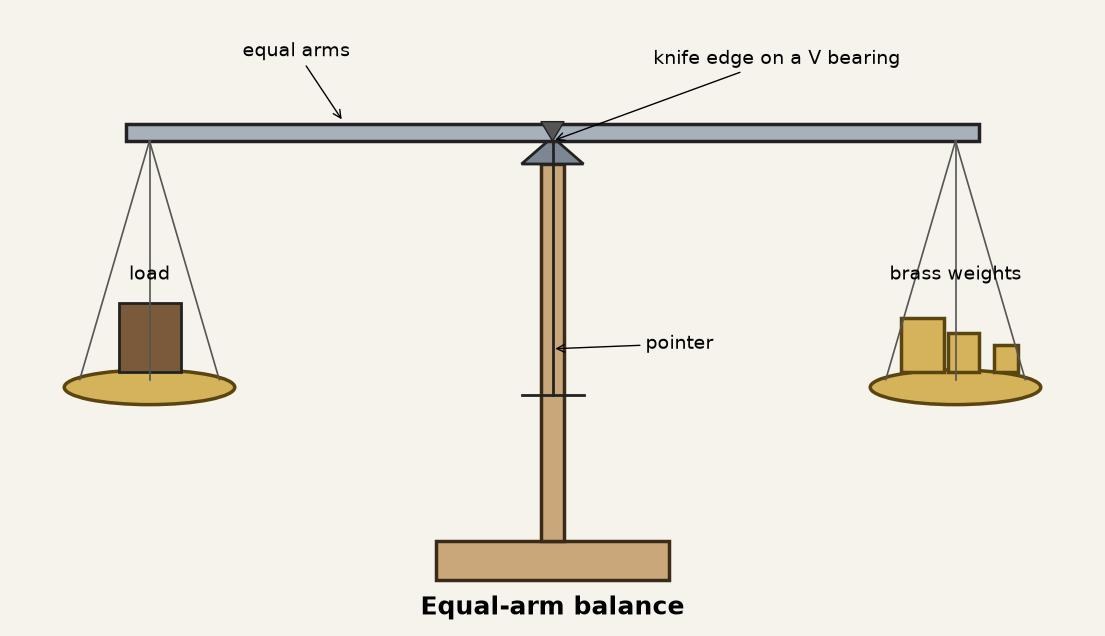


Equal-Arm Balance on a Knife Edge, with a Set of Brass Weights
The oldest weighing machine is a beam with equal arms balanced on a pivot, a pan hanging from each end: put the load in one pan and known weights in the other until the beam lies level. Balances go back to the Fourth Dynasty of Egypt. A hardened knife edge makes it sensitive and a long pointer shows the smallest tilt; the weights are cast in brass and adjusted against each other.
The picture: our diagram of the balance, its knife edge, pointer, pans and weights.
Intermediate
Two to three days
Instructions
1
1
Beam and knife edge
Beam and knife edge
File a straight beam from flat tool steel with a hole exactly in the middle and one near each end, the two end holes equally far from the centre. Forge and file a short steel knife edge, harden and temper it, and fit it through the centre hole, edge down. File a long pointer onto the beam.
Materials for this step:
 Flat Tool Steel Bar1 piece
Tools needed:
 Metal File
 Hand Drill
 Digital Caliper 6-Inch
 Blacksmith Forge
 Quench Bucket
 Safety Glasses
2
2
Stand and bearing
Stand and bearing
Make an upright stand of hardwood with a hardened steel V-block on top, shallower than the knife edge, so the beam rocks freely. Mark a zero line behind the pointer.
Materials for this step:
 Hardwood Strip2 pieces
 Mild Steel Rod0.3 m
Tools needed:
Metal FileBlacksmith ForgeQuench Bucket3
3
Pans
Pans
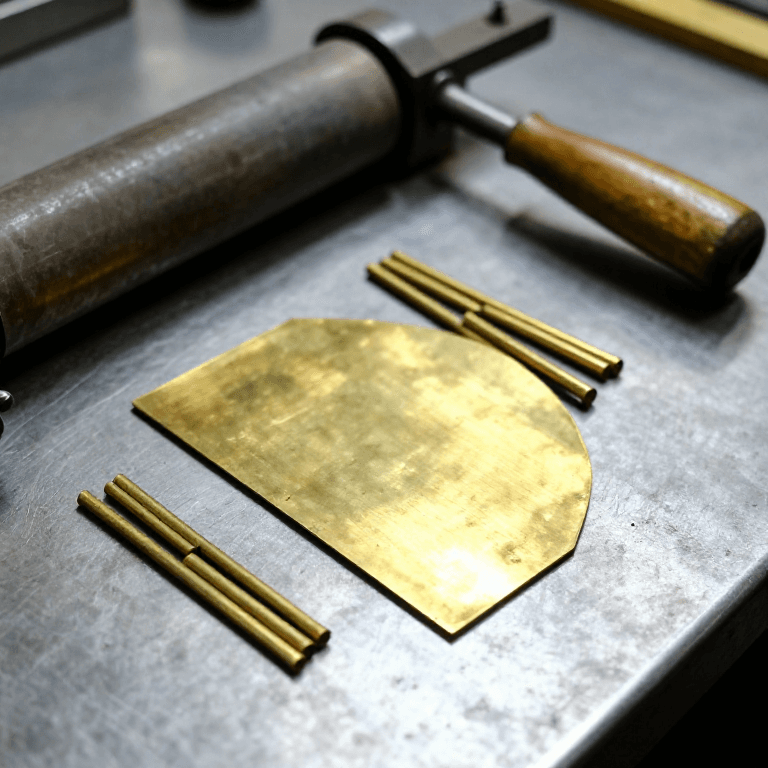
Cut two equal brass discs, dish them slightly, drill three holes in each rim and hang each from an end hole on three equal cords.
Materials for this step:
 Brass Sheet1 piece
 Waxed Linen Thread3 m
Tools needed:
 Tin SnipsHand DrillMetal File
4
4
Trim to level
Trim to level
With both pans empty, file the heavier side until the pointer rests on zero. Swap the pans and check again: if the pointer moves, the arms are unequal and the end holes need moving.
Tools needed:
Metal File5
5
Cast the weights
Cast the weights
Melt brass and cast a row of plain cylinders a little heavy in green sand.
Materials for this step:
 Brass Ingot2 kg
 Charcoal1 as required
 Casting Sand5 kg
Tools needed:
Blacksmith Forge Clay Crucible - Refractory
 Crucible Tongs
 Cope and Drag Flask
 Welding Gloves
6
6
Adjust the weights
Adjust the weights
Balance the largest weight against a litre of water measured in the cylinder (one kilogram, our reference), filing it down until the beam is level. Make the smaller ones by balancing pairs against a larger one and against each other, filing each to level.
Materials for this step:
 Water1 liter
Tools needed:
 Graduated CylinderMetal File
7
7
A binary set of weights
A binary set of weights
Loading Jupyter Notebook...
8
8
Limits
Limits
The balance's form and use are as Wikipedia describes; the sizes and the water reference are ours. Water's density changes a little with temperature, so the reference is good to a few parts in a thousand.
Materials
9- 1 piecePlaceholder
- 2 piecesPlaceholder
- 0.3 mPlaceholder
- 1 piecePlaceholder
- Placeholder
- 2 kgPlaceholder
- 1 as requiredPlaceholder
- 5 kgPlaceholder
- 1 literPlaceholder
Tools Required
12- Placeholder
- Placeholder
- Placeholder
- Placeholder
- Placeholder
- Placeholder
- Placeholder
- Placeholder
- Placeholder
- Placeholder
- Placeholder
- Placeholder
This blueprint makes
Related Blueprints
These blueprints share knowledge with this one — techniques, materials, or principles that connect them in the learning graph.


CC0 Public Domain
This blueprint is released under CC0. You are free to copy, modify, distribute, and use this work for any purpose, without asking permission.
Support the Maker by purchasing products through their Blueprint where they earn a Maker Commission set by Vendors, or create a new iteration of this Blueprint and include it as a connection in your own Blueprint to share revenue.