Collaboration
ART
BEAUTY & WELLNESS
CRAFT
CULTURE & HISTORY
ENTERTAINMENT
ENVIRONMENT
FOOD & DRINKS
REVERSE ENGINEERING
SCIENCES
SPORTS
TECHNOLOGY
WEARABLES
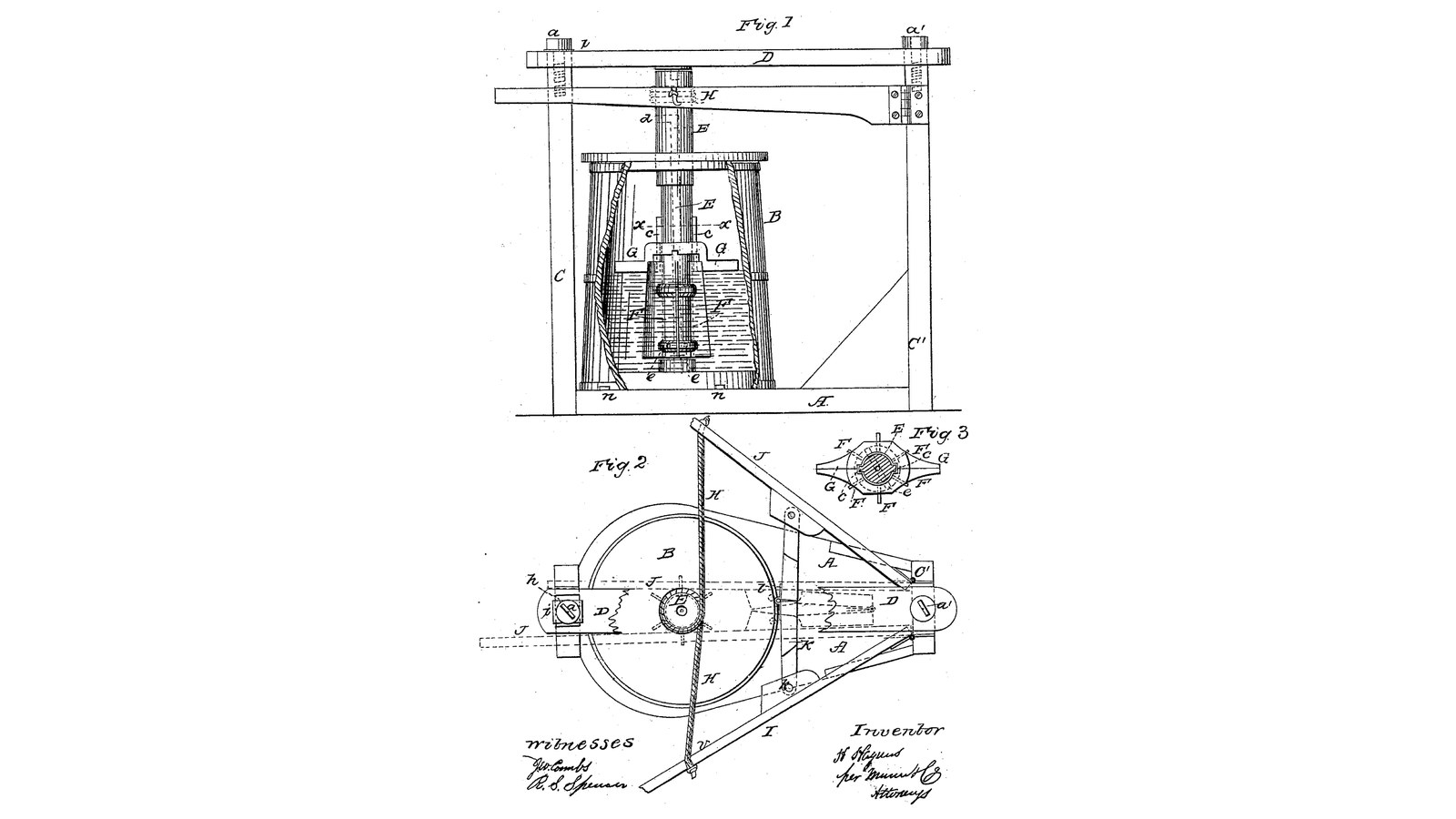

Cord-Lever Churn: A Cord Wound Round a Hollow Staff Turns It Back and Forth as a Hinged Lever Swings, a Loose Gatherer Rides Its Ribs
H. Hagans of Brandonville, Virginia, received US 32,868, dated 23 July 1861, for a churn turned like a bow drill. The dasher staff stands in an ordinary churn inside a frame; a cord tied to a bar hinged on one post is wound three times round the staff and hooked into a hand lever hinged on the other side of the same post, the two held apart by folding braces. Swinging the lever slides the cord and turns the staff back and forth. The staff is hollow, so air enters above the lid and leaves near the bottom; wings stir the cream, and a gatherer, loose on two ribs, rides up and down with the butter and gathers it.
The patent gives no sizes; every size here is ours.
Intermediate
About 2 days
Instructions
1
1
Cord and staff, like a bow drill
Cord and staff, like a bow drill
Loading Jupyter Notebook...
2
2
A cord kept tight round a turning part, a year and a half before
A cord kept tight round a turning part, a year and a half before
Willson keeps a cord tight with a sprung bow. Hagans winds it three times round the staff and keeps it taut with folding braces between a lever and a bar.
3
3
Read US 32,868
Read US 32,868
"The cord H is attached to the counter-bar J and is wound three times around the staff E, and the other end is placed in the notch v of the lever I, with the knot outside."
4
4
Frame: bed A, uprights C, C', cap D
Frame: bed A, uprights C, C', cap D
Glue up a hardwood bed A 760 x 320 x 30 mm and screw four hardwood steady pins n 12 mm round it where the churn's foot will stand. Mortise two hardwood uprights C and C' 50 x 50 mm, 560 tall, into the bed's ends, 710 mm apart over their centres. Cut a hardwood cap D 780 x 50 x 30 mm, bored 13 mm at the churn's centre for the staff's pivot. Pivot one end on the top of C' with a bolt a' and wing nut; at the other end cut a mortise h 12 x 20 mm over a bolt a in the top of C, with a flat bar binding plate i under its wing nut, so turning the plate lets that end lift off and swing aside.
Materials for this step:
 Hardwood Board3 pieces
 Wood Glue1 piece
 Hardwood Dowels1 piece
 Hex Bolt Assortment2 pieces
 Wing Nut2 pieces
 Mild Steel Flat Bar1 piece
Tools needed:
 Table Saw
 Chisel Set - Wood
 Router
 Cordless Drill
 Drill Bit Set
 Bar Clamp
 Adjustable Spanner
 Tape Measure
5
5
Print the step b
Print the step b
The step in the churn's bottom: 40 mm across, 12 high, with a 22.6 mm socket 10 deep. PETG, 0.2 mm layers, 30 % infill, 4 walls.
6
6
Print the gatherer G
Print the gatherer G
The butter-gatherer: a hub 60 mm across and 40 high, 23 mm bore with two slots for the ribs, and two tapered arms reaching 110 mm. Print it in two halves split through the slots, and screw them together on the staff. PETG, 0.2 mm layers, 30 % infill, 4 walls.
7
7
Churn B, staff E, wings F, ribs c and gatherer G
Churn B, staff E, wings F, ribs c and gatherer G
Use a 20-litre food-grade bucket as the churn B, with the step in its bottom, and cut an HDPE lid with a 24 mm hole. Cut a 22 mm stainless tube 525 mm long as the hollow staff E; drill four 8 mm holes e round it 30 mm above its foot and one d 430 mm up, above the lid. Glue and screw four hardwood wings F 110 x 40 x 6 mm radially on it 60 to 100 mm up, and two hardwood ribs c 8 x 6 mm, 120 long, on opposite sides 170 to 290 mm up. Screw the gatherer's halves together round it between the ribs, so it slides freely up and down. Plug the tube's top and turn a 12 mm pivot on it for the cap.
Materials for this step:
 20-Liter Bucket1 piece
 HDPE Sheet1 piece
 Stainless Steel Tube1 pieceHardwood Board1 pieceWood Glue1 piece
 Wood Screws12 pieces
 PETG Filament1 pieceHardwood Dowels1 piece
Tools needed:
 FDM 3D Printer
 Hacksaw
 Files (Hand File)Cordless DrillDrill Bit Set
 Screwdriver Set
 Compass
 Jigsaw
 Spade Bit Set
8
8
Lever I, bar J, braces K and cord H
Lever I, bar J, braces K and cord H
Cut a hardwood lever I 40 x 25 mm, 700 long with a handle, and a counter-bar J 520 long. Hang each on a butt hinge on opposite sides of C', 440 mm up, so they swing level, I on the front and J on the back, reaching past the staff on either side. Cut a notch v in I where it passes the staff. Make the braces K two strips of mild steel flat bar 200 mm long, each bolted to a lever at k 150 mm from the post, and bolted to each other at l, so they fold. Tie a braided cord H to J beside the staff, wind it three times round the staff above the lid, and hook its other end into the notch v with the knot outside, the braces straight and the cord taut.
Materials for this step:
Hardwood Board1 piece Cabinet Butt Hinge2 piecesWood Screws12 piecesMild Steel Flat Bar1 pieceHex Bolt Assortment3 pieces
 Cord1 piece
Tools needed:
Table SawJigsawHacksawFiles (Hand File) Bench ViseCordless DrillDrill Bit SetScrewdriver SetAdjustable Spanner
9
9
The build in 3D
The build in 3D
FreeCAD model of this build, the churn cut open: the bed with its steady pins, the two uprights and cap, the hollow staff with its wings, ribs and the loose gatherer, the step, the lid, the lever and counter-bar hinged on one post with the folding braces, and the cord wound round the staff.
10
10
Churn
Churn
Swing the cap aside, set the churn between the steady pins with the staff in its step, pour in about 10 litres of heavy cream at about 15 °C, checked with the thermometer, put on the lid and swing the cap back over the staff's pivot, turning the binding plate. Wind on the cord. Swing the lever to and fro, timing it; the staff turns back and forth and draws air down through itself. When the butter comes, slow down so the gatherer collects it. Fold the braces, unhook the cord, swing the cap aside, lift out the staff, take out the butter, pour the buttermilk into a bowl, wash the butter in cold water until it runs clear, salt and weigh it.
Materials for this step:
 Heavy Cream10 l
 Coarse Sea Salt1 piece
 Water1 piece
Tools needed:
 Leave-In Probe Thermometer
 Stopwatch
 Digital Kitchen Scale
 Stainless Steel Mixing Bowl (Large)
11
11
Troubleshooting
Troubleshooting
Cord-lever churn troubleshooting.
Flow
Loading...
12
12
History and honest limits
History and honest limits
**H. Hagans** of Brandonville, Preston County, Virginia (now West Virginia), US 32,868, 23 July 1861, "Improved Churn"; the drawing spells the name Hagan. He claimed the self-adjusting rotary butter-gatherer G and ribs c with the dasher rod and wings, and the jointed braces K, hinged levers I and J and driving cord H with the dasher rod and post C'. His churn was an ordinary barrel; ours is a bucket. His staff was wood bored hollow; ours is a stainless tube. The patent gives no sizes; every size here is ours.
Materials
16- 3 piecesPlaceholder
- 2 piecesPlaceholder
- 1 piecePlaceholder
- 5 piecesPlaceholder
- 2 piecesPlaceholder
- 1 piecePlaceholder
- 1 piecePlaceholder
- 1 piecePlaceholder
- 1 piecePlaceholder
- 24 piecesPlaceholder
- 1 piecePlaceholder
- 2 piecesPlaceholder
- 1 piecePlaceholder
- 10 lPlaceholder
- 1 piecePlaceholder
- 1 piecePlaceholder
Tools Required
20- 1 vendor sell this, none ship to you yetPlaceholder
- Placeholder
- Placeholder
- 1 vendor sell this, none ship to you yetPlaceholder
- Placeholder
- Placeholder
- Placeholder
- 1 vendor sell this, none ship to you yetPlaceholder
- Placeholder
- Placeholder
- Placeholder
- Placeholder
- Placeholder
- 1 vendor sell this, none ship to you yetPlaceholder
- Placeholder
- Placeholder
- Placeholder
- Placeholder
- Placeholder
- Placeholder
Design Files
3This blueprint makes

Related Blueprints
These blueprints share knowledge with this one — techniques, materials, or principles that connect them in the learning graph.
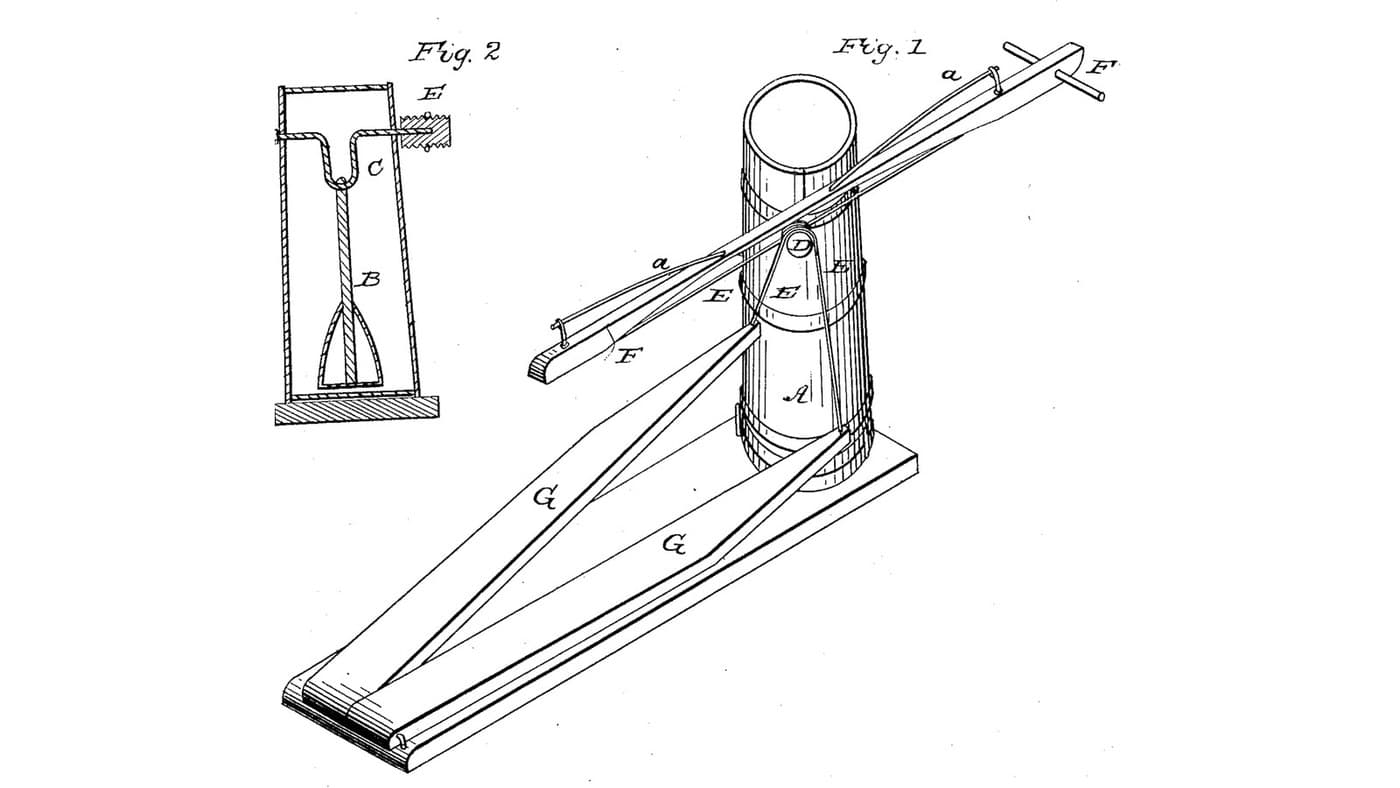
Spring-Bow Churn: A Bow With Two Springs Keeps Its Cord Tight Round a Screw Whirl on the Crank Shaft
by Buttercup
Woodworking
0
0
0
0
0
0
Sliding-Frame Churn: Push and Pull a Frame on Top and a Cord Spins Tilted, Perforated Beaters Back and Forth
by Buttercup
Woodworking
0
0
0
0
0
0
Hollow-Staff Plunger Churn: A Plunger in a Perforated Inner Cylinder Draws Air Down Its Staff on the Up Stroke
by Buttercup
Woodworking
1
0
0
0
0
0

Churning Butter from Cream — The 5,000-Year-Old Fat Separation
by TheChef
CRAFT
60
0
0
0
0
0
CC0 Public Domain
This blueprint is released under CC0. You are free to copy, modify, distribute, and use this work for any purpose, without asking permission.
Support the Maker by purchasing products through their Blueprint where they earn a Maker Commission set by Vendors, or create a new iteration of this Blueprint and include it as a connection in your own Blueprint to share revenue.