ART
BEAUTY & WELLNESS
CRAFT
CULTURE & HISTORY
ENTERTAINMENT
ENVIRONMENT
FOOD & DRINKS
REVERSE ENGINEERING
SCIENCES
SPORTS
TECHNOLOGY
WEARABLES


Hinged-Beater Swivel Dasher: Beaters That Tilt Rising and Lie Flat Falling
Garlick made a common up-and-down dash that also turns as it rises.
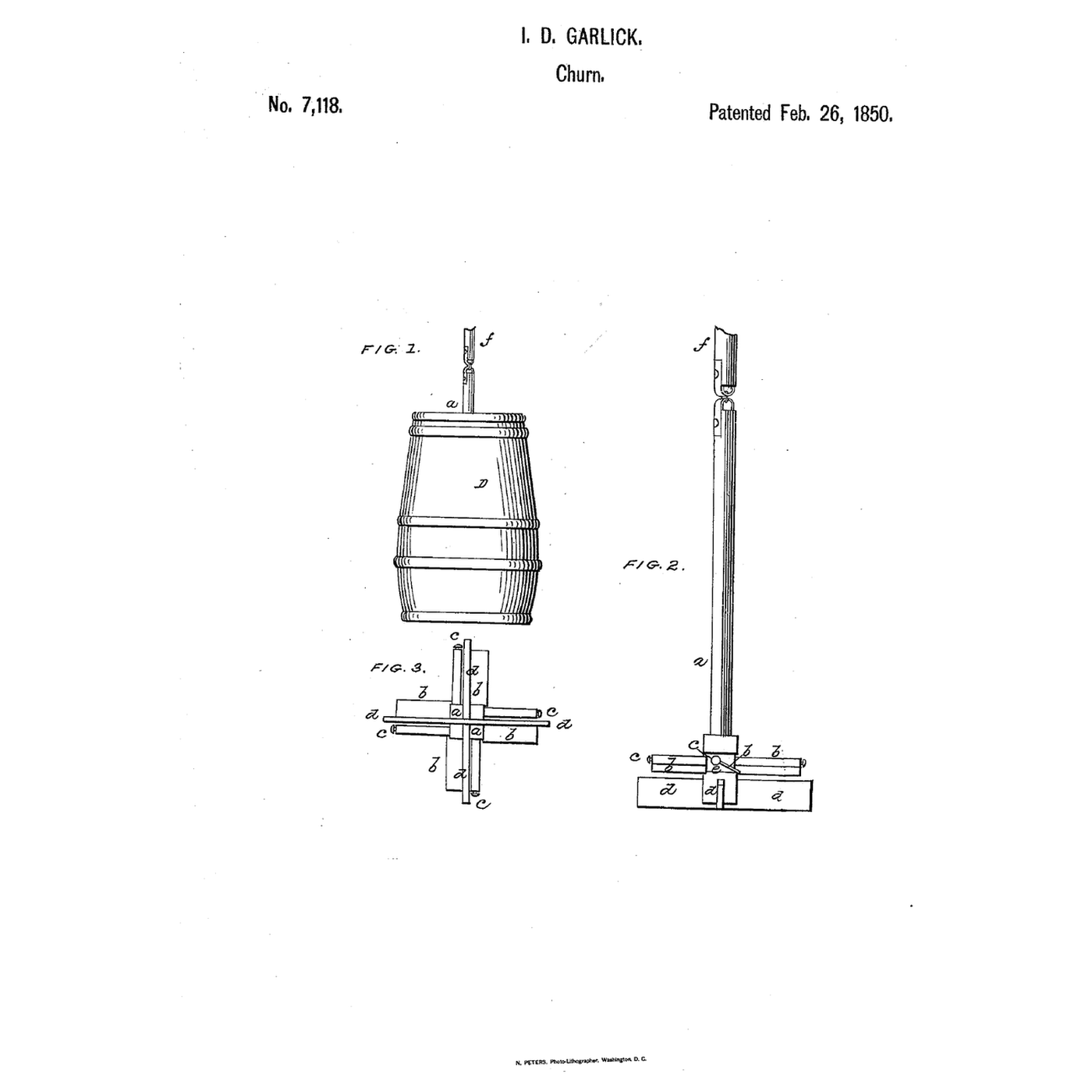
Isaac D. Garlick of Lyons, New York, received US 7,118, dated 26 February 1850, for a churn-dasher whose rod is in two parts joined by a swivel. At the foot are four radial wings; above them, in recesses in the rod's four sides, four vibrating metal beaters hang on pins. Rising, they fall to "angles with the dasher rod of from forty to forty five degrees" and "impart a rotary movement to the dasher"; falling, they are thrown to "horizontal positions, at right angles with the dasher rod."
This rung compares the beaters' two positions, then prints the head, beaters and swivel, assembles the dash, and makes butter in a bucket.
Beginner
About 2 hours, plus printing
Instructions
1
1
Two positions
Two positions
Loading Jupyter Notebook...
2
2
A dasher that turns as it moves up and down before it
A dasher that turns as it moves up and down before it
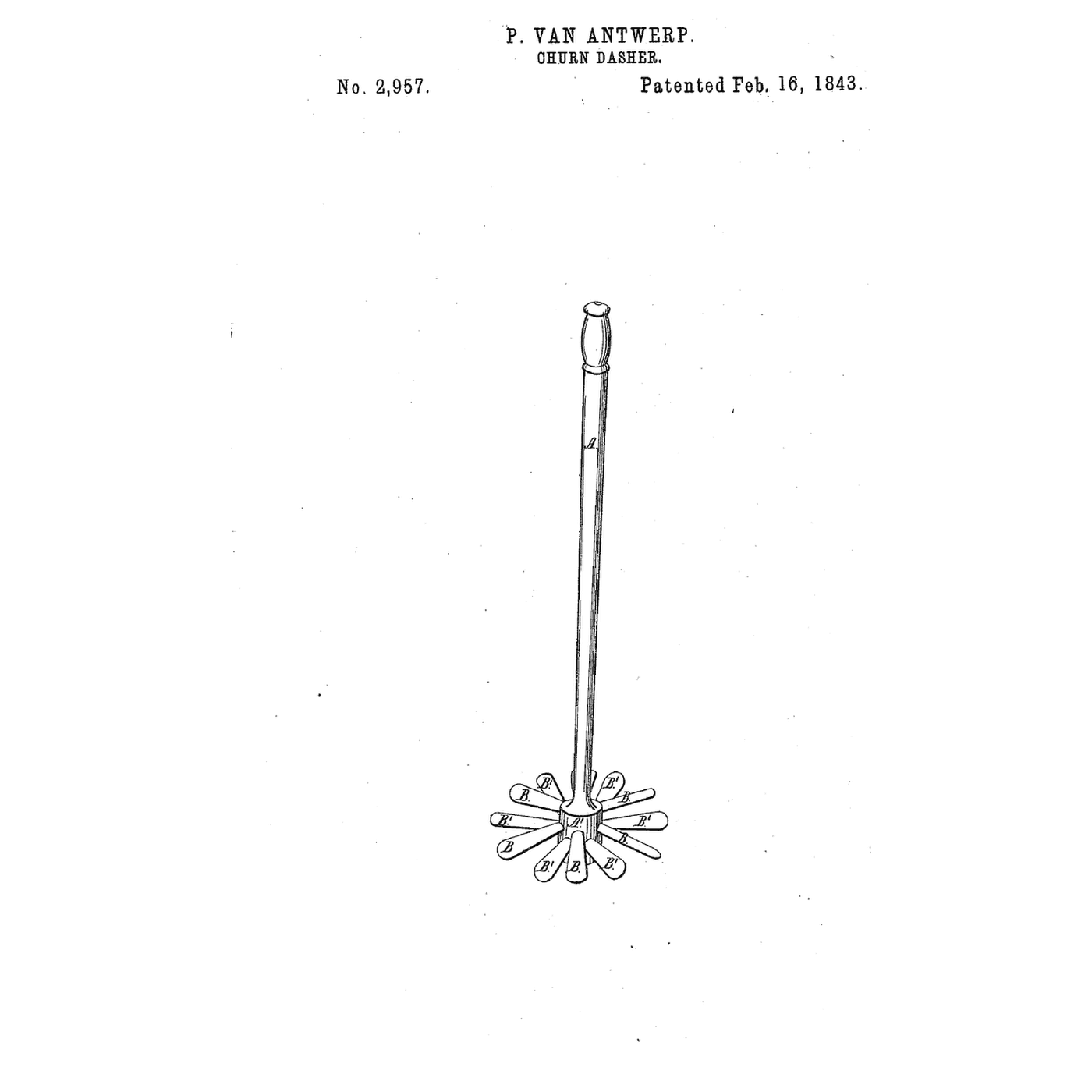
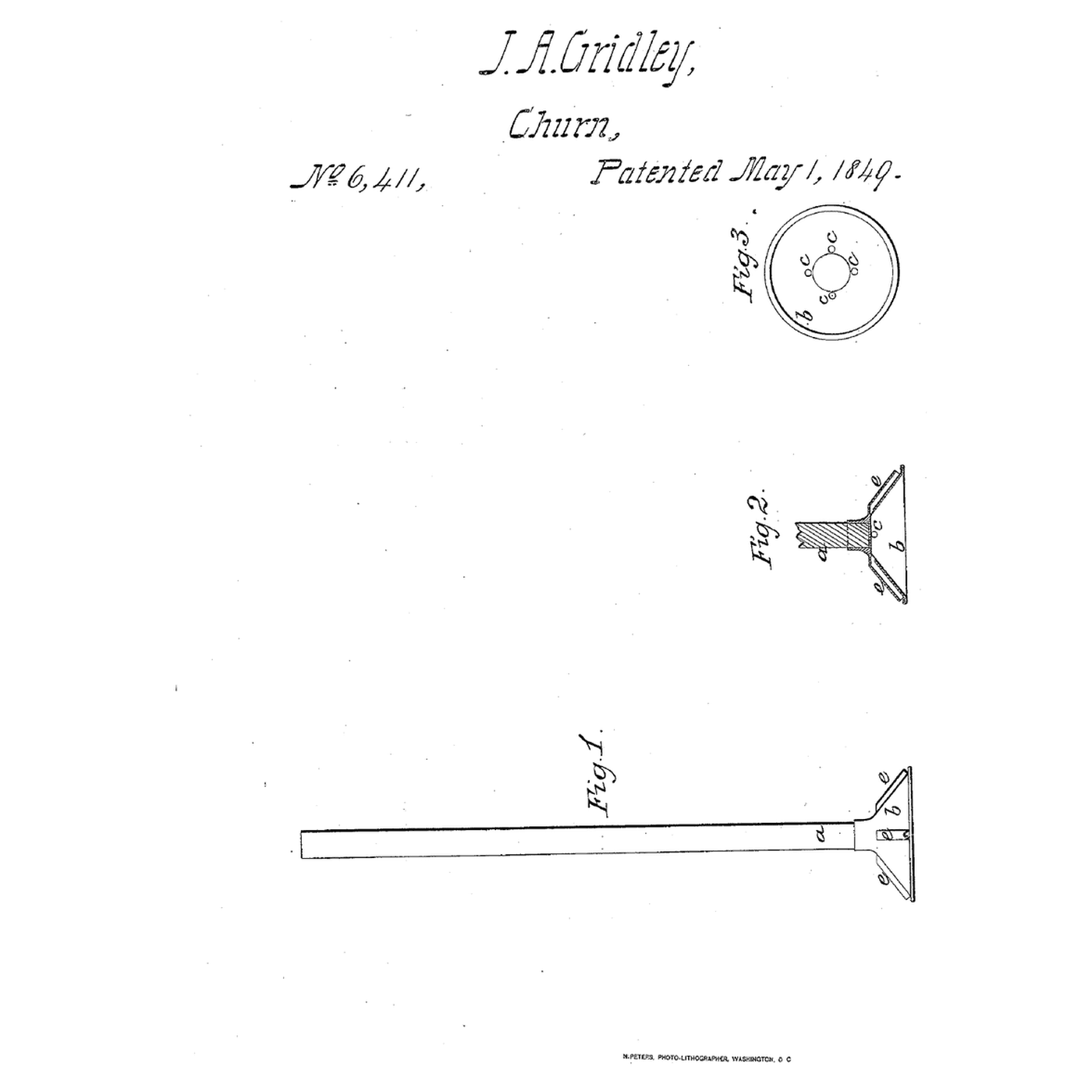
The embedded blueprint turns its dasher with a pin in a spiral slot. Garlick's hinged beaters turn it from the cream's own push, so the rod needs a swivel.
3
3
Read US 7,118
Read US 7,118
"When the dasher is operated in cream, the upward movement thereof will throw the beaters b, b, into the inclined position represented in Fig. 2, by which they will impart a rotary movement to the dasher, and thereby cause the vertical faces of the wings d, d, to aid in efficiently acting upon and agitating the cream during their upward movement; and when the dasher is forced downward, the beaters b, b, will be thrown into a horizontal position."
4
4
Print the parts
Print the parts
Print the head (/uploads/blueprints/hinged-beater-swivel-dasher-head.stl): a block with four radial wings and four recesses, each with a pin hole across its top. Print four beaters (/uploads/blueprints/hinged-beater-swivel-dasher-beater.stl) with their hinge eyes, and the swivel (/uploads/blueprints/hinged-beater-swivel-dasher-swivel.stl). Print in PETG at 0.2 mm layers, 30 % infill, 4 walls; wash before first use.
Materials for this step:
 PETG Filament1 piece
Tools needed:
 FDM 3D Printer
5
5
Hang the beaters
Hang the beaters
Set each beater's eye in its recess and push a 2 mm stainless pin (a cut nail will do) through the head and eye, so the beater swings freely between hanging at 40–45° and lying flat against the recess's top.
Materials for this step:
 Nails1 piece
Tools needed:
 Hacksaw
 Sandpaper
6
6
Rod and swivel
Rod and swivel
Glue a 12 mm hardwood dowel into the head as the lower rod. Join a second dowel to it with the swivel: glue the upper dowel into the swivel's top socket and let the lower dowel turn freely in its bottom socket, held by a small screw in a groove. Drill a bucket lid for the rod.
Materials for this step:
 Hardwood Dowels1 piece
 Wood Glue1 piece
 #8 x 1" Wood Screw1 piece
 20-Liter Bucket1 piece
Tools needed:
 Hand Saw
 Cordless Drill
 Drill Bit Set
 Screwdriver Set
7
7
The build in 3D
The build in 3D
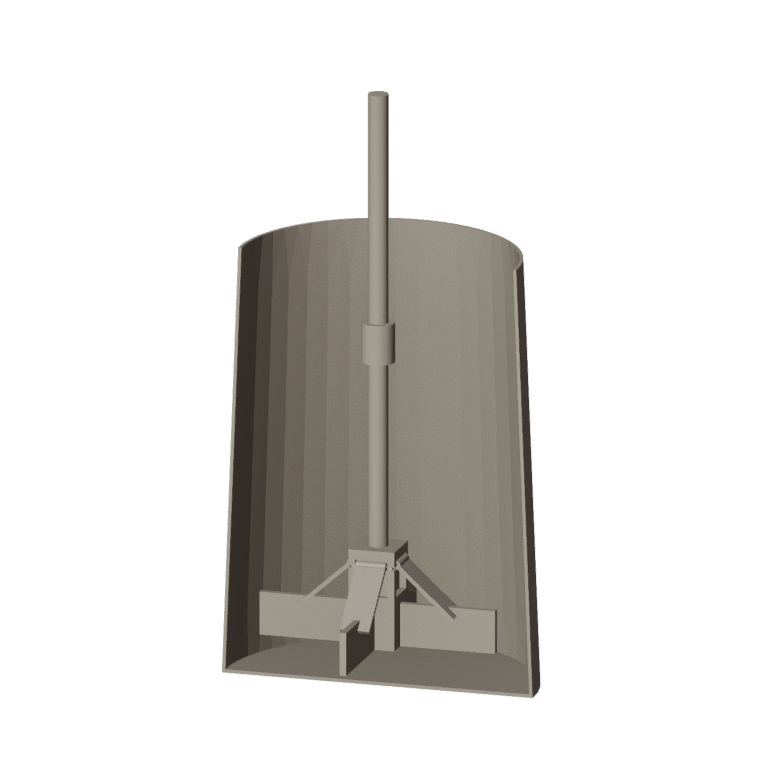
FreeCAD model of this build, not of the patent: the tub cut away to show the head with its four wings and four hinged beaters hanging at about 42°, the lower rod, the swivel and the upper rod.
8
8
Dash and make butter
Dash and make butter
Let the heavy cream stand until it reaches about 15 °C, checked with the thermometer. Pour in 2 litres. Work the upper rod up and down; the lower part should turn a little on each up-stroke. Time until the butter comes. Pour off the buttermilk, add cold water, churn a little and pour off again until it runs clear; work in a pinch of salt and weigh the butter.
Materials for this step:
 Heavy Cream2000 ml
 Coarse Sea Salt1 piece
 Water1 piece
Tools needed:
 Leave-In Probe Thermometer
 Stopwatch
 Digital Kitchen Scale
 Stainless Steel Mixing Bowl (Large)
9
9
Beaters that stick, a dash that won't turn
Beaters that stick, a dash that won't turn
Hinged-beater swivel dasher troubleshooting.
Flow
Loading...
10
10
History and honest limits
History and honest limits
**Isaac D. Garlick** of Lyons, Wayne County, New York, received US 7,118, dated 26 February 1850, signed 19 December 1849. His churn was a staved upright tub; the rod's upper part could be worked by hand or by machinery; the beaters were metal, hung by a rod through eyes "or a continuous beading on one edge." He claimed hinging the beaters so they are thrown inclined by the upward and horizontal by the downward movement, combined with the vertical-faced wings on the same rod.
**Honest limits.** Printed beaters and head stand in for his metal beaters and wooden rod; a bucket for his tub. FDM prints hold food in their layer lines, so wash well and replace when worn. Your times and weights are the result.
Materials
9- 1 piecePlaceholder
- 1 piecePlaceholder
- 1 piecePlaceholder
- 1 piecePlaceholder
- 1 piecePlaceholder
- 1 piecePlaceholder
- 2000 mlPlaceholder
- 1 piecePlaceholder
- 1 piecePlaceholder
Tools Required
11- Placeholder
- Placeholder
- Placeholder
- Placeholder
- 1 vendor sell this, none ship to you yetPlaceholder
- Placeholder
- Placeholder
- Placeholder
- Placeholder
- Placeholder
- Placeholder
Design Files
1Related Blueprints
These blueprints share knowledge with this one — techniques, materials, or principles that connect them in the learning graph.


CC0 Public Domain
This blueprint is released under CC0. You are free to copy, modify, distribute, and use this work for any purpose, without asking permission.
Support the Maker by purchasing products through their Blueprint where they earn a Maker Commission set by Vendors, or create a new iteration of this Blueprint and include it as a connection in your own Blueprint to share revenue.