ART
BEAUTY & WELLNESS
CRAFT
CULTURE & HISTORY
ENTERTAINMENT
ENVIRONMENT
FOOD & DRINKS
REVERSE ENGINEERING
SCIENCES
SPORTS
TECHNOLOGY
WEARABLES
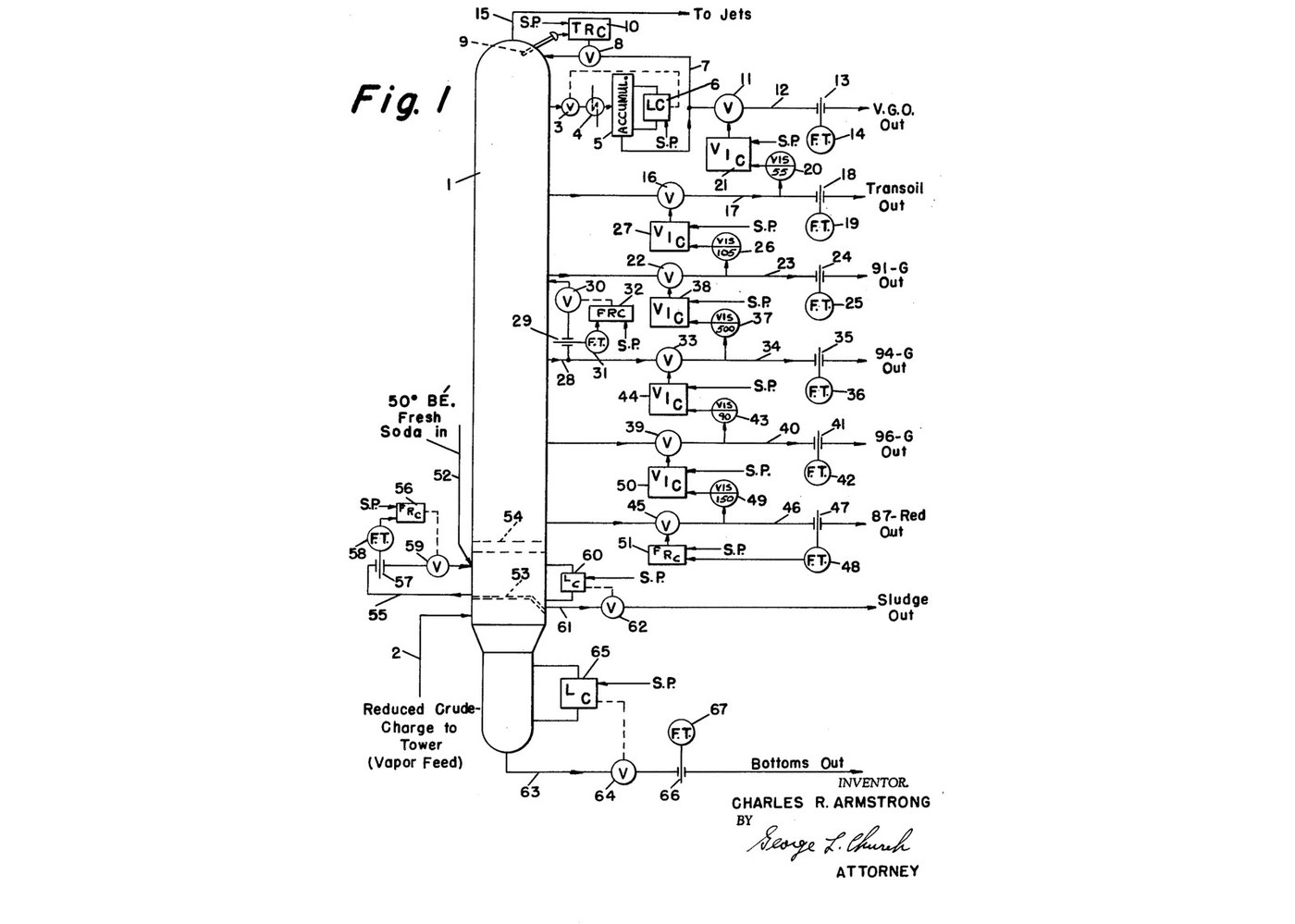


Naphthenic Distillates: Reduced Crude Cut by Viscosity in a Vacuum Tower (Armstrong 1965)
A wax-free naphthenic crude, stripped of its gasoline and naphtha, goes into a vacuum tower as hot vapour. Caustic soda near the bottom takes out its acids as a sludge. Five lubricating oils are drawn off the side of the tower, each held to its own viscosity. These are naphthenic distillates, the feed for white mineral oil.
Source: C. R. Armstrong (Sun Oil Company), US 3,184,396 (1965), a Sun Oil tower of 39 trays and 12,000 barrels a day. He does not give the crude tower's conditions, how the feed is heated or how much caustic is used. The steam boiler and hydrometer are ours. The picture: the patent's Fig. 1.
Advanced
continuous
Instructions
1
1
Top the crude
Top the crude
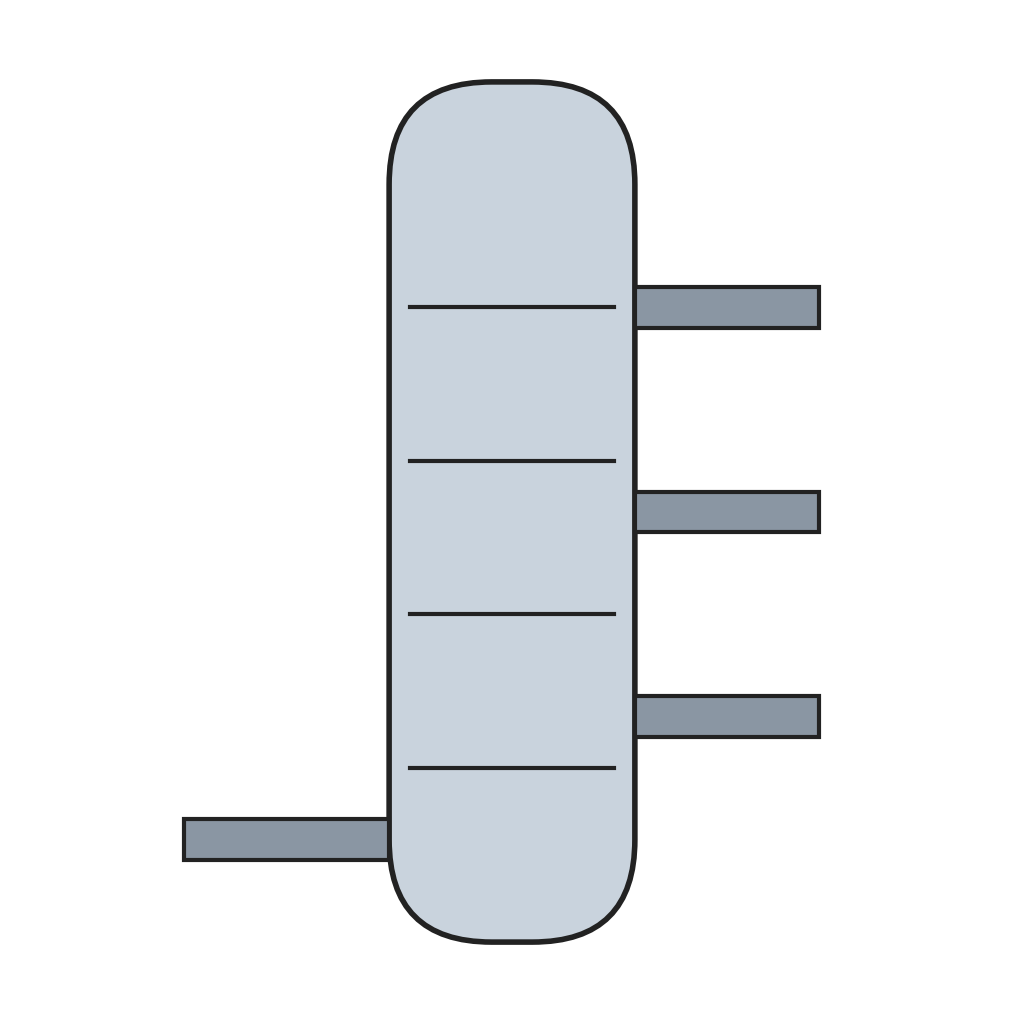
Take a wax-free naphthenic crude. Armstrong's crudes were sorted and blended to give lubricating oils with a viscosity-gravity constant of 0.885–0.893. Strip off the low-boiling part (straight-run gasoline, naphtha) in a separate crude tower; the patent gives no conditions for it. What is left is the "reduced" crude.
Materials for this step:
 Naphthenic Crude Oil1 as required
Tools needed:
 Atmospheric Distillation Column
2
2
Lay out the vacuum tower
Lay out the vacuum tower
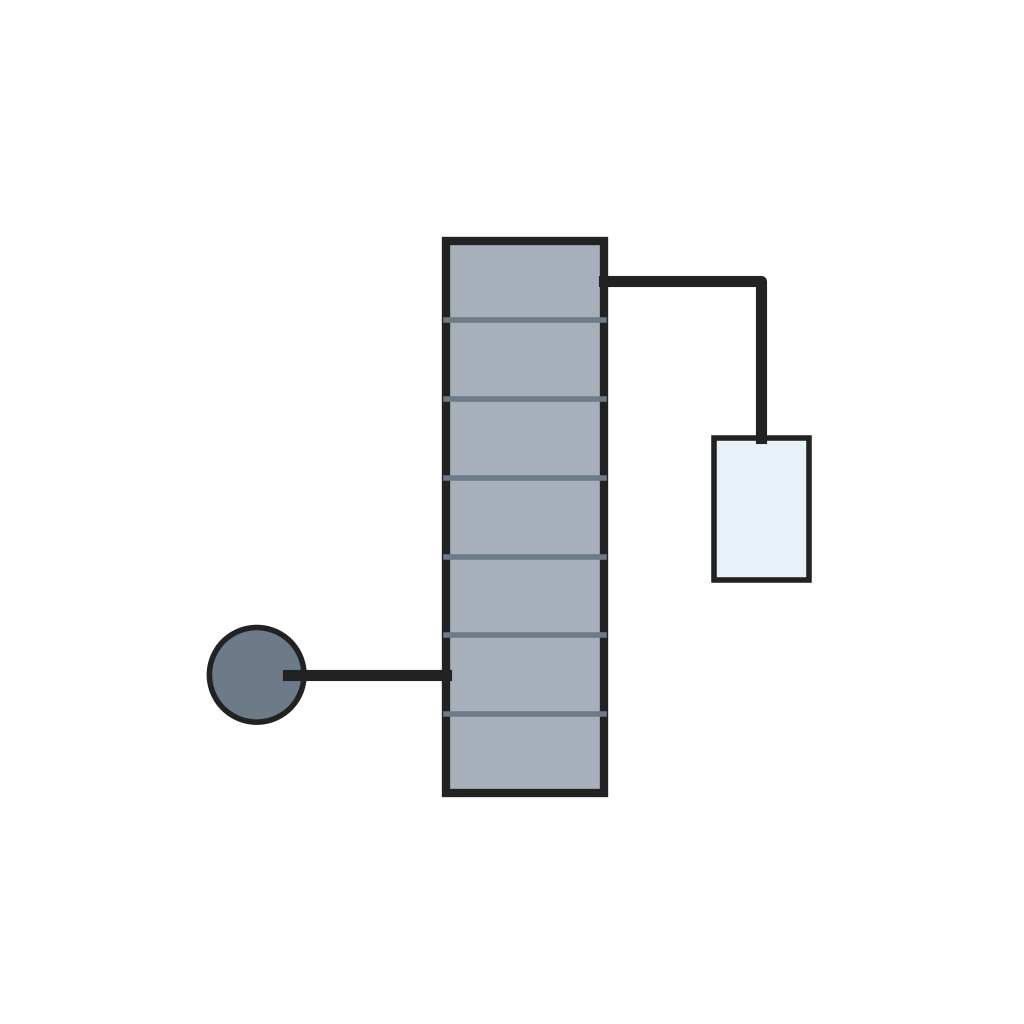
Armstrong's tower has 39 trays, 20 ft across and 128 ft high. Take-offs, counted from the bottom: gas oil overhead at tray 35, through a condenser to an accumulator, part of it sent back as reflux to hold the top temperature; transformer oil ("Transoil") at tray 29; 91-G at tray 26; 94-G below it, partly cooled in a heat exchanger and returned as reflux; 96-G at tray 19; 87-Red at tray 16. Tray 7 is a total trap-out tray with a demister above it: between them is the caustic section.
Tools needed:
 Vacuum Distillation Column
 Condenser Coil
 Heat Exchanger
3
3
Pull the vacuum
Pull the vacuum
Hold the top of the tower at 15–20 mm of mercury absolute with steam jet ejectors and barometric condensers. Ours: a steam boiler for the jets.
Tools needed:
 Steam Jet Ejector
 Barometric Condenser
 Steam Boiler
 Pressure Gauge
4
4
Feed the reduced crude as vapour
Feed the reduced crude as vapour
Charge the reduced crude near the bottom, below tray 7, at about 650 °F (343 °C), so it enters as vapour. The patent does not say how it is heated. Whatever does not vaporise runs down and is drawn off as tower bottoms, by level.
Tools needed:
Vacuum Distillation Column Thermocouple with Readout
5
5
Feed caustic soda into the caustic section
Feed caustic soda into the caustic section
Feed fresh caustic soda, 50° Baumé for example, at tray 10. It turns the acidic parts of the vapour into a sodium salt that does not boil, and this collects as a sludge on tray 7. Take some sludge off tray 7 and return it at tray 10 to stir it; leave some 87-Red in the tower to thin it so the section does not plug. Draw the sludge off by level. Ours: a hydrometer to check the Baumé.
Tools needed:
 Sodium Hydroxide Solution
 HydrometerVacuum Distillation Column
6
6
Hold each side stream to its viscosity
Hold each side stream to its viscosity
Measure each side stream with a viscometer: Transoil 55 S.S.U. at 100 °F (38 °C); 91-G 105 S.S.U. at 100 °F; 94-G 500 S.S.U. at 100 °F; 96-G 90 at 210 °F (99 °C); 87-Red 150 at 210 °F. Correct a stream by the draw-off of the stream just above it: Transoil by the gas oil. If a stream runs thick, draw more from the one above, so its lighter parts come down. Set 87-Red by hand.
Tools needed:
 ViscometerVacuum Distillation Column
7
7
Run the on-spec oils to storage
Run the on-spec oils to storage
Send only side streams that are on viscosity to storage. Each of the five lubricating oils is a naphthenic distillate. The gas oil, the sludge and the bottoms take the rest of the feed.
Tools needed:
ViscometerVacuum Distillation ColumnMaterials
1- 1 as requiredPlaceholder
Tools Required
12- Placeholder
- Placeholder
- Placeholder
- Placeholder
- Placeholder
- Placeholder
- Placeholder
- Placeholder
- Placeholder
- Placeholder
- Placeholder
- Placeholder
This blueprint makes
Related Blueprints
These blueprints share knowledge with this one — techniques, materials, or principles that connect them in the learning graph.
CC0 Public Domain
This blueprint is released under CC0. You are free to copy, modify, distribute, and use this work for any purpose, without asking permission.
Support the Maker by purchasing products through their Blueprint where they earn a Maker Commission set by Vendors, or create a new iteration of this Blueprint and include it as a connection in your own Blueprint to share revenue.