ART
BEAUTY & WELLNESS
CRAFT
CULTURE & HISTORY
ENTERTAINMENT
ENVIRONMENT
FOOD & DRINKS
REVERSE ENGINEERING
SCIENCES
SPORTS
TECHNOLOGY
WEARABLES


Oblique-Shaft Basin-Lid Churn: A Slanting Agitator Between Brakes, a Lid That Holds Tempering Water
James Hatfield of Falmouth, Indiana, and Henry M. Goldsmith of Burlington, Iowa, received US 20,878, dated 13 July 1858, for a churn with a triangular agitator shaft slanting across the vessel, wings set across it at 45 degrees, brakes above and below, and a lid sunk into a basin of hot or cold water, with a glass slide to watch.
This rung prints the shaft, agitator, brakes and basin lid at tabletop scale, on a stock pot.
Advanced
About 6 hours, plus printing
Instructions
1
1
The slant and the wings
The slant and the wings
Loading Jupyter Notebook...
2
2
Slanting dasher shafts, before it
Slanting dasher shafts, before it
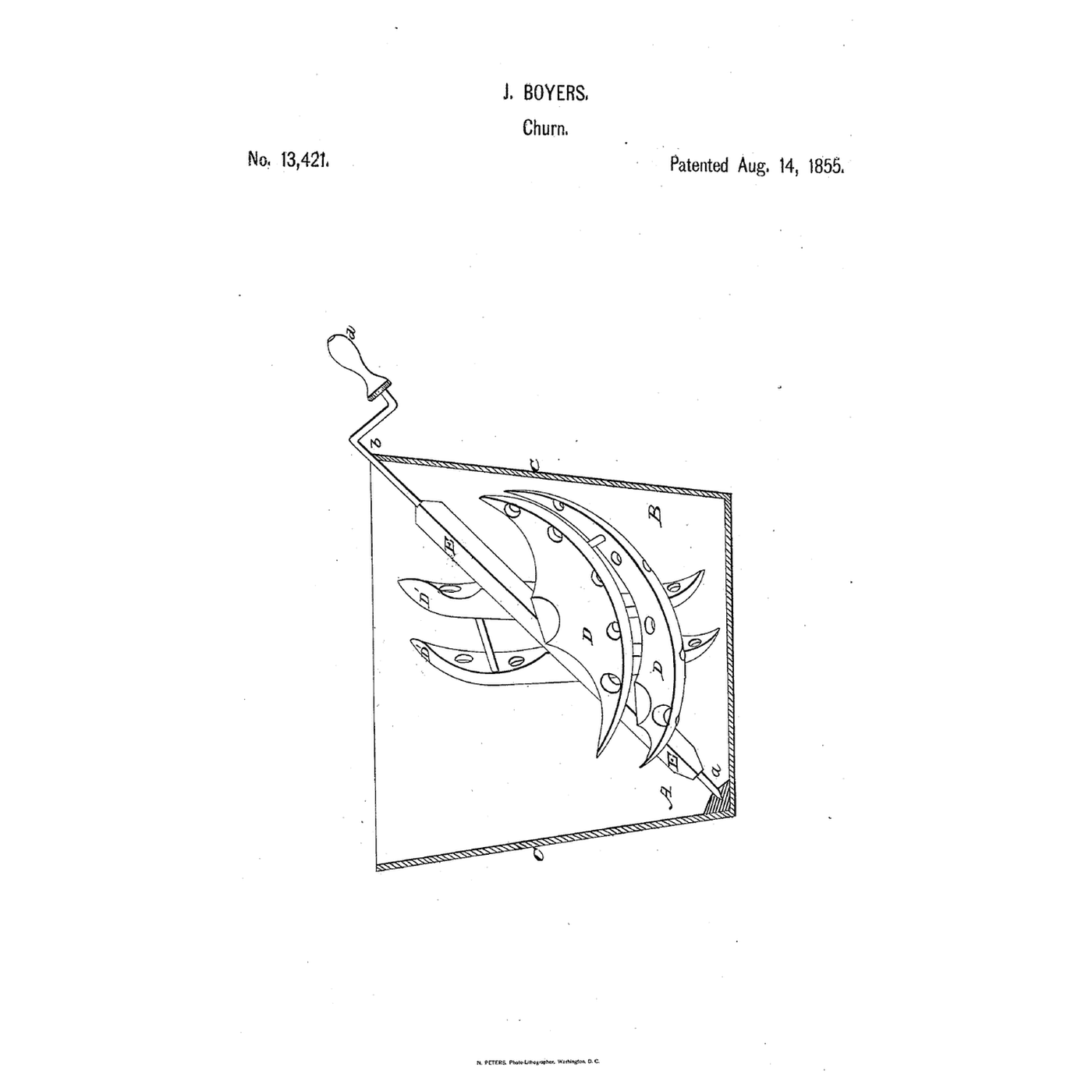
That shaft carried dished blades; this one a disk across it at 45 degrees, braced by quarter-circle wings.
3
3
Read US 20,878
Read US 20,878
"The basin or reservoir lid is so arranged as to contain either hot or cold water which being circulated through the cream by the action of the agitator and brakes soon reduces the cream to the desired temperature."
4
4
Print the parts
Print the parts
Print the shaft (/uploads/blueprints/oblique-shaft-basin-lid-churn-shaft.stl) lying on a flat face across the bed's diagonal, the agitator (/uploads/blueprints/oblique-shaft-basin-lid-churn-agitator.stl) with supports, the hoop with its brakes (/uploads/blueprints/oblique-shaft-basin-lid-churn-hoop.stl), the basin (/uploads/blueprints/oblique-shaft-basin-lid-churn-basin.stl) floor down, the rim (/uploads/blueprints/oblique-shaft-basin-lid-churn-rim.stl), three brakes for the lid (/uploads/blueprints/oblique-shaft-basin-lid-churn-brake.stl) and the crank (/uploads/blueprints/oblique-shaft-basin-lid-churn-crank.stl). The shaft, rim and hoop need a 256 mm print bed. Print in PETG at 0.2 mm layers, 30 % infill, 4 walls; wash before first use.
Materials for this step:
 PETG Filament1 piece
Tools needed:
 FDM 3D Printer
5
5
Agitator and vessel
Agitator and vessel
Slide the agitator onto the triangular shaft to its middle and fix it with an M3 screw through the collar. Set the hoop in the bottom of the pot and stand the shaft's foot in the socket of its foot block, the shaft slanting across to the opposite side.
Materials for this step:
 Stock Pot1 piece
 Machine Screws1 piece
Tools needed:
 Screwdriver Set
6
6
Lid, glass and crank
Lid, glass and crank
Screw the three brakes under the basin's floor with M4 screws. Set the basin in the rim and the rim on the pot, threading the shaft's top journal out through the chamber and the rim's bearing. Cut a strip of glass 72 by 34 mm and lay it over the chamber. Fix the crank on the shaft's triangular end with an M3 screw.
Materials for this step:
Machine Screws1 piece Float Glass Sheet1 piece
Tools needed:
 Glass CutterScrewdriver Set
7
7
The build in 3D
The build in 3D
FreeCAD model of this build: the pot cut open, the hoop with three curved brakes and the foot block, the slanting triangular shaft, the disk of wings at 45 degrees with quarter-circle wings to each end, the basin lid with its air chamber and glass, the rim with the bearing, the brakes under the lid and the crank.
8
8
Temper and churn
Temper and churn
Pour in 2 litres of heavy cream, put the lid on and fill the basin with warm or cold water to bring the cream to about 15 °C, checked with the thermometer. Turn the crank steadily, timing it with the stopwatch, and watch through the glass. When the butter comes, lift the lid and the shaft out, pour off the buttermilk, wash the butter in cold water until it runs clear, work in a pinch of salt and weigh it.
Materials for this step:
 Heavy Cream2 l
 Water1 piece
 Coarse Sea Salt1 piece
Tools needed:
 Leave-In Probe Thermometer
 Stopwatch
 Digital Kitchen Scale
 Stainless Steel Mixing Bowl (Large)
9
9
Troubleshooting
Troubleshooting
Basin-lid churn troubleshooting.
Flow
Loading...
10
10
History and honest limits
History and honest limits
**James Hatfield** of Falmouth, Fayette County, Indiana, and **Henry M. Goldsmith** of Burlington, Des Moines County, Iowa, US 20,878, 13 July 1858. Their vessel could be of any size or form, round and largest at the top preferred. They wrote that the belt and brakes lift out to wash and that the glass makes it needless to raise the lid to see the work. They claimed the basin lid with its glass slide, and the agitator with the wings L used with the brakes G and H. Our pot, sizes, printed parts and the brakes' shapes are ours. FDM prints hold food in their layer lines, so wash well and replace when worn.
Materials
7- 1 piecePlaceholder
- 1 piecePlaceholder
- 2 piecesPlaceholder
- 1 piecePlaceholder
- 2 lPlaceholder
- 1 piecePlaceholder
- 1 piecePlaceholder
Tools Required
7- Placeholder
- Placeholder
- Placeholder
- Placeholder
- Placeholder
- Placeholder
- Placeholder
Design Files
1Related Blueprints
These blueprints share knowledge with this one — techniques, materials, or principles that connect them in the learning graph.

CC0 Public Domain
This blueprint is released under CC0. You are free to copy, modify, distribute, and use this work for any purpose, without asking permission.
Support the Maker by purchasing products through their Blueprint where they earn a Maker Commission set by Vendors, or create a new iteration of this Blueprint and include it as a connection in your own Blueprint to share revenue.