ART
BEAUTY & WELLNESS
CRAFT
CULTURE & HISTORY
ENTERTAINMENT
ENVIRONMENT
FOOD & DRINKS
REVERSE ENGINEERING
SCIENCES
SPORTS
TECHNOLOGY
WEARABLES

S-Dasher Friction-Board Churn: A Double-Curved Dasher Throwing Cream Over Grooved Boards
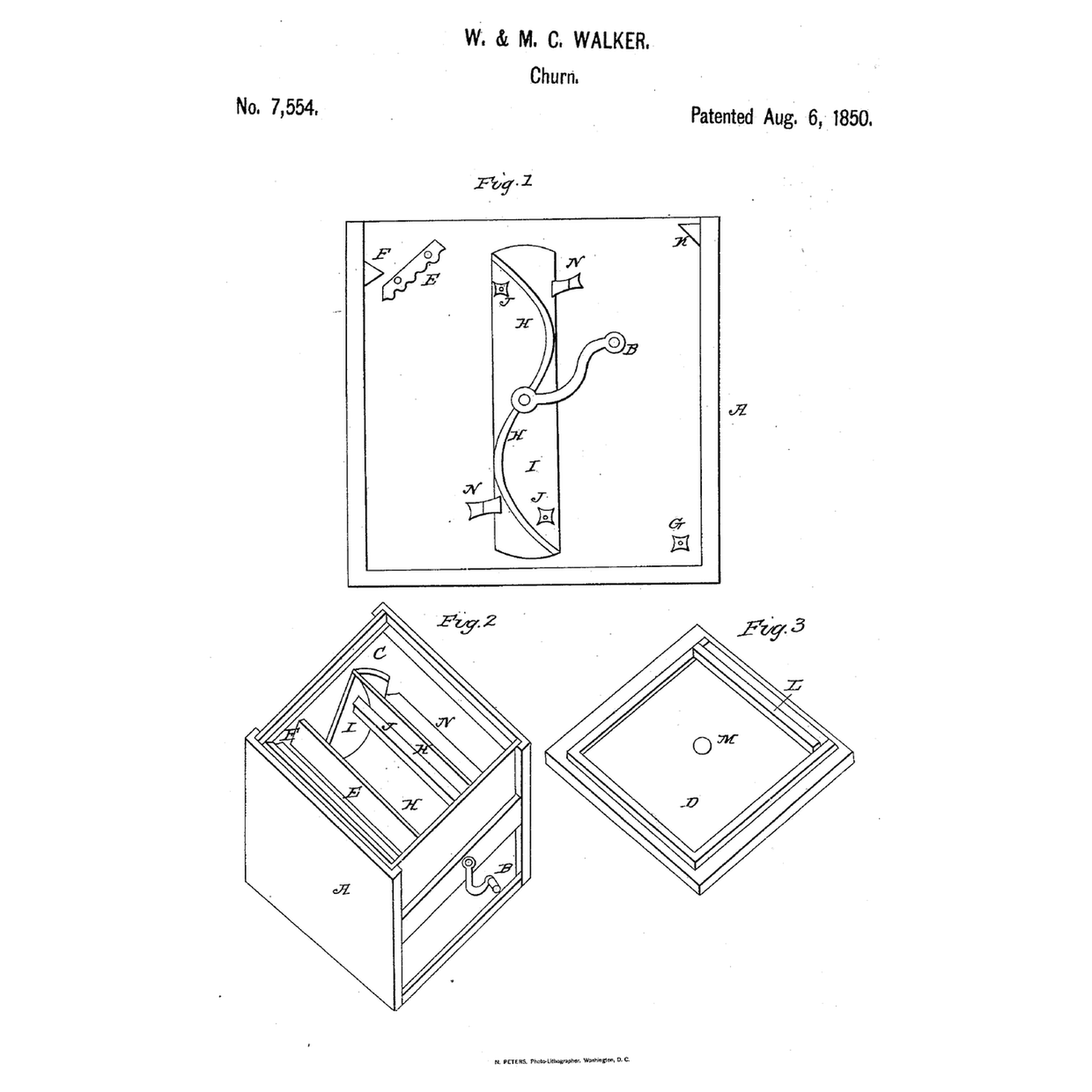
The Walkers lined a square churn with grooved boards so the cream would be thrown against them "thus keeping up a constant friction on all sides."
William Walker and Matthew C. Walker of Lancaster, Pennsylvania, received US 7,554, dated 6 August 1850, for a square water-tight box about fourteen inches each way holding about 40 quarts, half filled, with a "double curved or S shaped dasher" revolving in the centre by a crank and a thumb screw. Four grooved cross pieces run along each side of its curved ends; a friction board grooved underneath inclines across the top; a triangular board returns the cream onto it; a grooved friction piece sits in the lower right corner.
This rung checks the box's capacity, then prints the S dasher, friction boards and corner piece, fits them in a box, and makes butter.
Intermediate
About 4 hours, plus printing
Instructions
1
1
Capacity
Capacity
Loading Jupyter Notebook...
2
2
A shaped dash in a box churn before it
A shaped dash in a box churn before it
The embedded blueprint twists its wings into a screw. The Walkers bend theirs into an S and add grooved boards round the box for friction.
3
3
Read US 7,554
Read US 7,554
"As the churn is put in operation, the cream is thrown against the grooves of the incline board E, dashed around and under it, and passed over and against the friction piece G, in the right hand corner of box, while the ends of the dasher H and wide cross piece N keep the cream continually dashing against the grooves of the incline board E thus keeping up a constant friction on all sides."
4
4
Print the parts
Print the parts
Print the S dasher with its four grooved cross pieces in one piece (/uploads/blueprints/s-dasher-friction-board-churn-s-dasher.stl), the grooved incline board (/uploads/blueprints/s-dasher-friction-board-churn-incline-board.stl), the grooved corner piece (/uploads/blueprints/s-dasher-friction-board-churn-corner-piece.stl) and the crank arm (/uploads/blueprints/s-dasher-friction-board-churn-crank-arm.stl). Print in PETG at 0.2 mm layers, 30 % infill, 4 walls; wash before first use.
Materials for this step:
 PETG Filament1 piece
Tools needed:
 FDM 3D Printer
5
5
Fit the box
Fit the box
Take a food-safe box about 180 mm each way. Glue the incline board across the top, sloping down to within 20 mm of the left side, grooves underneath, and a triangular plywood board on that side to turn the cream back onto it. Glue the corner piece in the lower right corner. Drill both ends on the centre for the dasher's shaft.
Materials for this step:
 Food-Grade Storage Container1 piece
 Plywood Sheet1 piece
 Silicone Sealant1 piece
Tools needed:
 Coping Saw
 Cordless Drill
 Drill Bit Set
 Clamps
6
6
Dasher and crank
Dasher and crank
Pass a 10 mm square hardwood shaft through the box and the dasher, glue the crank arm and a dowel handle on one end, and hold the other with a thumb screw through a washer, as theirs. Cut an air hole in the lid.
Materials for this step:
 Hardwood Dowels1 piece
 Machine Screws1 piece
 Flat Washer1 piece
 Wood Glue1 piece
Tools needed:
 Hand SawCordless Drill
 Screwdriver Set
7
7
The patent drawing
The patent drawing
US 7,554 drawing sheet, public domain (expired patent).
8
8
Crank and make butter
Crank and make butter
Let the heavy cream stand until it reaches about 15 °C, checked with the thermometer. Fill the box half full, about 2.9 litres. Crank steadily; time until the butter comes. Pour off the buttermilk, add cold water, churn a little and pour off again until it runs clear; work in a pinch of salt and weigh the butter.
Materials for this step:
 Heavy Cream2900 ml
 Coarse Sea Salt1 piece
 Water1 piece
Tools needed:
 Leave-In Probe Thermometer
 Stopwatch
 Digital Kitchen Scale
 Stainless Steel Mixing Bowl (Large)
9
9
Dasher that strikes, cream that escapes
Dasher that strikes, cream that escapes
S-dasher friction-board troubleshooting.
Flow
Loading...
10
10
History and honest limits
History and honest limits
**William Walker and Matthew C. Walker** of Lancaster, Pennsylvania, received US 7,554, dated 6 August 1850. Their box was of inch boards; a ledge at the top confined the lid, with a projecting strip on its underside to close it tight, and an aperture M let the air through. They claimed the double-curved S-shaped dasher with the grooved pieces.
**Honest limits.** A food-safe box and printed parts stand in for their wooden churn, at about a third of its size. FDM prints hold food in their layer lines, so wash well and replace when worn. Your times and weights are the result.
Materials
11- 1 piecePlaceholder
- 1 piecePlaceholder
- 1 piecePlaceholder
- 1 piecePlaceholder
- 1 piecePlaceholder
- 1 piecePlaceholder
- 1 piecePlaceholder
- 1 piecePlaceholder
- 2900 mlPlaceholder
- 1 piecePlaceholder
- 1 piecePlaceholder
Tools Required
11- Placeholder
- Placeholder
- 1 vendor sell this, none ship to you yetPlaceholder
- Placeholder
- Placeholder
- Placeholder
- Placeholder
- Placeholder
- Placeholder
- Placeholder
- Placeholder
Related Blueprints
These blueprints share knowledge with this one — techniques, materials, or principles that connect them in the learning graph.
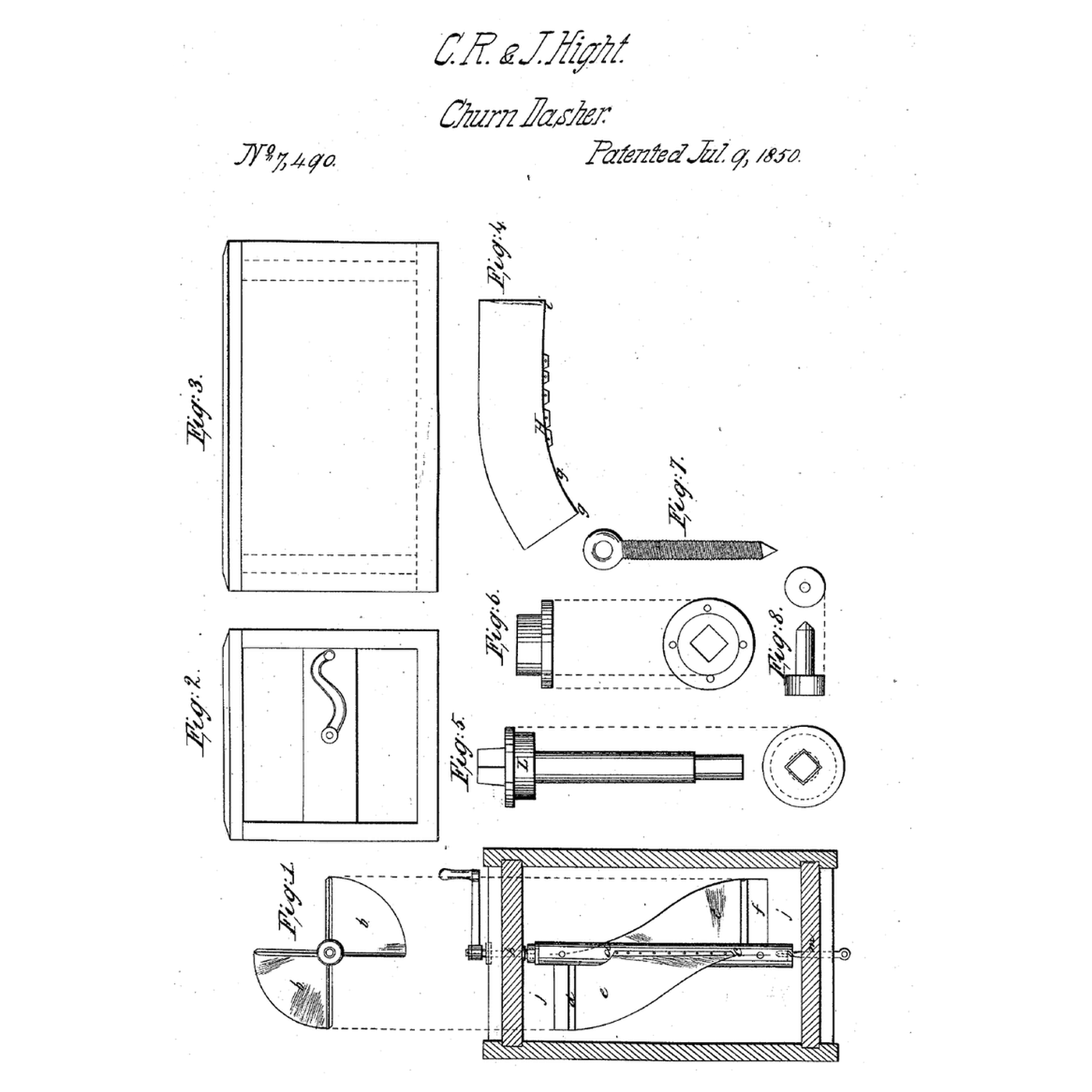
Quarter-Twist Spiral Dash Churn: Wings Twisted Between Arms Set at Right Angles
by Woody
Woodworking
2
0
0
0
0
0
Butter-Strainer Churn: Cream Thrown Into a Strainer That Keeps the Butter
by TheChef
FOOD & DRINKS
3
0
0
0
0
0
Shaftless Dasher-Wheel Churn: Bevelled Buckets Drive the Cream to the Centre
by Martin
FOOD & DRINKS
2
0
0
0
0
0
CC0 Public Domain
This blueprint is released under CC0. You are free to copy, modify, distribute, and use this work for any purpose, without asking permission.
Support the Maker by purchasing products through their Blueprint where they earn a Maker Commission set by Vendors, or create a new iteration of this Blueprint and include it as a connection in your own Blueprint to share revenue.