ART
BEAUTY & WELLNESS
CRAFT
CULTURE & HISTORY
ENTERTAINMENT
ENVIRONMENT
FOOD & DRINKS
REVERSE ENGINEERING
SCIENCES
SPORTS
TECHNOLOGY
WEARABLES
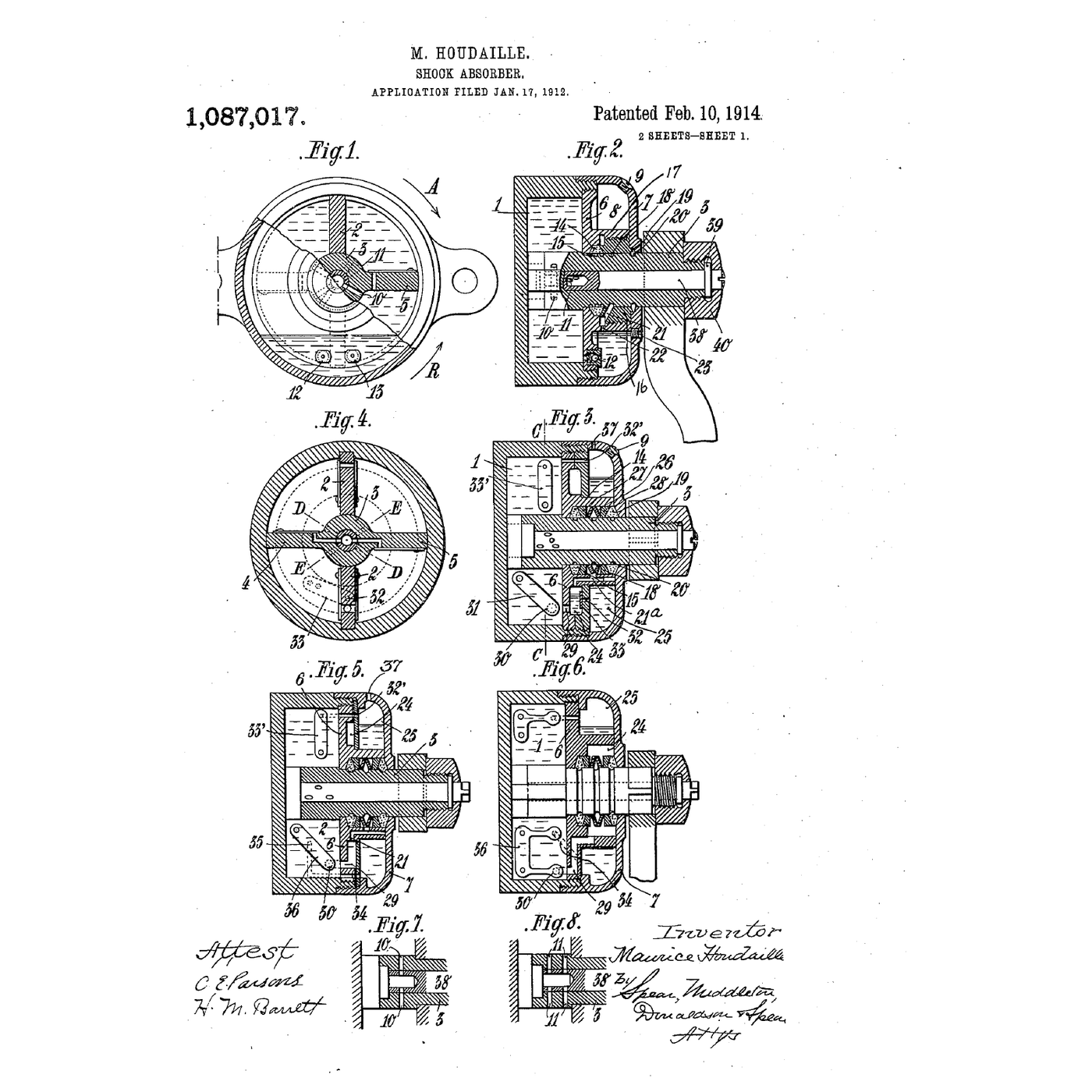
Maurice Houdaille, Paris, assignor to La Société Houdaille et Sabot · Public domain (expired patent)


The Hydraulic Shock Absorber: Liquid Forced Through a Small Passage
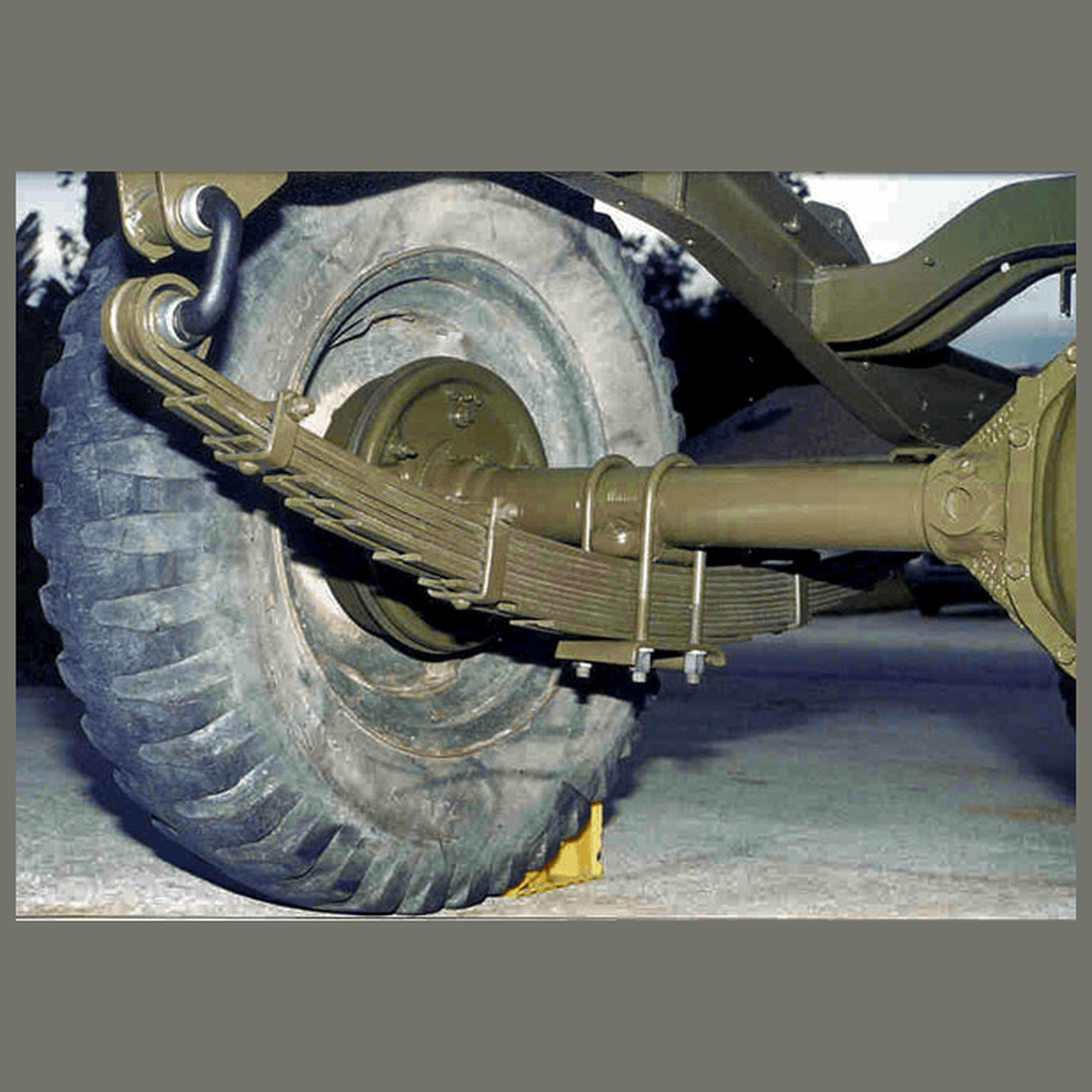
Springs store the energy of a bump and give it back; without something to take it away, the car keeps bouncing. Early 'shock absorbers' were friction discs clamped together, which resisted the same whether the car moved slowly or fast. Maurice Houdaille in Paris made it hydraulic: a vane on a spindle, turned by a lever from the axle, sweeps liquid from one compartment of a casing to another through passages whose size can be adjusted. The faster the axle moves, the harder the liquid resists.
His US patent of 1914 is also about a practical problem every hydraulic damper has: liquid leaks past the seals, so the patent adds valves that let liquid from a reserve refill the working chamber and keep it full.
This rung simulates a car corner with four levels of damping and measures a syringe damper's force against speed.
Intermediate
About 3 hours
Instructions
1
1
Read Houdaille's rotary damper
Read Houdaille's rotary damper
US 1,087,017, 'Shock Absorber', Maurice Houdaille of Paris, filed 17 January 1912, granted 10 February 1914. A cylindrical casing is *"divided into two compartments by a fixed partition"*; a hollow spindle carries *"two blades"*, turned by a lever and connecting rod from the spring, which sweep through the compartments. The liquid — *"glycerin or other suitable liquid"* — must pass *"from one chamber into the other"* through conduits in the spindle whose *"cross-section … can be adjusted"*.
Valves 12 and 13 are *"automatically opened in order to allow liquid to pass into the compartment and closed to prevent any liquid from returning"* to the reserve chamber 8 — the recuperation of leakage the patent is built around.
2
2
A quarter-car with four dampers
A quarter-car with four dampers
Loading Jupyter Notebook...
3
3
Measure a syringe damper
Measure a syringe damper
Fill a large syringe with mineral oil and fit a needle or a short thin tube to its nozzle as the orifice. Clamp the syringe upright and press the plunger down with the spring scale at a steady reading, timing how long the plunger takes to travel 20 mm.
Repeat at four or five different pushes. Plot force against plunger speed. For a long thin passage the force rises in proportion to speed; for a short sharp orifice it rises faster, nearer the square. Real dampers use both — and valves that open at high speed so a sharp pothole does not become a hammer blow.
Swap the oil for glycerine: same speeds, far higher forces. Houdaille's liquid was glycerine.
Materials for this step:
 Syringe Set1 set
 Food-grade Mineral Oil100 ml
 Glycerin (Vegetable)100 ml
Tools needed:
 Force Meter (Spring Scale)
 Stopwatch
 Steel Ruler
 Bench Vise
4
4
History and context
History and context
**US 1,087,017, 'Shock Absorber', Maurice Houdaille, Paris, assignor to La Société Houdaille et Sabot; filed 17 January 1912, granted 10 February 1914.** Houdaille's rotary-vane lever-arm dampers were fitted to cars for decades; the telescopic damper, a piston in a tube of oil, replaced them from the 1930s.
**Honest limits.** The linear model in the notebook is a simplification: real dampers are valved to resist differently in bump and rebound, and their force is not proportional to speed. Oil thins as it heats, so a hard-worked damper fades. And a damper cannot fix a spring that is wrong for the load.
Materials
3- 1 setPlaceholder
- 100 mlPlaceholder
- 100 mlPlaceholder
Related Blueprints
These blueprints share knowledge with this one — techniques, materials, or principles that connect them in the learning graph.

CC0 Public Domain
This blueprint is released under CC0. You are free to copy, modify, distribute, and use this work for any purpose, without asking permission.
Support the Maker by purchasing products through their Blueprint where they earn a Maker Commission set by Vendors, or create a new iteration of this Blueprint and include it as a connection in your own Blueprint to share revenue.