ART
BEAUTY & WELLNESS
CRAFT
CULTURE & HISTORY
ENTERTAINMENT
ENVIRONMENT
FOOD & DRINKS
REVERSE ENGINEERING
SCIENCES
SPORTS
TECHNOLOGY
WEARABLES
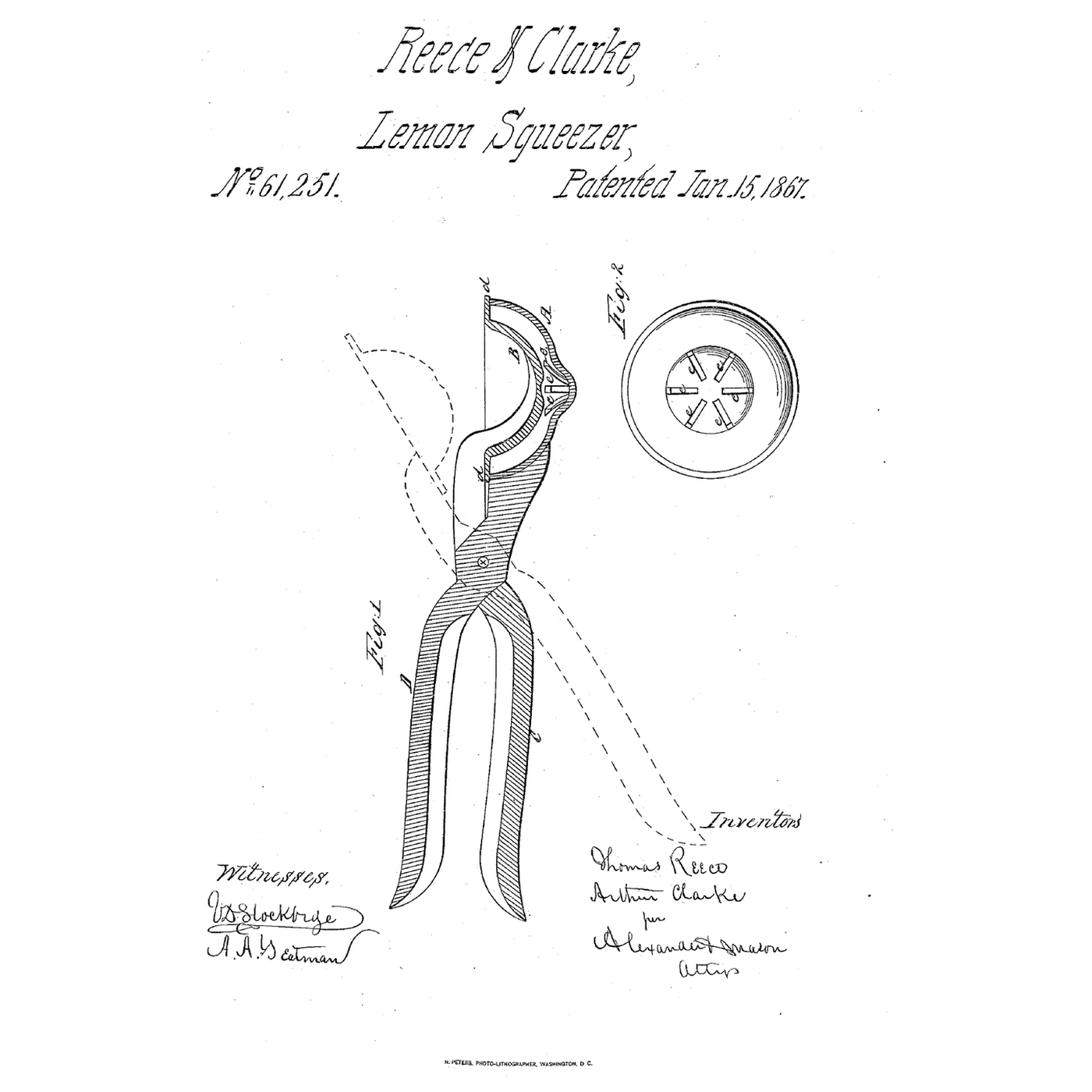


The Shears-Cup Lemon Squeezer: Two Cups on Crossed Handles, a Slotted Recess for the Juice
A lemon squeezer lets the seeds through with the juice, or crushes them into it, and its holes clog with pulp.
Thomas Reece and Arthur Clarke of Philadelphia, Pennsylvania, received US 61,251, dated 15 January 1867, for a squeezer of two cups of metal or wood on handles "pivoted together at x, so that the cups may be separated or brought together similar to the blades of a pair of shears." The larger cup has a small recess in its bottom with slots radiating from its centre, so formed "as not to allow any seed to pass through them", and the smaller cup has a flange that stops it going too far into the other.
This rung works out the squeeze through the crossed handles, with a work check, then makes the squeezer from two tins on flat-bar handles, and squeezes lemons with it.
Intermediate
About 4 hours
Instructions
1
1
Crossed handles
Crossed handles
Loading Jupyter Notebook...
2
2
A hinged squeezer before it
A hinged squeezer before it
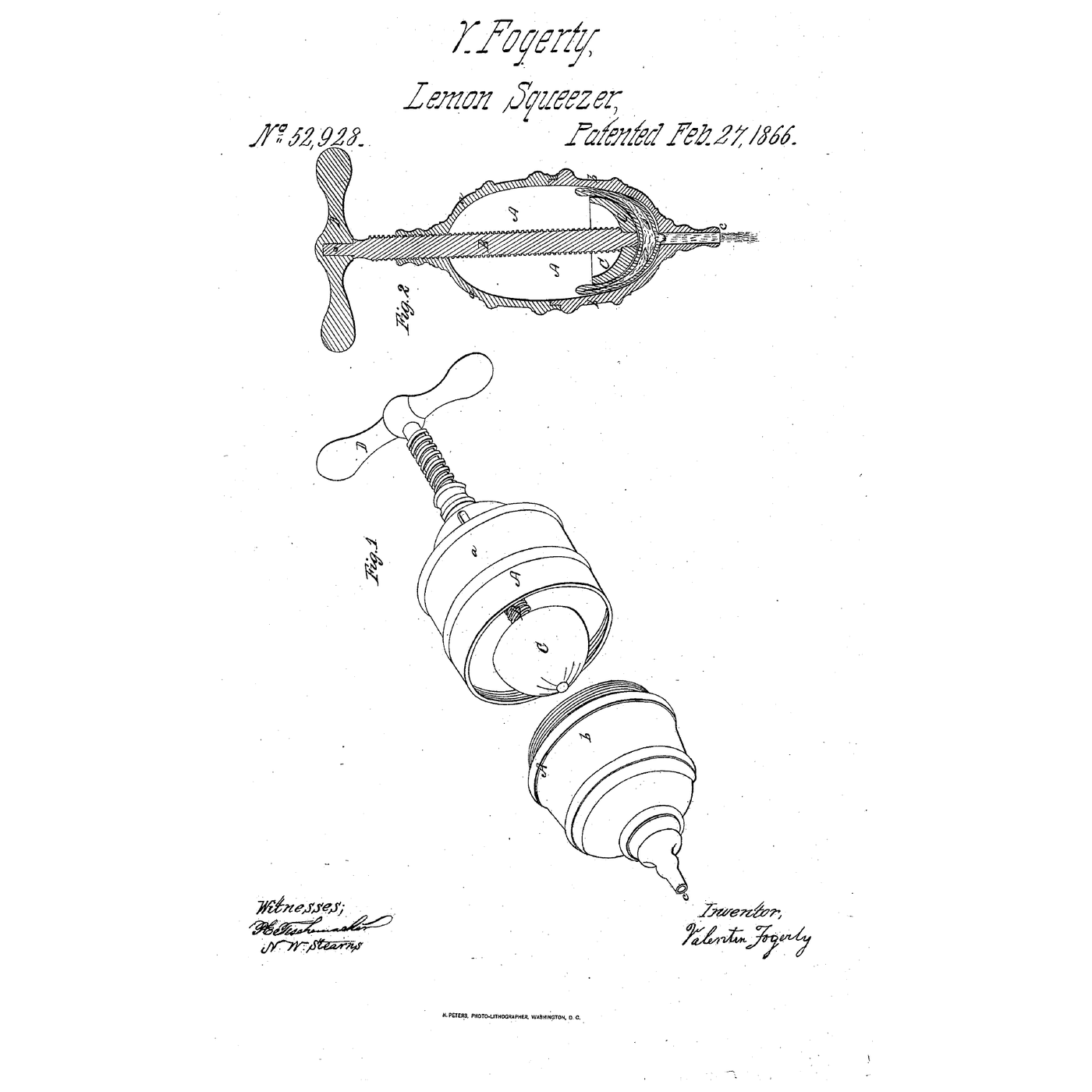
The embedded blueprint pins its handles at their front ends. Reece and Clarke cross theirs like shears and slot the recess so seeds stay behind.
3
3
Read US 61,251
Read US 61,251
"The cup B is made smaller than cup A, and works within it with its bottom down. This cup B is provided around its mouth with a flange, d, which catches upon the mouth of cup A when the two cups are brought together, as shown in Figure 1. These cups are provided with the handles C and D, which said handles are pivoted together at x, so that the cups may be separated or brought together similar to the blades of a pair of shears."
"The space between the two cups allows the juice to be pressed out through the slots or openings without breaking the seed, and the slots are so formed and are of such a size as not to allow any seed to pass through them."
4
4
Make the squeezer and press lemons
Make the squeezer and press lemons
**Handles.** Cut two 25 cm lengths of 20 × 5 mm mild steel flat bar and drill each 8 cm from one end for an M6 pivot bolt, so they cross like shears.
**Cups.** Cut the bottoms from two clean tin cans, one about 8 cm across and one about 6.5 cm, each 3 cm deep. In the larger one's base, hammer a small recess over a hole in a hardwood block, and cut four narrow slots in it radiating from the centre, 2 mm wide. Rivet a ring of tinplate round the smaller one's mouth as the flange d.
**Assemble.** Rivet each cup to the short end of a handle so the smaller cup, bottom down, closes into the larger one when the handles are squeezed, and bolt the handles at the pivot.
**Test.** Halve a lemon, put one half cut side down in the larger cup over a glass, and squeeze. Count the seeds left in the cup and in the glass, and weigh the juice.
Materials for this step:
 Mild Steel Flat Bar0.5 meter
 Tin Can2 pieces
 Tinplate Sheet1 piece
 Steel Rivets8 pieces
 Hex Bolt Assortment1 piece
 Hex Nut1 piece
 Hardwood Block1 piece
 Lemon2 pieces
Tools needed:
 Hacksaw
 Cordless Drill
 Drill Bit Set
 Files (Hand File)
 Needle File Set
 Bench Vise
 Tin Snips
 Hammer
 Rivet Set
 Adjustable Wrench
 Kitchen Knife
 Digital Kitchen Scale
 Drinking Glass
 Leather Work Gloves
5
5
A squeezer that lets seeds through, clogs or sprays
A squeezer that lets seeds through, clogs or sprays
Shears-cup lemon squeezer troubleshooting.
Flow
Loading...
6
6
History and honest limits
History and honest limits
**Thomas Reece and Arthur Clarke** of Philadelphia, Pennsylvania, received US 61,251, dated 15 January 1867. The cups could be metal, galvanized, or wood tinned against the acid; the peculiar shape of cup A with its recess kept the squeezer from clogging or choking. Their claim is the two hinged handles with the two cups, one with a slotted recess and the other with a flange.
**Honest limits.** Tin cans and flat bar stand in for their made-up cups and handles. The notebook ignores friction; its forces and lengths are examples. Your seed count and juice are the result.
Materials
8- 0.5 meterPlaceholder
- 2 piecesPlaceholder
- 1 piecePlaceholder
- 8 piecesPlaceholder
- 1 piecePlaceholder
- 1 piecePlaceholder
- 1 piecePlaceholder
- 2 piecesPlaceholder
Tools Required
14- Placeholder
- 1 vendor sell this, none ship to you yetPlaceholder
- Placeholder
- Placeholder
- Placeholder
- Placeholder
- Placeholder
- Placeholder
- Placeholder
- Placeholder
- Placeholder
- Placeholder
- Placeholder
- Placeholder
This blueprint makes

Related Blueprints
These blueprints share knowledge with this one — techniques, materials, or principles that connect them in the learning graph.




CC0 Public Domain
This blueprint is released under CC0. You are free to copy, modify, distribute, and use this work for any purpose, without asking permission.
Support the Maker by purchasing products through their Blueprint where they earn a Maker Commission set by Vendors, or create a new iteration of this Blueprint and include it as a connection in your own Blueprint to share revenue.