ART
BEAUTY & WELLNESS
CRAFT
CULTURE & HISTORY
ENTERTAINMENT
ENVIRONMENT
FOOD & DRINKS
REVERSE ENGINEERING
SCIENCES
SPORTS
TECHNOLOGY
WEARABLES



The Sponge-Filter Inkstand: Press the Funnel and Clean Ink Rises Round the Pen
Ink standing in an open well collects dust and sediment, which the pen picks up, and dries in the air.
Walter Hunt of New York received US 4,306, dated 11 December 1845, for "a new Improvement in the Construction of Filtering-Tubes to be Used and Connected with the Tops of Ordinary Inkstands": a tube under the top, closed at the bottom by a cork with a small aperture, holding a piece of sponge, a spiral spring and a plunger with a conical funnel on top. The pen presses the funnel down, the ink is forced up through the sponge and around the pen's point, and when the pen is withdrawn the spring lifts the plunger and the ink sinks back below.
This rung works out how much ink a stroke lifts, then builds the filter tube into a jar lid and writes with ink drawn up through it.
Intermediate
About 4 hours
Instructions
1
1
Ink lifted by a stroke
Ink lifted by a stroke
Loading Jupyter Notebook...
2
2
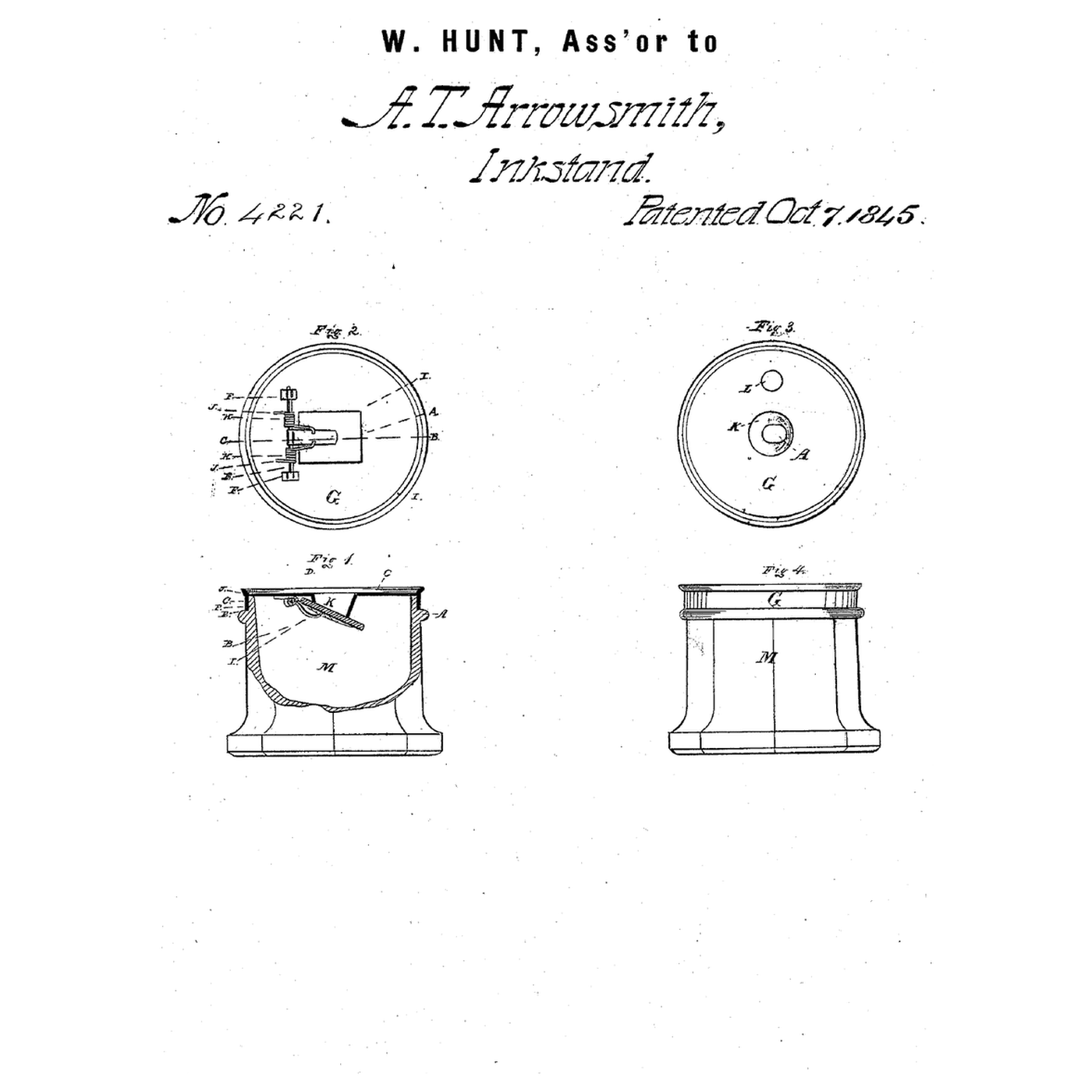
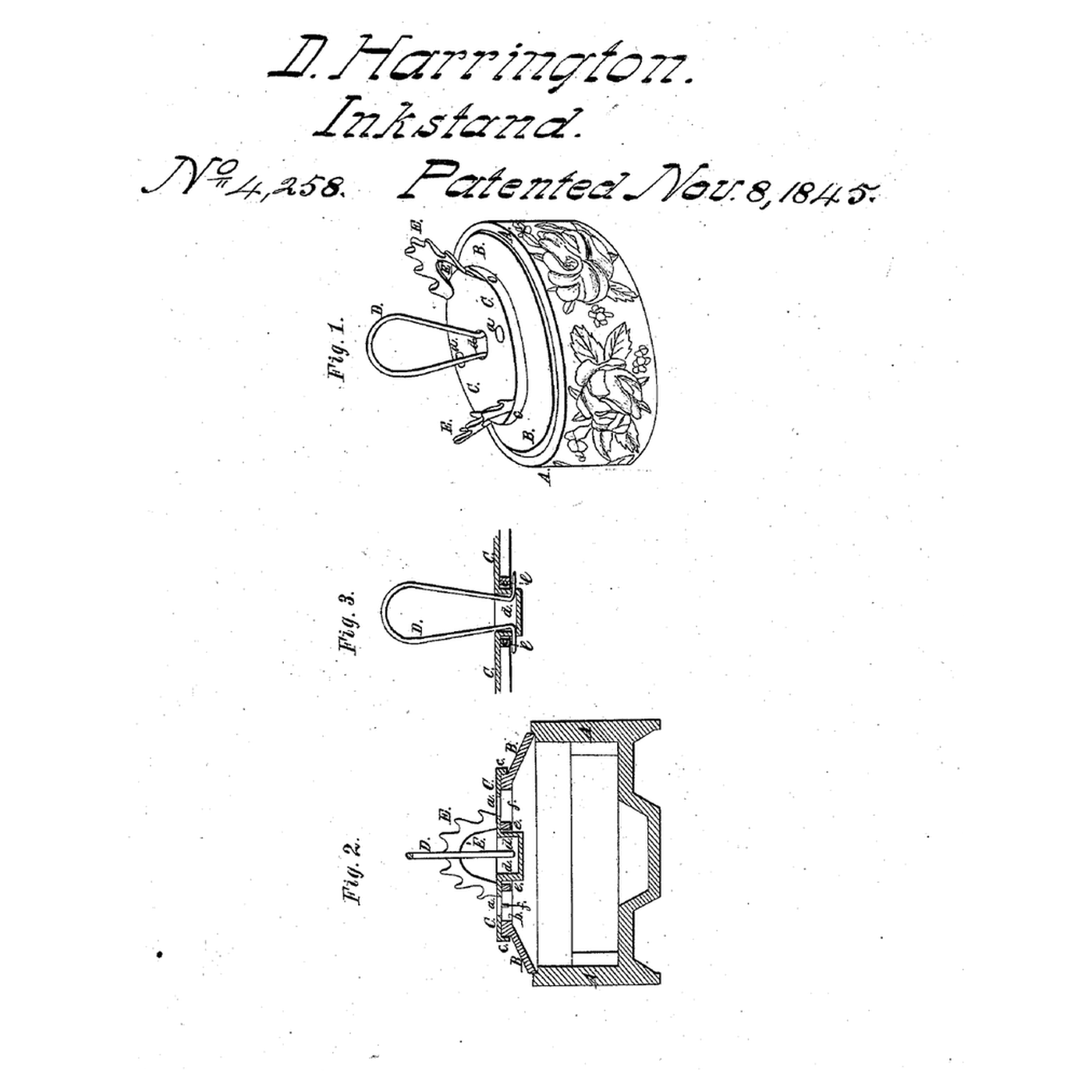
Hunt's earlier inkstand
Hunt's earlier inkstand
The embedded blueprint closes the ink tube with a glass valve the pen opens. Two months later Hunt drew the ink up through a sponge when the pen presses a spring plunger.
3
3
Read US 4,306
Read US 4,306
"Upon the top of said spring K, is fitted a plunger L, (made of cork or otherwise) and which can be moved up and down freely in said filter tube. The upper surface of said plunger is covered with a conical, or conical shaped cop M, firmly secured by cement, (or otherwise) upon the same. Said cop has a small opening N in its center (see Fig. 4, top view) precisely similar to the common funnel, with the tube removed, which is only large enough to admit the nib of the pen in using."
"Concentric with said opening, is one of similar diameter through said plunger, in which is inserted a small piece of sponge as shown at O, which prevents a sudden jet of the ink when the pen is introduced, and also allows the ink to subside gently, when the pen is withdrawn, while at the same time it excludes the atmosphere from the ink in the filter-tube below."
4
4
Build the filter tube and write
Build the filter tube and write
**Top and tube.** Print a jar lid with a funnel-shaped ink tube through its middle and a filter tube, 12 mm inside, that screws onto the tube's lower end and reaches nearly to the jar's bottom. Close the filter tube's bottom with a cork drilled with a 1 mm hole, as Hunt's stopper H and aperture I.
**Sponge, spring and plunger.** Push a plug of sponge into the tube's lower quarter, then a light compression spring. Cut a cork plunger that slides freely in the tube, drill it through, put a small piece of sponge in the hole, and cement a small printed cone on top with a hole just large enough for a nib.
**Test.** Fill the jar with ink and fit the lid. Press a dip pen into the cone: ink rises round the nib. Lift the pen and write. Stir some fine dust into a second, open well of the same ink and compare the two pens' lines.
Materials for this step:
 Glass Jar1 piece
 PLA Filament1 piece
 Corks2 pieces
 Sponge1 piece
 Compression Spring Assortment1 piece
 Two-Part Epoxy1 piece
 India Ink1 piece
 Paper1 piece
Tools needed:
 FDM 3D Printer
 Cordless Drill
 Drill Bit Set
 Kitchen Knife
 Calligraphy Pen Set
 Digital Caliper 6-Inch
5
5
A filter tube that floods, starves or sticks
A filter tube that floods, starves or sticks
Sponge-filter inkstand troubleshooting.
Flow
Loading...
6
6
History and honest limits
History and honest limits
**Walter Hunt** of New York, New York, assignor to George Arrowsmith, received US 4,306, dated 11 December 1845. His metal top A had a flange B fitting the reservoir; the funnel-shaped ink tube C screwed into it with a collar E for the thumb and finger, and the filter tube G was fitted to it at a ferrule joint F; the spring K was to be of silver or another metal the ink does not affect. His claims are the filter tube with its funnel, plunger, spring, sponge and perforated bottom.
**Honest limits.** A printed top and tube, corks and a bought spring stand in for his metal parts. The notebook assumes all the displaced ink goes into the funnel's mouth; its sizes and strokes are examples. Your lines are the result.
Materials
8- 1 piecePlaceholder
- 1 piecePlaceholder
- 2 piecesPlaceholder
- 1 piecePlaceholder
- Placeholder
- 1 piecePlaceholder
- 1 piecePlaceholder
- 1 piecePlaceholder
Tools Required
6- Placeholder
- 1 vendor sell this, none ship to you yetPlaceholder
- Placeholder
- Placeholder
- Placeholder
- Placeholder
Related Blueprints
These blueprints share knowledge with this one — techniques, materials, or principles that connect them in the learning graph.


CC0 Public Domain
This blueprint is released under CC0. You are free to copy, modify, distribute, and use this work for any purpose, without asking permission.
Support the Maker by purchasing products through their Blueprint where they earn a Maker Commission set by Vendors, or create a new iteration of this Blueprint and include it as a connection in your own Blueprint to share revenue.