ART
BEAUTY & WELLNESS
CRAFT
CULTURE & HISTORY
ENTERTAINMENT
ENVIRONMENT
FOOD & DRINKS
REVERSE ENGINEERING
SCIENCES
SPORTS
TECHNOLOGY
WEARABLES


The Ticket Punch: Shearing a Hole, and Catching the Chad
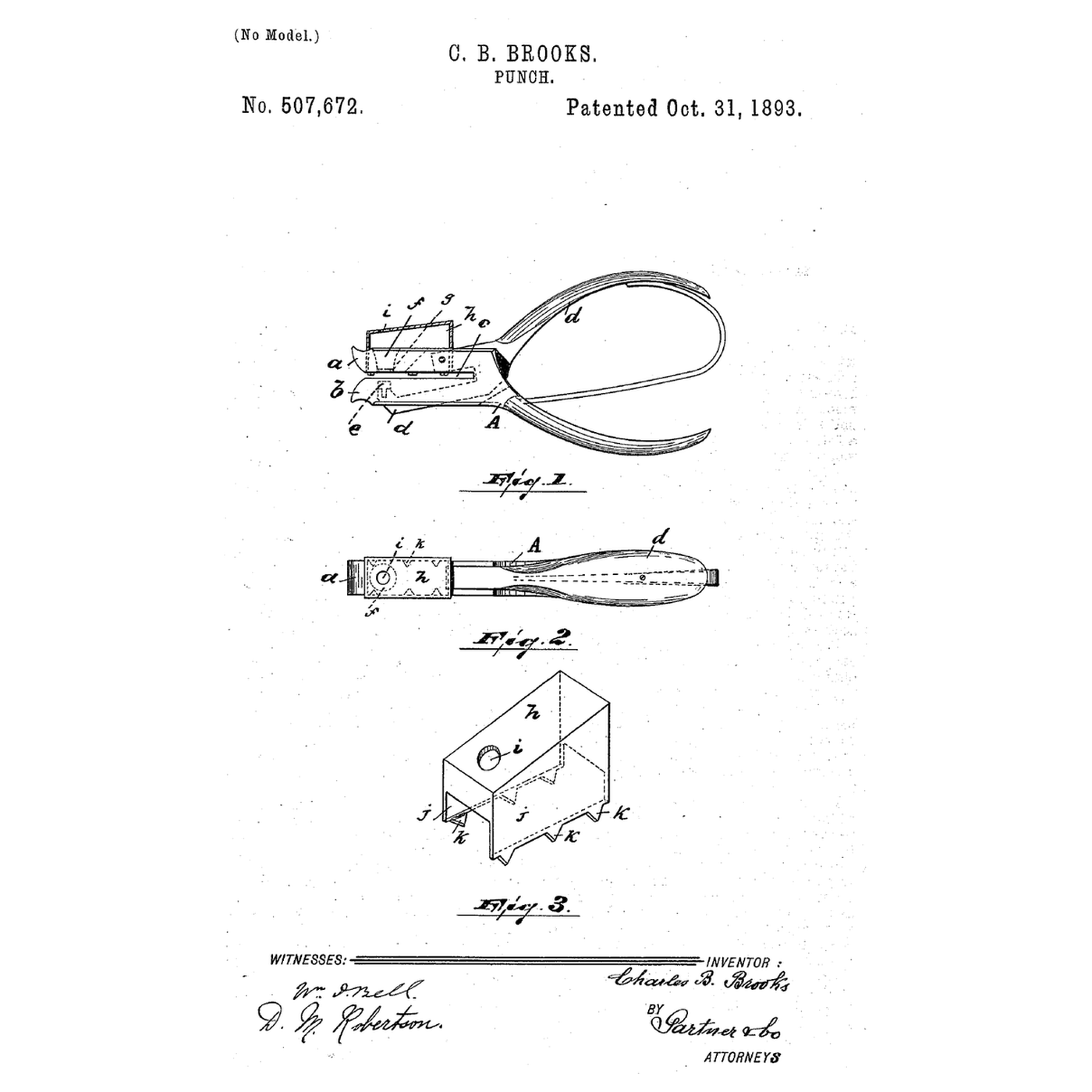
A railway conductor proved a ticket had been used by punching a hole in it with a hand punch like a pair of pliers. The punch works like any press tool: a punch passes through a hole in a die and shears the card cleanly round its edge.
Charles B. Brooks of Newark, New Jersey, patented an attachment for ticket punches in US 507,672 (filed 10 January 1893, dated 31 October 1893). A small box clipped over the slotted lower jaw catches the punched-out pieces "to prevent the same from scattering over the floor of the car", and a smaller hole in its top lets the conductor see the ticket before punching.
This rung works out the force to punch paper and card and the lever that supplies it, and measures it on a desk punch.
Beginner
About 2 hours
Instructions
1
1
Shear force and the lever
Shear force and the lever
Loading Jupyter Notebook...
2
2
The press tool in miniature
The press tool in miniature
A ticket punch is a blanking tool for card. The embedded blueprint explains the punch, the die and the clearance between them.
3
3
Read US 507,672
Read US 507,672
The lower jaw A of the punch is split at its end into an upper portion a and a lower portion b by a horizontal slot c "in which slot the ticket to be punched is inserted." The upper jaw d pivots on it "in the usual well known manner" and carries a removable punch section e which, when d is pressed, enters "the conical hole f" in portion a "and to cut the ticket against the cutting edge g thereof." Brooks notes that this form of punch is well known.
His addition is a receptacle or box h fitted over portion a, with an aperture i "of smaller diameter than and coinciding with" hole f. Prongs on its sides bend under the jaw to hold it on. The clippings "are prevented from flying over the floor and furniture of the car" and are kept until "a suitable place and time" to empty them, and the aperture "enables the conductor to see the ticket before it is punched".
4
4
Punch, count and measure
Punch, count and measure
Punch holes through one sheet of paper, then stacks of 5, 10 and 20, and through a strip of card stock. Hook the spring scale to the end of the punch's handle and pull until it cuts: that force times the lever ratio is the punch force. Compare with the notebook and work out the paper's shear strength from your readings.
Look at the edges of the holes under a hand lens: a sharp punch with a small clearance leaves a clean edge; a worn one tears and leaves fibres. Save the chads in a box, as Brooks did, and count them.
Materials for this step:
 Paper1 piece
 Card Stock1 piece
Tools needed:
 Hole Punch
 Force Meter (Spring Scale)
 Digital Caliper 6-Inch
 Hand Lens - 10x
 Ruler
Ruler5
5
A punch that tears instead of cutting
A punch that tears instead of cutting
Hole punch troubleshooting.
Flow
Loading...
6
6
History and honest limits
History and honest limits
**Charles B. Brooks** of Newark, New Jersey, filed on 10 January 1893; US 507,672 is dated 31 October 1893. It claims a ticket punch whose slotted jaw carries a removable receptacle with an aperture smaller than, and in line with, the punch hole.
**Honest limits.** The shear strength of paper varies widely with grade and humidity; the figure in the notebook is an assumption to be replaced by your measurement.
Tools Required
5- Placeholder
- Placeholder
- Placeholder
- Placeholder
- Placeholder
Related Blueprints
These blueprints share knowledge with this one — techniques, materials, or principles that connect them in the learning graph.

Blanking: The Punch, the Die, and the Gap Between Them
by Forge
Metalworking
39
0
0
0
0
0
Punching and Drifting: A Hole Without Removing Metal
by Forge
Metalworking
31
0
0
0
0
0

The Law of the Lever — Archimedes' Balance of Weight and Distance
by Martin
Physics
64
0
0
0
1
0
The Jacquard Mechanism — Punch Card Programmable Pattern Weaving
by Tex
Textile & Leather
100
0
0
0
4
0
CC0 Public Domain
This blueprint is released under CC0. You are free to copy, modify, distribute, and use this work for any purpose, without asking permission.
Support the Maker by purchasing products through their Blueprint where they earn a Maker Commission set by Vendors, or create a new iteration of this Blueprint and include it as a connection in your own Blueprint to share revenue.