Collaboration
ART
BEAUTY & WELLNESS
CRAFT
CULTURE & HISTORY
ENTERTAINMENT
ENVIRONMENT
FOOD & DRINKS
REVERSE ENGINEERING
SCIENCES
SPORTS
TECHNOLOGY
WEARABLES
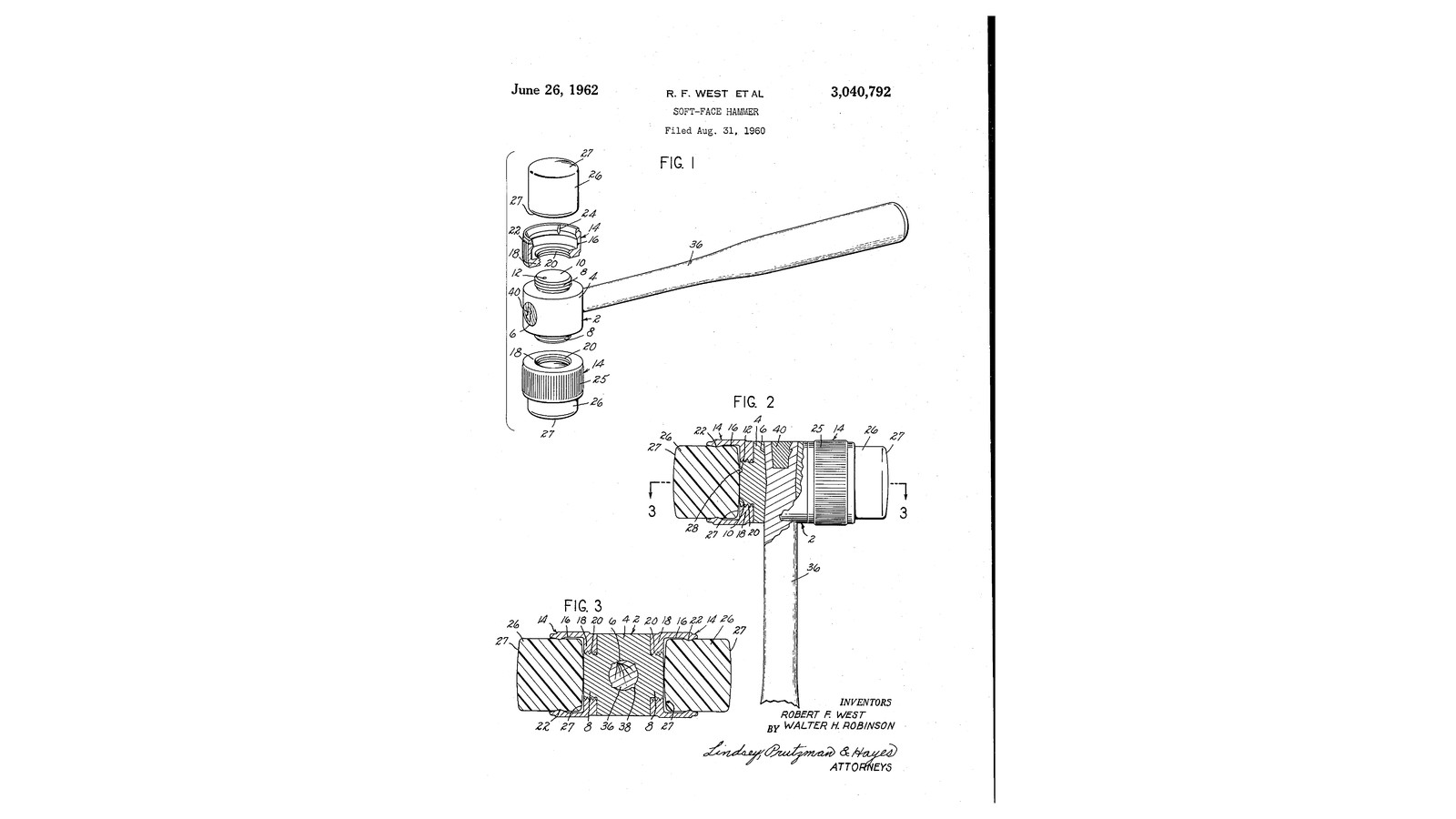


Reversible-Tip Soft-Face Hammer: Domed Rubber Tips Locked in Screw-On Sockets by an Internal Rib (West & Robinson, 1962)
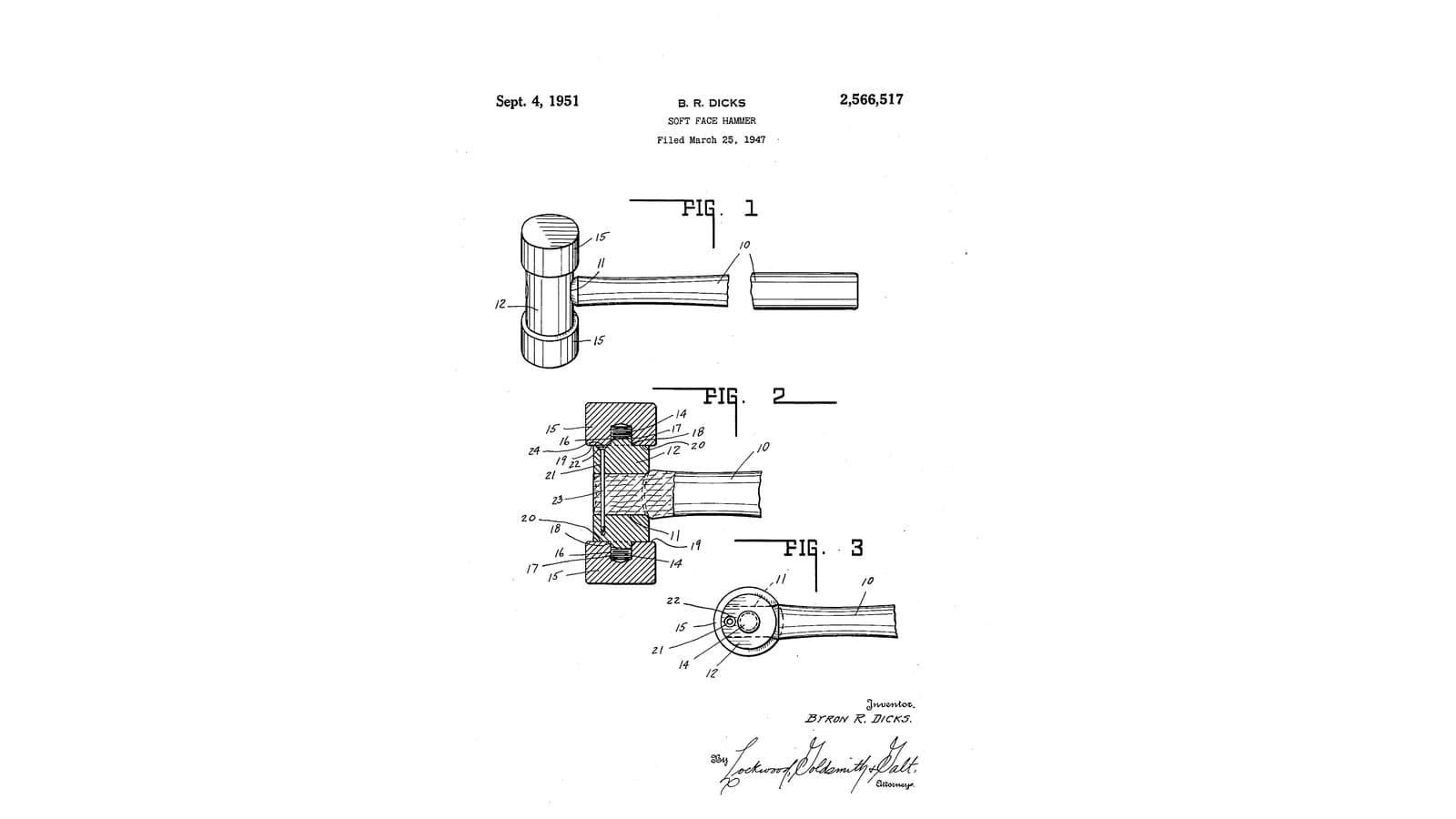
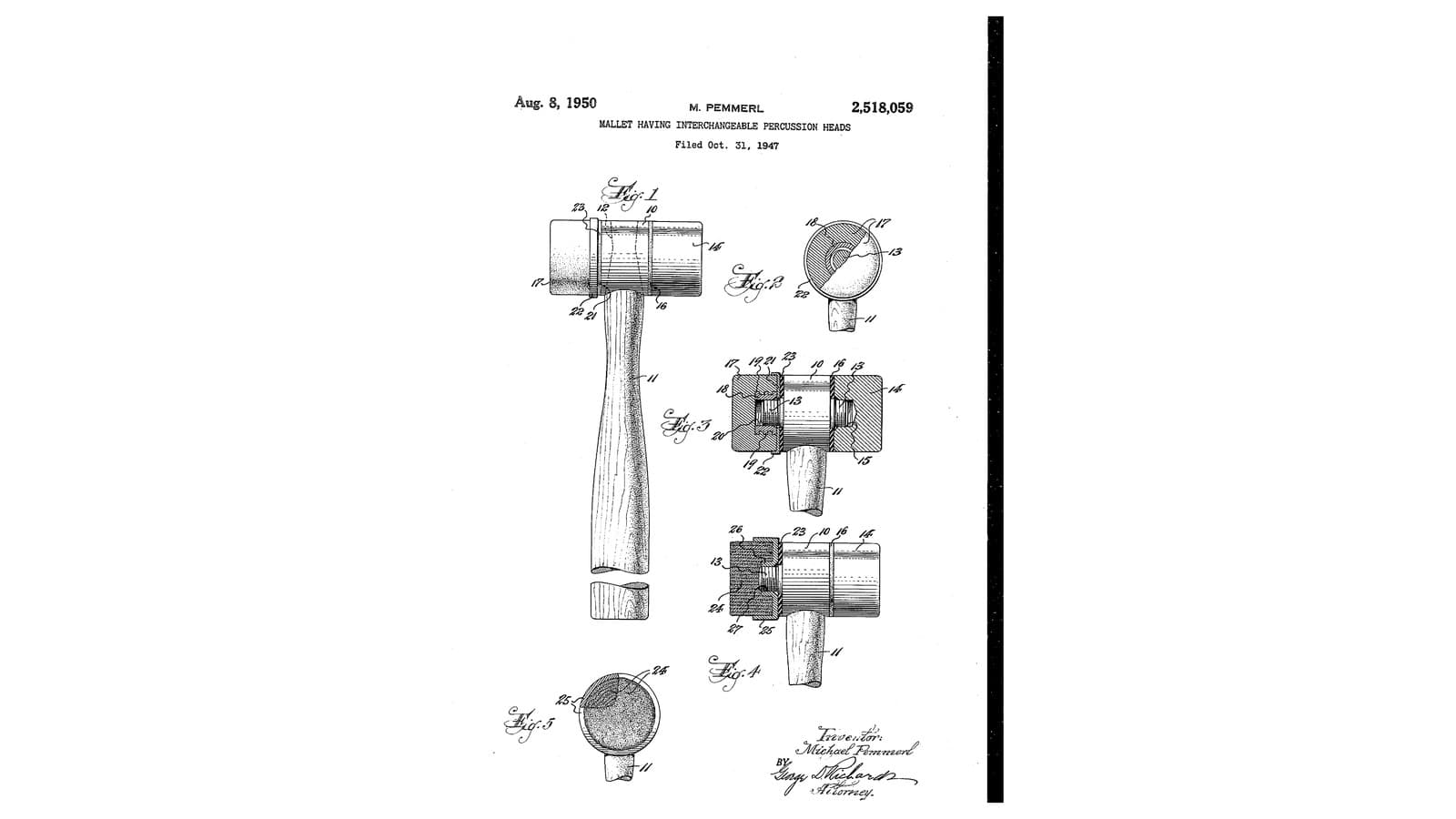
Robert F. West and Walter H. Robinson of Connecticut received US 3,040,792, dated 26 June 1962, for The Stanley Works. A tubular socket screws onto a threaded boss at each end of the hammer's head. A rubber tip, domed at both ends, is pushed into the socket past an internal rib, which bites into it, and its rubber fills short grooves so it cannot turn. The tip can be pulled out and turned round to use its other end. On its first blows the tip's inner face squeezes into an off-centre hole in the boss and forms its own dowel, which stops the socket unscrewing.
The patent gives no sizes; every size here is ours.
Advanced
About 2 days
Instructions
1
1
The tip's proportions
The tip's proportions
Loading Jupyter Notebook...
2
2
Read US 3,040,792
Read US 3,040,792
"Upon being subjected to the percussive forces during initial use, some of the plastic material of the inner face 27 of the striking tip 26 will be extruded or forced into the eccentrically located recess 12 in the boss surface 10 to provide a self-forming dowel pin 28 which effectively prevents inadvertent loosening of the threaded connection between boss and mounting socket during use."
3
3
Turn the head 2
Turn the head 2
From 35 mm steel bar turn a body 4 80 mm long with a boss 8 20 mm across and 15 mm long at each end; cut M20 threads on the bosses with the die. In each boss's end face drill a recess 12 4 mm across and 4 mm deep, 6 mm off centre. Drill a 20 mm handle eye 6 through the middle in a V-block.
Materials for this step:
 Mild Steel Round Bar1 piece
 Cutting Oil1 piece
Tools needed:
 Metal Lathe
 Lathe Chuck 3-Jaw
 Lathe Cutting Tool
 Parting Tool
 Tap and Die Set
 Die Stock
 Bench Vise
 Drill Press
 V-Block
 Drill Bit Set
 Center Punch
 Digital Caliper 6-Inch
 Safety Glasses
4
4
Turn the sockets 14
Turn the sockets 14
From 48 mm bar turn two sockets 30 mm long. Knurl the outside 25. Drill and tap the collar end 18 M20, 8 mm deep. From the other end, before boring, drill four 4 mm holes 20 mm deep centred on a 38 mm circle, for the grooves 24. Bore the aperture 16 38 mm across and 20 mm deep, leaving a rib 22 4 mm wide 10 mm in, turned to 35 mm with 30 degree ramps either side.
Materials for this step:
Mild Steel Round Bar2 piecesCutting Oil1 pieceTools needed:
Metal LatheLathe Chuck 3-JawLathe Cutting Tool Boring BarParting Tool
 Knurling ToolDrill PressDrill Bit SetTap and Die Set
 Tap WrenchDigital Caliper 6-Inch
5
5
Make the tips 26
Make the tips 26
For each tip, cut nine discs of 4 mm natural rubber sheet 40 mm across and bond them into a stack with contact cement; clamp it overnight. Grind it round to 38.5 mm on the belt sander, then dome both ends: a large curve over most of the face and a small round where it meets the side, the same at both ends, 36 mm long overall.
Materials for this step:
 Natural Rubber Sheet1 piece
 Contact Cement1 piece
Tools needed:
 Compass
 Craft Knife
 Bar Clamp
 Belt SanderDigital Caliper 6-Inch
6
6
Assemble
Assemble
Turn an ash handle to drive into the eye and wedge it. Screw a socket onto each boss hand-tight. Push a tip into each socket, squeezing it past the rib in the vice between soft packing, until its inner dome bears on the boss. Give the first few blows on a wood block: the rubber pushes into the boss's recess and locks the socket. To turn a tip round, pull it out, reverse it and push it back.
Materials for this step:
 Hardwood Board1 piece
 Wood Glue1 piece
Tools needed:
 Wood Lathe
 Lathe Tool Set (HSS)
 Hacksaw
 Ball Peen HammerBench Vise
7
7
Troubleshooting
Troubleshooting
Reversible-tip hammer troubleshooting.
Flow
Loading...
8
8
History and honest limits
History and honest limits
**Robert F. West** of Simsbury and **Walter H. Robinson** of West Hartford, Connecticut, assignors to The Stanley Works, US 3,040,792, dated 26 June 1962, filed 31 August 1960. They claimed sockets with an internal portion of reduced cross-section whose surfaces are "inclined to provide ramp surfaces", and symmetrical tips "having end surfaces of convexly curvilinear configuration", removable and "reversible in said sleeves". They list natural rubber, synthetic rubbers, nylon and cellulose esters for the tips; ours are laminated natural rubber. They give proportions but no sizes; every size here is ours.
Materials
6- 2 piecesPlaceholder
- 2 piecesPlaceholder
- 1 piecePlaceholder
- 1 piecePlaceholder
- 1 piecePlaceholder
- 1 piecePlaceholder
Tools Required
24- Placeholder
- Placeholder
- Placeholder
- Placeholder
- Placeholder
- Placeholder
- Placeholder
- Placeholder
- Placeholder
- Placeholder
- Placeholder
- Placeholder
- Placeholder
- Placeholder
- Placeholder
- Placeholder
- Placeholder
- Placeholder
- Placeholder
- 1 vendor sell this, none ship to you yetPlaceholder
- Placeholder
- Placeholder
- Placeholder
- Placeholder
This blueprint makes

Related Blueprints
These blueprints share knowledge with this one — techniques, materials, or principles that connect them in the learning graph.
CC0 Public Domain
This blueprint is released under CC0. You are free to copy, modify, distribute, and use this work for any purpose, without asking permission.
Support the Maker by purchasing products through their Blueprint where they earn a Maker Commission set by Vendors, or create a new iteration of this Blueprint and include it as a connection in your own Blueprint to share revenue.