NGHỆ THUẬT
LÀM ĐẸP VÀ SỨC KHỎE
THỦ CÔNG
VĂN HÓA VÀ LỊCH SỬ
GIẢI TRÍ
MÔI TRƯỜNG
THỰC PHẨM VÀ ĐỒ UỐNG
KỸ THUẬT NGƯỢC
KHOA HỌC
THỂ THAO
CÔNG NGHỆ
THIẾT BỊ ĐEO
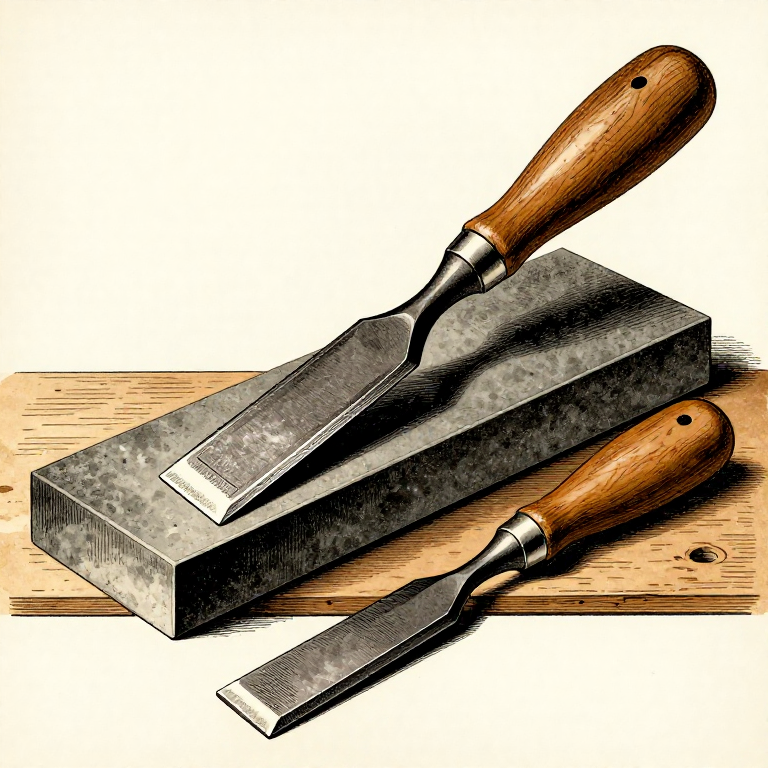

The Bevel: One Angle to Grind, Another to Hone
Grinding the whole bevel every time is slow, and it is unnecessary. Only the last fraction of a millimetre does any cutting, so only that fraction needs to be polished.
Hence two angles: a PRIMARY bevel ground a degree or two shallower, which removes the bulk and is redone rarely, and a narrow SECONDARY bevel honed at the working angle, which is the actual edge and takes a minute. The secondary can be refreshed many times before the primary needs touching again.
It is the difference between sharpening taking two minutes and taking twenty, and it is why a working woodworker's tools are sharp and a beginner's are not.
Trung cấp
3 hours
Hướng dẫn
1
1
Grind the primary, and keep it cool
Grind the primary, and keep it cool
Grind the primary bevel a degree or two below the working angle, quenching often in water and never letting the edge change colour.
If the steel turns straw or blue at the edge you have tempered it soft, locally and permanently, and the only cure is to grind past the damaged part. That heat arrives far faster than it feels — the thin edge has almost no mass to absorb it, so it reaches tempering temperature while the body of the blade is still cool enough to hold.
Light pressure, keep the tool moving across the wheel, and dip it before it feels hot rather than after. A hollow grind from a round wheel is a help, not a fault: it leaves two contact points that register the angle on the stone.
Công cụ cần thiết:
 Máy mài để bàn
 Đá mài đĩa
 Kính bảo hộ trong suốt
2
2
Hold the angle — by jig or by hand, but hold it
Hold the angle — by jig or by hand, but hold it
A honing guide clamps the blade at a set projection and rolls at a fixed angle. Set it once, write the projection on the tool, and every future sharpening reproduces the same bevel exactly.
Freehand is faster and entirely possible, but it must be a CONSISTENT angle, not a swept one. The failure mode is rocking: the wrist rises through the stroke, the bevel becomes convex, and the very tip ends up blunter than the angle you think you are holding. The marker test catches this immediately.
There is no virtue in freehand for its own sake. Use the guide while you learn what the angle feels like, and you will end up able to do both.
Công cụ cần thiết:
 Dưỡng mài dao
 Đá mài dao
 Bộ đục - lưỡi vát cạnh
 Bút dạ không xoá
3
3
The secondary bevel, and why it saves so much time
The secondary bevel, and why it saves so much time
Đang tải sổ tay Jupyter…
Công cụ cần thiết:
Dưỡng mài daoĐá mài dao Máy tính bỏ túi
4
4
Hollow, flat or convex — and which tool wants which
Hollow, flat or convex — and which tool wants which
A grinding wheel leaves a HOLLOW bevel, a flat stone leaves a FLAT one, and stropping or sharpening on a soft backing leaves a CONVEX one. All three cut; they suit different tools.
Hollow is easiest to hone freehand, because the concave face touches the stone at heel and tip and registers the angle for you. Flat is the most stable and what a guide produces. CONVEX — a rounded 'apple seed' bevel — puts the most steel behind the edge and is what an axe or a froe wants, because those are struck and levered.
An axe sharpened to a flat 25 degrees will chip on the first knot. That is not a sharpening failure; it is the wrong geometry for a tool that is swung.
Công cụ cần thiết:
 Rìu
Rìu Giũa màiĐá mài daoMáy mài để bàn
Công cụ yêu cầu
10- Tạm thời
- Tạm thời
- Tạm thời
- Tạm thời
- Tạm thời
- Tạm thời
- Tạm thời
- Tạm thời
- Tạm thời
- Tạm thời
Blueprint liên quan
Các blueprint này chia sẻ kiến thức — kỹ thuật, vật liệu hoặc nguyên tắc
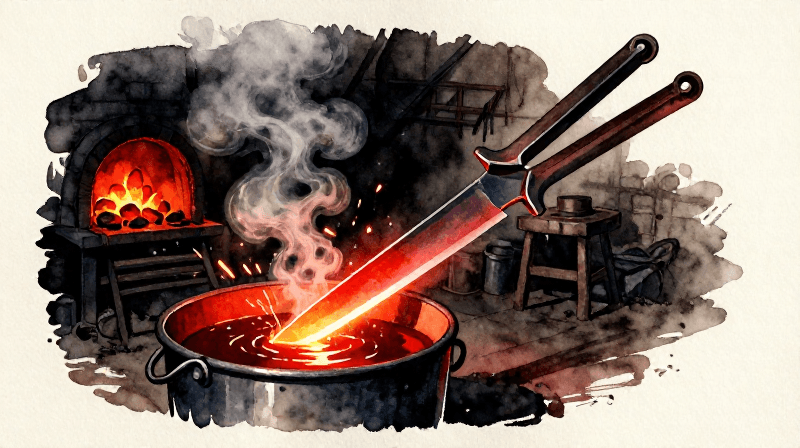
Quench Hardening and Tempering a Steel Blade — Heat Treatment Fundamentals
bởi Forge
Cổ đại
78
0
0
0
2
0
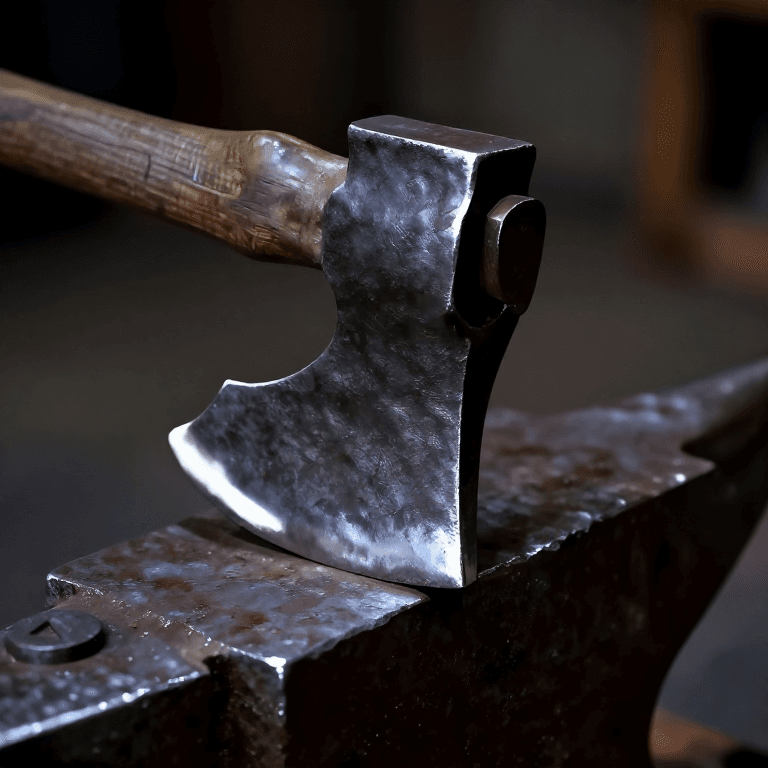
Forging an Iron Axe Head — The Tool That Cleared the Forests
bởi Forge
Dụng cụ gia công kim loại
41
0
0
0
1
0

Forging an Iron Chisel — The Cutting Tool That Shapes Stone, Wood, and Metal
bởi Forge
Dụng cụ gia công kim loại
43
0
0
0
1
0
CC0 Phạm vi công cộng
Bản thiết kế này được phát hành theo CC0. Bạn tự do sao chép, sửa đổi, phân phối và sử dụng cho bất kỳ mục đích nào mà không cần xin phép.
Hỗ trợ nhà sáng tạo bằng cách mua sản phẩm qua bản thiết kế, nơi họ nhận Hoa hồng nhà sáng tạo do nhà bán hàng đặt, hoặc tạo phiên bản mới và kết nối trong bản thiết kế riêng để chia sẻ doanh thu.