NGHỆ THUẬT
LÀM ĐẸP VÀ SỨC KHỎE
THỦ CÔNG
VĂN HÓA VÀ LỊCH SỬ
GIẢI TRÍ
MÔI TRƯỜNG
THỰC PHẨM VÀ ĐỒ UỐNG
KỸ THUẬT NGƯỢC
KHOA HỌC
THỂ THAO
CÔNG NGHỆ
THIẾT BỊ ĐEO
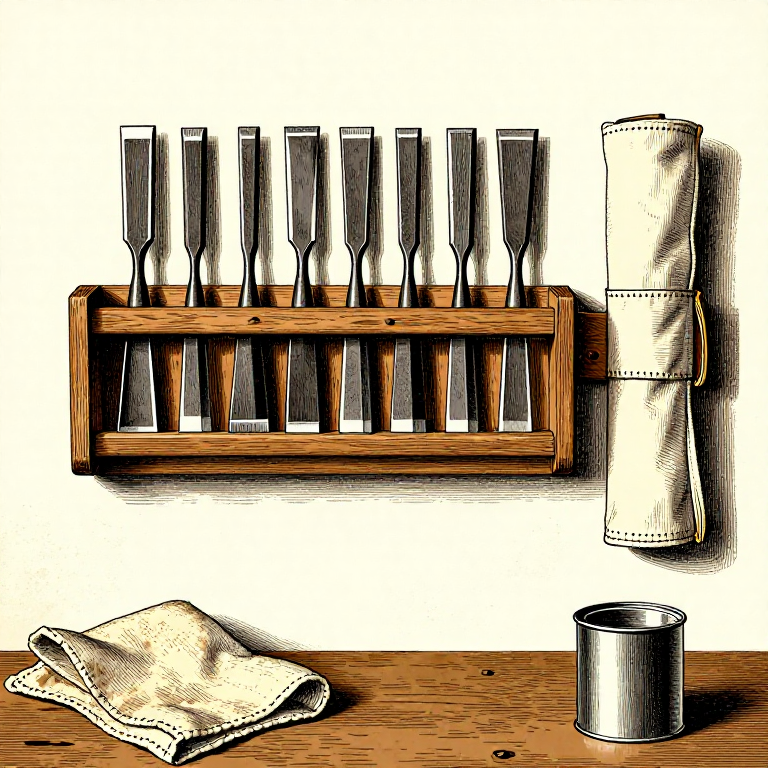


Keeping an Edge: Storage, Rust and the Habits That Save Steel
Most edges are not destroyed by cutting. They are destroyed between cuts — knocked against another tool in a drawer, driven into a benchtop, left damp, or pushed through a knot that was visible from the start.
Every one of those costs metal, because the repair is a trip to the coarse stone and the coarse stone is where a tool gets shorter. A carving chisel has perhaps a centimetre of usable blade over its whole life, and how long that lasts is decided almost entirely by habits.
This rung is the unglamorous half of sharpening, and it is the half that determines whether a tool lasts five years or fifty.
Cơ bản
2 hours
Hướng dẫn
1
1
Nothing touches the edge but the work
Nothing touches the edge but the work
Edges in a drawer together chip each other. Give every edged tool its own slot — a wall rack, a drilled block, a canvas roll, or a slotted till.
A tool roll is the cheapest solution and travels: a strip of canvas with sewn pockets, rolled and tied. Cheaper still, a scrap of hose slit lengthways slips over a chisel edge and costs nothing.
Never lay a chisel edge-down on the bench, and never set one on a metal surface. A single knock against a vice jaw puts a nick in the edge that takes ten minutes on the coarse stone to remove, and a tenth of a millimetre off the tool's life.
Vật liệu cho bước này:
 Tấm gỗ cứng1 cái
 Da thuộc1 cái
Công cụ cần thiết:
 Bộ đục - lưỡi vát cạnh
2
2
Rust eats the apex first
Rust eats the apex first
Wipe every carbon steel blade before it goes away, and leave a film of oil on it. Fingerprints are the usual culprit — salt and moisture, left exactly where a hand gripped the blade.
Rust attacks the apex first because that is where the steel is thinnest, so a blade that looks only lightly spotted may already be blunt. A tool put away sharp and found rusty months later needs the stone again, and that is metal spent on nothing.
Camellia oil traditionally, mineral oil in practice — any light non-drying oil works. In a damp workshop add a desiccant to the tool chest and check it seasonally. Stainless is the exception and generally holds a slightly worse edge in exchange.
Vật liệu cho bước này:
 Dầu khoáng dùng cho thực phẩm1 cái
Công cụ cần thiết:
 Vải cô tôngBộ đục - lưỡi vát cạnh
 Dao bếp
3
3
Look at the wood before you cut it
Look at the wood before you cut it
Grit in bark, a hidden nail, sand in reclaimed timber and a knot will each do more damage in one pass than a day of clean cutting.
Brush or scrub dirty stock before it meets an edge, and take reclaimed boards past a magnet first. Cut around knots rather than through them where you can, and when you cannot, use the tool ground for it — this is what the blunter mortise chisel angle is for.
The same applies in the kitchen: a glass or stone board destroys a knife edge far faster than anything it cuts. Use end-grain wood or soft plastic, and the same knife will need the stone a fraction as often.
Công cụ cần thiết:
 Tấm gỗ mềm đã khôVải cô tôngDao bếp
4
4
Sharpen on a schedule, not on a failure
Sharpen on a schedule, not on a failure
Strop before the tool feels dull. Hone before stropping stops working. Grind only when the secondary bevel has grown wide or the edge is damaged.
Waiting until a tool is visibly blunt means it was cutting badly for a long time before that — tearing fibres, needing more force, drifting off the line — and the repair takes ten times as long as prevention. Sharp tools are also safer, because the force that skids a blunt blade off the work is the force that reaches a hand.
In practice: strop at every break, hone at the end of a session or when stropping stops biting, and grind perhaps twice a year. That rhythm keeps a set of chisels sharp for a working lifetime and is the whole of this batch in three sentences.
Công cụ cần thiết:
 Dây da liếc dao
 Đá mài dao
 Dưỡng mài dao
Vật liệu
3- 1 cáiTạm thời
- 1 cáiTạm thời
- Tạm thời
Công cụ yêu cầu
7- Tạm thời
- Tạm thời
- Tạm thời
- Tạm thời
- Tạm thời
- Tạm thời
- Tạm thời
Blueprint liên quan
Các blueprint này chia sẻ kiến thức — kỹ thuật, vật liệu hoặc nguyên tắc
CC0 Phạm vi công cộng
Bản thiết kế này được phát hành theo CC0. Bạn tự do sao chép, sửa đổi, phân phối và sử dụng cho bất kỳ mục đích nào mà không cần xin phép.
Hỗ trợ nhà sáng tạo bằng cách mua sản phẩm qua bản thiết kế, nơi họ nhận Hoa hồng nhà sáng tạo do nhà bán hàng đặt, hoặc tạo phiên bản mới và kết nối trong bản thiết kế riêng để chia sẻ doanh thu.