NGHỆ THUẬT
LÀM ĐẸP VÀ SỨC KHỎE
THỦ CÔNG
VĂN HÓA VÀ LỊCH SỬ
GIẢI TRÍ
MÔI TRƯỜNG
THỰC PHẨM VÀ ĐỒ UỐNG
KỸ THUẬT NGƯỢC
KHOA HỌC
THỂ THAO
CÔNG NGHỆ
THIẾT BỊ ĐEO
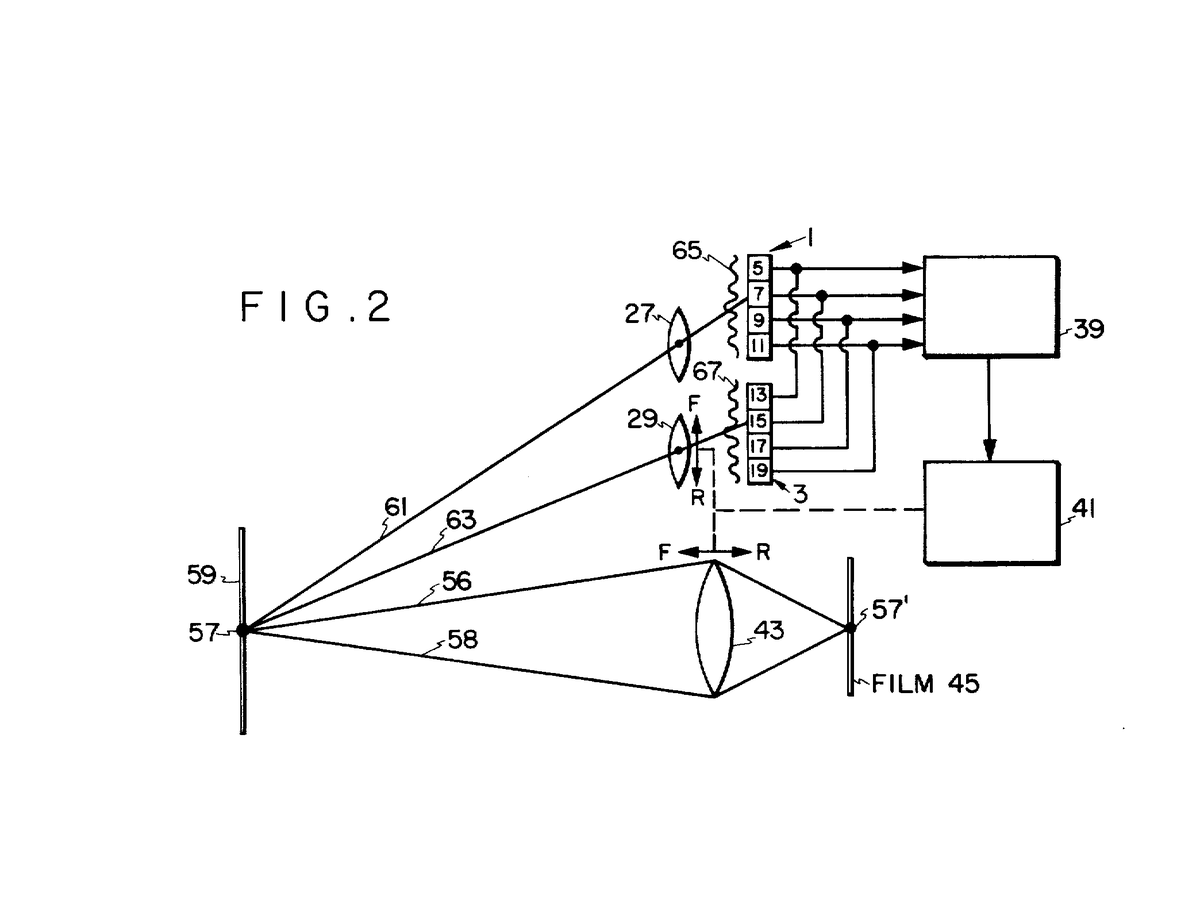


Passive Autofocus (Two-Array Comparison)
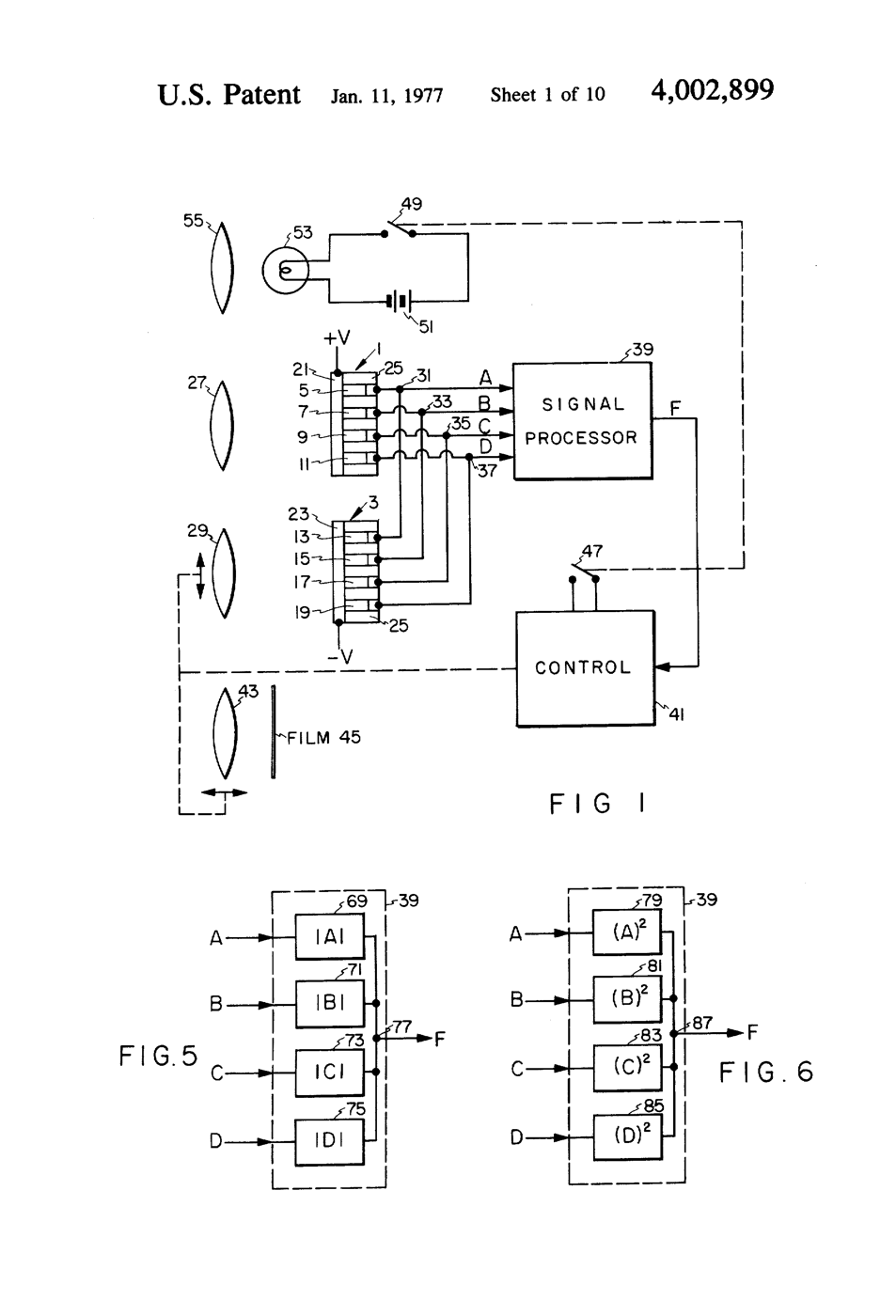
Norman Stauffer at Honeywell built a focus detector from two rows of tiny light sensors side by side on one chip. In his FIGURE 2 each row views the subject through its own small lens, a short distance from the other - like the two windows of a rangefinder. How far one row's picture is shifted against the other's gives the subject's distance, and the camera sets the taking lens to match, without trial and error. Compact cameras from 1977 used it; later SLRs moved the same comparison behind the taking lens itself (phase detection).
**US 4,002,899**, "Focus detecting apparatus", Stauffer, assigned to Honeywell, filed 31. October 1975, granted 11. January 1977: "radiation responsive elements formed on a single planar substrate and divided into two similar coplanar detector arrays lying immediately adjacent each other".
**You see the principle with a card**: a two-hole mask gives a lens two viewpoints, just as Stauffer's two lenses do; out of focus the point splits in two, and which spot vanishes when you cover one hole tells you which way to focus.
Trung cấp
90 minutes
Hướng dẫn
1
1
Make the two-hole mask
Make the two-hole mask
Cut a card disc to fit a lens holder. Punch two 3 mm holes 20 mm apart, symmetric about the centre.
Vật liệu cho bước này:
 Bìa đen1 tờ
Công cụ cần thiết:
 Dao rọc thủ công
 Thước kẻ
2
2
A point of light
A point of light
Cover the torch with foil pierced by one pin-sized hole. Put it 2 m from the bench in a dim room.
Vật liệu cho bước này:
 Giấy nhôm1 tờ
 Băng keo giấy1 cuộn
Công cụ cần thiết:
 Đèn pin LED soi kiểm tra
 Thước dây cuộn
3
3
Split and join
Split and join
Mount a 100 mm convex lens with the mask right in front of it, and a tracing-paper screen behind. Slide the screen: two spots merge into one exactly at focus. Measure their separation 5 and 10 mm either side of focus.
Vật liệu cho bước này:
 Bộ thấu kính hội tụ1 bộ
 Cuộn giấy can rập1 tờ
Công cụ cần thiết:
 Băng quang học và ray trượt
 Bộ giá giữ thấu kínhThước kẻ
4
4
Which way?
Which way?
With the screen too close, cover the left hole and note which spot disappears. Repeat with the screen too far. The answer flips: that is the direction signal phase detection gives for free.
5
5
Triangles and correlation
Triangles and correlation
Đang tải sổ tay Jupyter…
6
6
History & Context
History & Context
**What the patent specifies:** two similar, adjacent, coplanar arrays of radiation-sensitive elements on one substrate, whose outputs are compared to measure distance or focus. **Modern build (derived):** a Scheiner two-hole mask - two viewpoints and an image shift, made visible.
Christoph Scheiner described the two-hole experiment in 1619 to study the eye's focusing. Honeywell's chips put it into cameras; today's phones put phase-detection pixels directly into the image sensor. Its limits: it needs contrast (a blank wall defeats it) and precise alignment between the detector and the lens.
Vật liệu
5- 1 tờTạm thời
- 1 tờTạm thời
- 1 cuộnTạm thời
- Tạm thời
- Tạm thời
Công cụ yêu cầu
6- Tạm thời
- Tạm thời
- Tạm thời
- 1 vendor sell this, none ship to you yetTạm thời
- Tạm thời
- Tạm thời
Blueprint liên quan
Các blueprint này chia sẻ kiến thức — kỹ thuật, vật liệu hoặc nguyên tắc

CC0 Phạm vi công cộng
Bản thiết kế này được phát hành theo CC0. Bạn tự do sao chép, sửa đổi, phân phối và sử dụng cho bất kỳ mục đích nào mà không cần xin phép.
Hỗ trợ nhà sáng tạo bằng cách mua sản phẩm qua bản thiết kế, nơi họ nhận Hoa hồng nhà sáng tạo do nhà bán hàng đặt, hoặc tạo phiên bản mới và kết nối trong bản thiết kế riêng để chia sẻ doanh thu.