

Smelting Pig Iron in a Coke Blast Furnace — Molten Iron at Industrial Scale
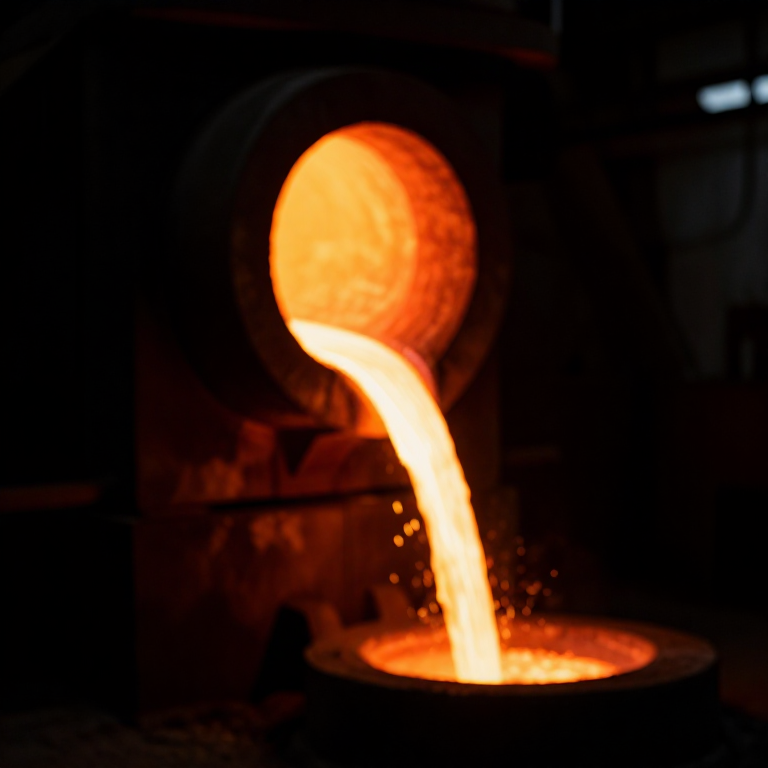
The bloomery gave the ancient world iron, but only in small spongy lumps, one slow batch at a time. The blast furnace changed everything: a tall shaft kept continuously charged and blown produces a steady river of molten iron. Where a bloomery never melts its metal, a blast furnace runs hot enough to liquefy iron entirely, letting it pool at the hearth and be tapped out by the tonne.
The key is heat and chemistry working together. A powerful air blast burns coke to carbon monoxide, which strips the oxygen from iron ore; meanwhile the descending iron soaks up carbon until it melts. Limestone added as flux carries off the stony impurities as a floating slag. What runs out of the tap hole is pig iron — iron saturated with about four percent carbon: hard, brittle, and perfect for casting or for refining into wrought iron and steel.
When coke replaced charcoal as the blast-furnace fuel in the early 1700s, iron could finally be made in unlimited quantity without consuming whole forests. Cheap pig iron became the raw material of the Industrial Revolution — the metal behind rails, bridges, engines, and machines.
Hướng dẫn
Understand pig iron
Understand pig iron
Build the shaft furnace
Build the shaft furnace
Vật liệu cho bước này:
 Gạch chịu lửa80 cái
Công cụ cần thiết:
 Bay làm vườn
Crush the ore and flux
Crush the ore and flux
Vật liệu cho bước này:
 Quặng sắt đầm lầy đã sấy30 kg
 Phiến đá vôi8 kg
Công cụ cần thiết:
 Búa
BúaSet up the air blast
Set up the air blast
Công cụ cần thiết:
 Bễ thổi
Light the coke bed
Light the coke bed
Vật liệu cho bước này:
 Than cốc luyện kim40 kg
Charge in layers
Charge in layers
Vật liệu cho bước này:
Than cốc luyện kim40 kgReduce the ore
Reduce the ore
Melt and carburize
Melt and carburize
Form and tap the slag
Form and tap the slag
Công cụ cần thiết:
 Thanh chọc lò
Tap the molten iron
Tap the molten iron
Công cụ cần thiết:
Thanh chọc lòCast the pigs
Cast the pigs
Vật liệu cho bước này:
 Cát đúc50 kg
Cool, break, and identify
Cool, break, and identify
Công cụ cần thiết:
BúaVật liệu
5- 80 cáiTạm thời
- Tạm thời
- 8 kgTạm thời
- 40 kgTạm thời
- 50 kgTạm thời
Vật liệu bản thiết kế liên kết

Blueprint liên quan
Các blueprint này chia sẻ kiến thức — kỹ thuật, vật liệu hoặc nguyên tắc


CC0 Phạm vi công cộng
Bản thiết kế này được phát hành theo CC0. Bạn tự do sao chép, sửa đổi, phân phối và sử dụng cho bất kỳ mục đích nào mà không cần xin phép.
Hỗ trợ nhà sáng tạo bằng cách mua sản phẩm qua bản thiết kế, nơi họ nhận Hoa hồng nhà sáng tạo do nhà bán hàng đặt, hoặc tạo phiên bản mới và kết nối trong bản thiết kế riêng để chia sẻ doanh thu.