NGHỆ THUẬT
LÀM ĐẸP VÀ SỨC KHỎE
THỦ CÔNG
VĂN HÓA VÀ LỊCH SỬ
GIẢI TRÍ
MÔI TRƯỜNG
THỰC PHẨM VÀ ĐỒ UỐNG
KỸ THUẬT NGƯỢC
KHOA HỌC
THỂ THAO
CÔNG NGHỆ
THIẾT BỊ ĐEO
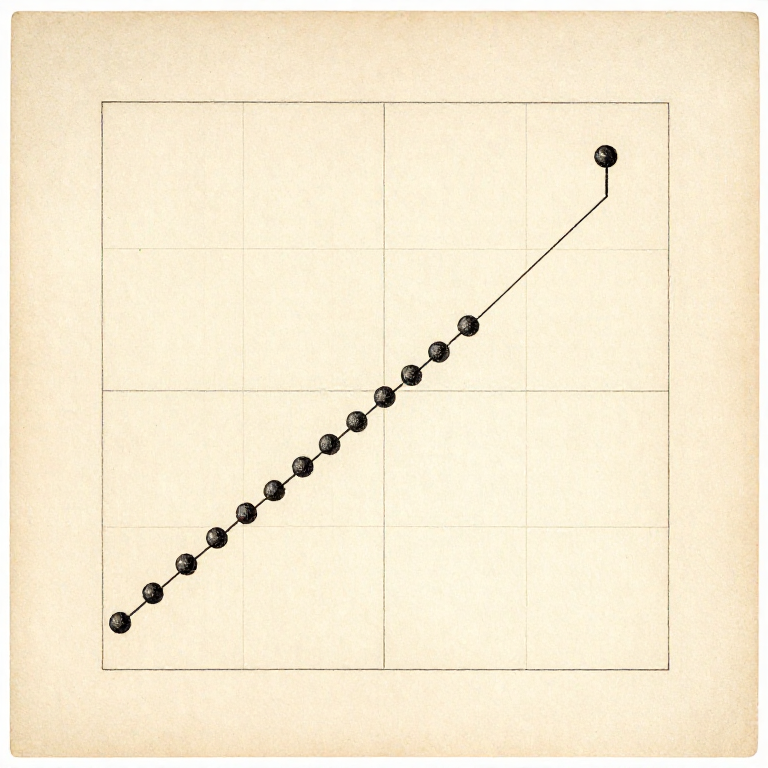


Plot It Before You Conclude: What a Table of Numbers Hides
Summary statistics are a compression, and like any compression they throw information away. A mean, a spread and a trend line can be identical for data that behaves in completely different ways — and the difference is obvious the moment you draw it.
This is not a hypothetical worry. Frank Anscombe published four small datasets in 1973 that share their mean, their variance, their correlation and their fitted line to two decimal places, and look nothing whatever like each other on paper.
So the rule is: plot it FIRST, before computing anything. The plot takes a minute, it cannot be fooled the way a summary can, and it is the only step that reliably catches a single bad point, a curve you assumed was a line, or a group that should never have been averaged together.
Trung cấp
3 hours
Hướng dẫn
1
1
Four datasets, one set of statistics
Four datasets, one set of statistics
Đang tải sổ tay Jupyter…
Công cụ cần thiết:
 Máy tính để bàn
 Giấy kẻ ô ly
2
2
Plot the raw points, not the averages
Plot the raw points, not the averages
Plot every reading you took, not one mean per condition. Six repeats plotted as six dots show their spread, their drift through the session and any outlier; collapsed to one dot they show none of it.
If you must plot means, draw the spread on them as error bars. A plot of bare means invites the eye to join them into a trend, and the eye will do it even when the bars overlap completely — which is the graphical version of calling a difference smaller than the scatter an effect.
Plot in the ORDER you took them too, as a second graph against run number. That one plot catches every drift: a warming room, a battery going flat, a blade dulling, an operator getting better at the job.
Công cụ cần thiết:
Giấy kẻ ô ly Thước kẻ
3
3
Choose the axes so a straight line means something
Choose the axes so a straight line means something
A curve is hard to judge by eye; a straight line is easy. So if theory says the period goes as the square root of the length, plot period against the square root of length rather than against length, and the relationship becomes a line you can check with a ruler.
The same trick handles growth and decay: plot the logarithm, and an exponential becomes a straight line whose slope is the rate. Quantities spanning several powers of ten almost always want a log axis, because otherwise every small value is crushed against the bottom.
Start the axes at zero unless you have a reason not to, and say so when you do not. A truncated axis makes a 2% difference look enormous, and that is the commonest way an honest plot misleads an honest reader.
Công cụ cần thiết:
Giấy kẻ ô ly Máy tính bỏ túiThước kẻ
4
4
Plot as you go, not at the end
Plot as you go, not at the end
Draw the points onto the graph while you are still taking them. A plot growing in front of you shows a problem while the apparatus is still set up and the sample still exists.
It also tells you where to spend the remaining time. Points crowding into one corner with a gap in the middle means the next few readings should go in the gap; a curve appearing where you expected a line means taking more points at the ends before packing up.
Graph paper in the notebook is enough. A hand-drawn plot made during the experiment is worth more than a beautiful one made a week later from numbers that can no longer be questioned.
Công cụ cần thiết:
Giấy kẻ ô lyBlueprint liên quan
Các blueprint này chia sẻ kiến thức — kỹ thuật, vật liệu hoặc nguyên tắc

CC0 Phạm vi công cộng
Bản thiết kế này được phát hành theo CC0. Bạn tự do sao chép, sửa đổi, phân phối và sử dụng cho bất kỳ mục đích nào mà không cần xin phép.
Hỗ trợ nhà sáng tạo bằng cách mua sản phẩm qua bản thiết kế, nơi họ nhận Hoa hồng nhà sáng tạo do nhà bán hàng đặt, hoặc tạo phiên bản mới và kết nối trong bản thiết kế riêng để chia sẻ doanh thu.