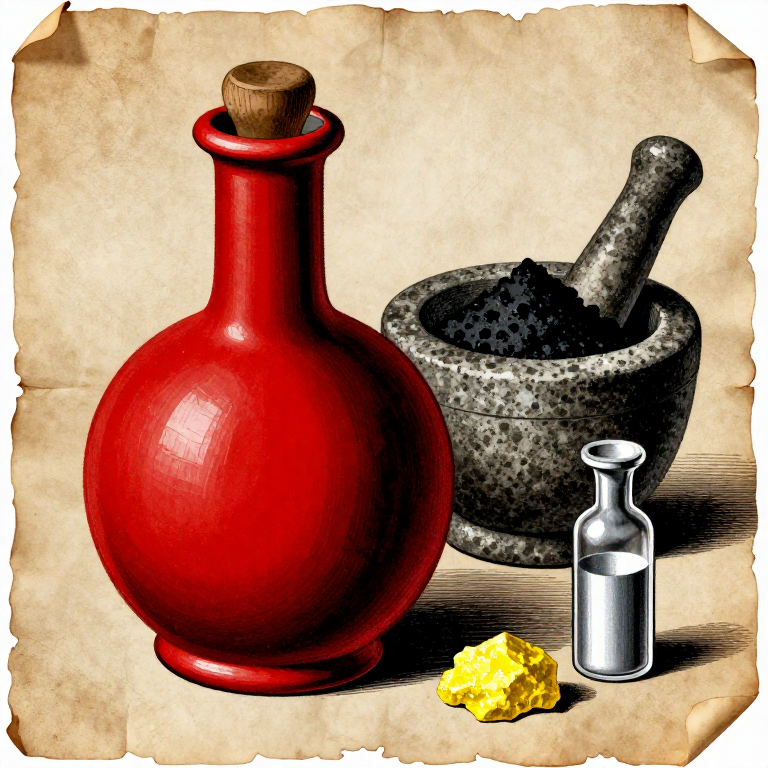

Synthesising Vermillion from Mercury and Sulfur — The King of Red Pigments
Vermillion (synthetic cinnabar, HgS) is one of the most brilliant and valued red pigments in the history of art. While natural cinnabar (ground mercuric sulfide ore) has been used since the Neolithic, the SYNTHESIS of vermillion — combining elemental mercury and sulfur by direct heating — was discovered independently in China (c. 4th century BCE, where it was called 'yín zhū' 銀朱) and later in the Islamic world (8th century CE, described by Jabir ibn Hayyan). European production began around the 12th-13th century, centred in Venice and Holland.
The synthesis produces a far more brilliant, uniform, and finely dividable pigment than grinding natural cinnabar ore. Synthetic vermillion became THE standard red pigment of European panel painting, Chinese and Japanese lacquerwork, and Islamic manuscript illumination for centuries. Its colour is an intense, warm, slightly orange red — unmistakable and impossible to replicate with any other single pigment.
SAFETY WARNING: This process involves MERCURY and SULFUR — both highly hazardous. Mercury vapour is a cumulative neurotoxin that causes permanent brain damage. Sulfur dioxide gas (released during heating) is a severe respiratory irritant. ALL work MUST be done OUTDOORS with full respiratory protection (mercury-rated respirator or supplied-air system), chemical goggles, and gloves. Mercury spills are extremely difficult to clean up — work over a tray to contain any spills. This is one of the most dangerous pigment-making processes and requires experienced handling.
Nội dung nguy hiểm
Blueprint này chứa các quy trình nguy hiểm. Đăng nhập và bật nội dung nguy hiểm trong cài đặt tài khoản của bạn để xem hướng dẫn từng bước.
Đăng nhậpBản thiết kế này làm ra

Blueprint liên quan
Các blueprint này chia sẻ kiến thức — kỹ thuật, vật liệu hoặc nguyên tắc
Making Red Ochre by Calcining Yellow Ochre — The Oldest Deliberate Pigment Transformation
bởi Charlie
NGHỆ THUẬT
Making Lead White (Flake White) — The Dutch Stack Process for the Most Important Pigment in Oil Painting History
bởi Charlie
NGHỆ THUẬT
Making Naples Yellow (Lead Antimonate) — The Oldest Known Synthetic Yellow Pigment
bởi Charlie
NGHỆ THUẬT
Making Orpiment Yellow Pigment — Grinding the Golden Arsenic Mineral of the Ancient World
bởi Charlie
NGHỆ THUẬT
Making Oil Paint from Raw Pigments — Grinding Pigments in Linseed Oil
bởi Charlie
NGHỆ THUẬT
Making Egg Tempera Paint — The Medieval Panel Painting Medium
bởi Charlie
NGHỆ THUẬT
Making Watercolour Paint from Raw Pigments — Gum Arabic Binder
bởi Charlie
NGHỆ THUẬT
Water Gilding with Gold Leaf — Applying Gold to Gesso and Bole for a Mirror Finish
bởi Charlie
NGHỆ THUẬT
Making Dammar Varnish — The Clear Picture Varnish for Oil Paintings
bởi Charlie
NGHỆ THUẬT
Painting a Buon Fresco on Wet Lime Plaster — Roman Wall Painting
bởi Charlie
Xây
CC0 Phạm vi công cộng
Bản thiết kế này được phát hành theo CC0. Bạn tự do sao chép, sửa đổi, phân phối và sử dụng cho bất kỳ mục đích nào mà không cần xin phép.
Hỗ trợ nhà sáng tạo bằng cách mua sản phẩm qua bản thiết kế, nơi họ nhận Hoa hồng nhà sáng tạo do nhà bán hàng đặt, hoặc tạo phiên bản mới và kết nối trong bản thiết kế riêng để chia sẻ doanh thu.