NGHỆ THUẬT
LÀM ĐẸP VÀ SỨC KHỎE
THỦ CÔNG
VĂN HÓA VÀ LỊCH SỬ
GIẢI TRÍ
MÔI TRƯỜNG
THỰC PHẨM VÀ ĐỒ UỐNG
KỸ THUẬT NGƯỢC
KHOA HỌC
THỂ THAO
CÔNG NGHỆ
THIẾT BỊ ĐEO

The Bin That Stops Flowing: Arching, Ratholing, and the Gate That Causes It
Every machine in this batch needs to be fed steadily. The jaw and the cone want to be choke fed; the hammer mill tells you audibly when it is starved; the screen's efficiency collapses if the bed depth wanders. So the last rung is the one that decides whether any of them work: getting material out of a bin at a rate you chose.
A bin that has stopped looks the same whatever the cause, and there are two causes with nothing in common. Coarse lumps can jam mechanically across a small opening. Fine or damp material can develop real strength and stand up as an arch — and that strength grows while the bin sits full, which is why the bin that ran all week blocks on Monday morning.
There is also a third cause, and it is the commonest of all: somebody fitted a gate and used it to control the rate. Throttling a gate makes the outlet smaller, and a smaller outlet is exactly what arching needs.
Trung cấp
About 3 hours
Hướng dẫn
1
1
Make an arch on the bench, twice
Make an arch on the bench, twice
Cut a cone from sheet — or use a large funnel, or a bucket with a hole in it — and stand it over a tray.
**Mechanical interlocking first.** Fill it with coarse aggregate whose largest pieces are about a third the size of the outlet. It will jam, and if you look up into the outlet you will see three or four stones wedged against each other in a ring. Enlarge the outlet in stages and find the size at which it stops jamming. Compare with the six-to-eight-times rule in step 4.
**Cohesive arching second.** Empty it and fill it with crusher fines or damp sand. Poke a hole through and let it drain. Now watch what is left: a vertical pipe through the middle with the material standing untouched against the walls. That is a **rathole**, and the bin is still nominally half full.
Do the second test again after leaving the material sitting for a day. It will be noticeably harder to start, and the arch it forms will span further. That is the time-consolidation in step 4, and it is the whole reason bins are emptied at the end of a shift rather than left standing.
Never clear a blocked bin from underneath, and never reach into an outlet. A bulk solid that lets go does so all at once, and it does not have to be a large bin to kill someone.
Vật liệu cho bước này:
 Đá cốt liệu1 bucket
 Cát thô (xây dựng/gốm)1 bucket
 Tấm thép mềm1 cái
Công cụ cần thiết:
 Bay xây
 Xẻng
Xẻng Thước dây cuộn
 Thước kẻ
 Xô
Xô Găng tay da bảo hộ
 Kính bảo hộ trong suốt
 Khẩu trang chống bụi
2
2
Measure the wall friction, because everything depends on it
Measure the wall friction, because everything depends on it
Whether a hopper flows at the wall is decided by one number and the number is easy to get.
Take a flat plate of the material the hopper is actually made of — not 'steel', but the steel it is made of, in the condition it is in: rusty, painted, lined, polished. Put a shallow open-bottomed ring of your bulk solid on it. Tilt the plate slowly until the material slides.
The tangent of that angle is the wall friction coefficient. Write down the angle, the material, the surface and the moisture — all four, because changing any one of them changes the answer.
Now do it again with a different surface. A sheet of polished stainless or a scrap of UHMW polyethylene beside a piece of rusty mild steel is an education: the same material that will not move on one will run off the other. Lining a hopper is not a coating job, it is a change to the mechanics.
And do it again after the sample has been standing wetted overnight. Wall friction is the least constant 'constant' in the rung.
Vật liệu cho bước này:
 Tấm thép mềm1 cái
 Tấm nhôm1 cáiCát thô (xây dựng/gốm)1 nắm
Công cụ cần thiết:
 Thước đo góc
 Thước thủy (nivô)Thước kẻ
 Cân điện tửGăng tay da bảo hộ
3
3
Fit a feeder, not a gate
Fit a feeder, not a gate
This is the sentence that matters most in the rung: **a gate turns flow on and off; a feeder controls the rate.** They are not interchangeable and using one for the other is what blocks most bins.
The reason is in step 5's arithmetic. A part-closed slide gate is a small outlet, and a small outlet arches. The operator throttles it because the flow is too fast, the bin blocks, somebody hits it with a hammer, and the conclusion drawn is that the material is difficult.
A feeder sits under the **full** outlet and withdraws material across all of it. A belt feeder, a screw with a tapered flight or a variable pitch, a vibrating tray — each meters what leaves while the whole opening stays open.
The detail that is easy to get wrong: a feeder must draw from the whole outlet, not just from one end of it. A plain constant-pitch screw under a long slot fills up at the back end and then conveys without drawing any more, so the bin empties through a rathole above the first few flights and the rest stands still. Taper the flight, or step the pitch, so the screw's capacity increases along its length.
And build an interlock: the feeder starts before the bin is filled and stops after it, so the bin is never left standing full over a shutdown. That single piece of sequencing prevents more blockages than any vibrator ever fitted.
Vật liệu cho bước này:
 Động cơ rung1 cái
 Băng tải công nghiệp1 cái
 Thép góc cán nóng1 cái
 Vít máy8 cái
Công cụ cần thiết:
 Động cơ hộp số
 Bộ cờ lê
 Máy khoan pin
 Bộ mũi khoanThước thủy (nivô)Thước dây cuộnKính bảo hộ trong suốtGăng tay da bảo hộ
 Bảo vệ thính giác
4
4
The minimum outlet, and why it changes over a weekend
The minimum outlet, and why it changes over a weekend
Đang tải sổ tay Jupyter…
5
5
Mass flow, funnel flow, and what the gate does
Mass flow, funnel flow, and what the gate does
Đang tải sổ tay Jupyter…
6
6
History and context
History and context
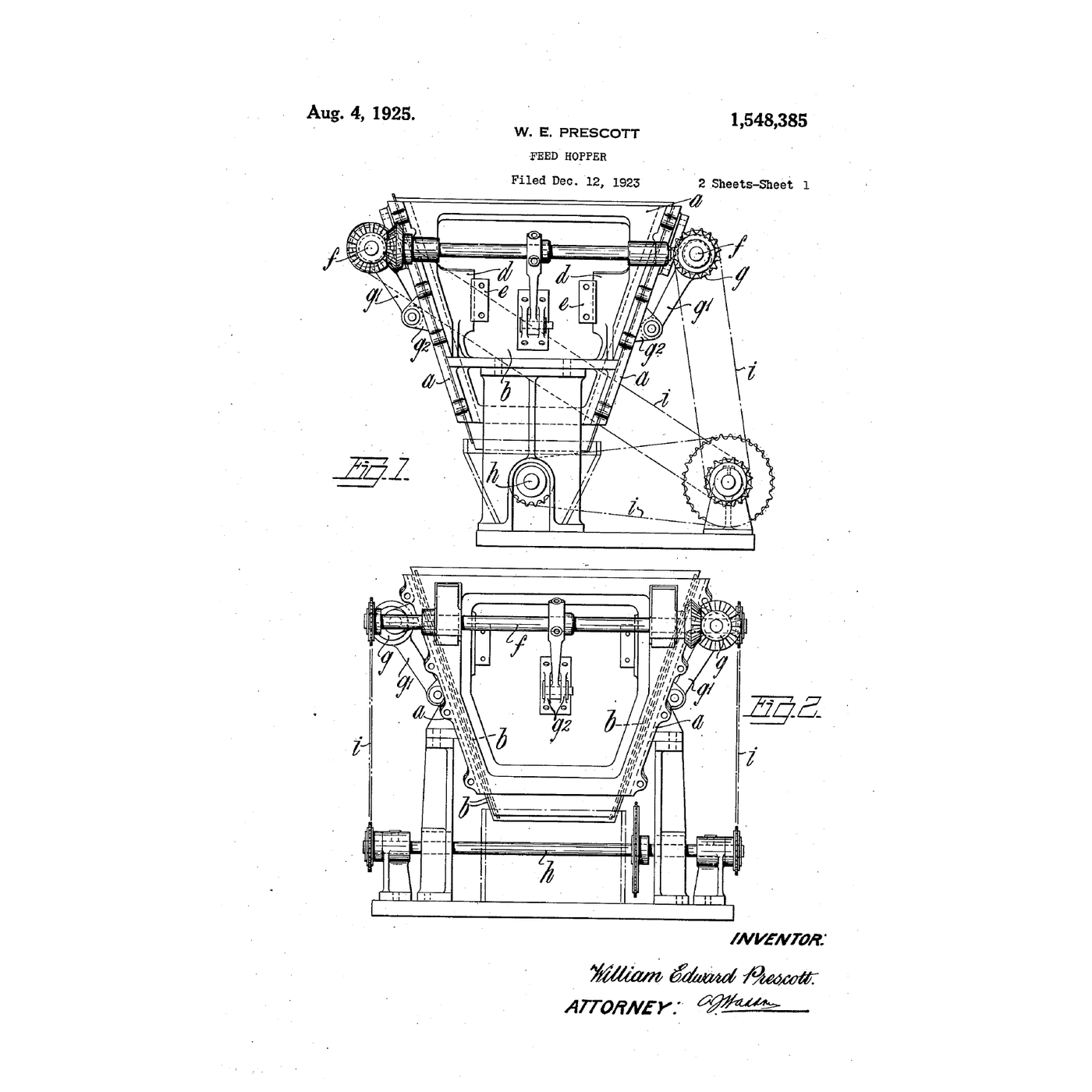
**US 1,548,385, 'Feed Hopper', William Edward Prescott of London, assignor to Baker-Perkins Company Incorporated of New York, application filed 12 December 1923, granted 4 August 1925.** The specification states its own purpose plainly: hoppers for feeding *'semi-liquid, plastic, powdered or granulated substances'* to machines such as mixers, with *'improved means for agitating or keeping in movement the contents in order to facilitate the discharge or feed.'*
The mechanism is worth the visit. Prescott builds the hopper's sides as a skeleton framework and completes the walls with plates that **slide**, reciprocated in sequence by eccentrics on shafts along each side. The wall itself keeps moving, so material at the wall cannot come to rest and an arch has nothing to spring from. It is the mass-flow problem attacked from the other end — instead of making the wall slippery enough for the material to slide on, make the wall slide under the material.
The systematic theory came later. **Andrew Jenike's work at the University of Utah, published in 1961 as Bulletin 108, 'Gravity Flow of Bulk Solids'**, turned hopper design from craft into engineering: the flow-function measurement, the mass-flow and funnel-flow distinction, and the arching calculation in step 4 are all his. No patent number is asserted for that work, because it was published rather than patented.
**Honest limits.** The arching calculation needs the material's unconfined yield strength, and that has to be measured on a shear tester at the consolidation and moisture the bin will actually see — a number taken from a handbook is a guess. Mass flow costs headroom and it costs wall wear, because all the material now slides on the wall instead of on itself. Lined hoppers wear their liners. And no amount of hopper design helps a material that changes: the bin that was designed for dry fines will block on wet ones, and the weather is not a design parameter anyone gets to fix.
Vật liệu
9- 1 bucketTạm thời
- Tạm thời
- 1 cáiTạm thời
- 1 cáiTạm thời
- 1 cáiTạm thời
- từ$4.93
- 1 cáiTạm thời
- 1 cáiTạm thời
- 8 cáiTạm thời
Công cụ yêu cầu
16- Tạm thời
- Tạm thời
- 1 vendor sell this, none ship to you yetTạm thời
- Tạm thời
- Tạm thời
- Tạm thời
- Tạm thời
- Tạm thời
- Tạm thời
- Tạm thời
- Tạm thời
- Động cơ hộp sốHoa hồng 10%Magento Legacy Storeships internationallyTạm thời
- Tạm thời
- 1 vendor sell this, none ship to you yetTạm thời
- Tạm thời
- Bảo vệ thính giácHoa hồng 10%Tạm thời
Blueprint liên quan
Các blueprint này chia sẻ kiến thức — kỹ thuật, vật liệu hoặc nguyên tắc

The Troughed Belt: Two Tipped Rollers That Doubled What a Conveyor Carries
bởi Emma
Cơ học
12
0
0
0
0
0
Breaking by Impact: The Swing Hammer and the Grate That Sets the Size
bởi Martin
Gia công kim loại
11
0
0
0
0
0
The Cone Crusher: A Parallel Zone Nothing Gets Past
bởi Martin
Gia công kim loại
12
0
0
0
0
0

Sorting by Size: Why a Screen Never Makes a Clean Cut
bởi Emma
Cơ học
15
0
0
0
0
0
CC0 Phạm vi công cộng
Bản thiết kế này được phát hành theo CC0. Bạn tự do sao chép, sửa đổi, phân phối và sử dụng cho bất kỳ mục đích nào mà không cần xin phép.
Hỗ trợ nhà sáng tạo bằng cách mua sản phẩm qua bản thiết kế, nơi họ nhận Hoa hồng nhà sáng tạo do nhà bán hàng đặt, hoặc tạo phiên bản mới và kết nối trong bản thiết kế riêng để chia sẻ doanh thu.