NGHỆ THUẬT
LÀM ĐẸP VÀ SỨC KHỎE
THỦ CÔNG
VĂN HÓA VÀ LỊCH SỬ
GIẢI TRÍ
MÔI TRƯỜNG
THỰC PHẨM VÀ ĐỒ UỐNG
KỸ THUẬT NGƯỢC
KHOA HỌC
THỂ THAO
CÔNG NGHỆ
THIẾT BỊ ĐEO
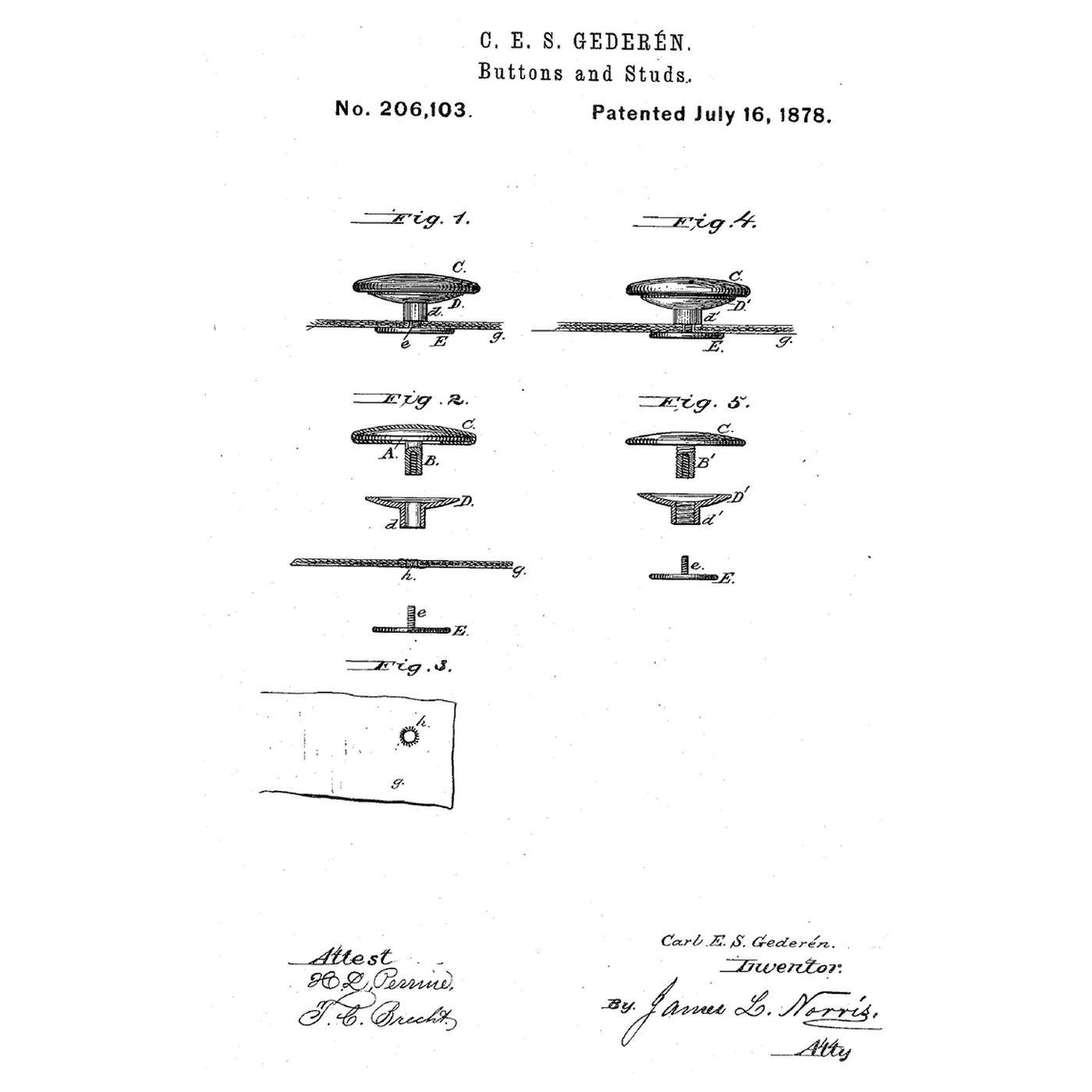


The Screw-Back Button: Two Halves That Clamp the Cloth
A sewn button holds by thread, and its cloth cover wears out with it. A screw-back button holds by clamping: two halves screwed together through a small hole in the cloth.
Carl E. S. Gederén of Philadelphia received US 206,103, dated 16 July 1878 (filed 29 April 1878), for buttons and shirt-studs, with the aim "to provide a means for readily securing a covering to the head of the button, and to provide for securing the button to the fabric to which it is to be attached without sewing." When the cover wears, the button comes apart, takes a new cover, and "may be readily transferred from one garment to another".
This rung checks why a small thread stays done up and how hard it clamps, then pull-tests a screw-back button against a sewn one.
Cơ bản
About 1 hour
Hướng dẫn
1
1
Self-locking and clamp force
Self-locking and clamp force
Đang tải sổ tay Jupyter…
2
2
The button it replaces
The button it replaces
The embedded blueprint sews a button on with a thread shank; this rung clamps one on instead.
3
3
Read US 206,103
Read US 206,103
"This invention relates to certain improvements in buttons, shirt-studs, and other like articles; and it has for its object to provide a means for readily securing a covering to the head of the button, and to provide for securing the button to the fabric to which it is to be attached without sewing."
The bottom disk's "screw-threaded stem" is "passed through the aperture or eyelet from the opposite side of the fabric, engaged with the internal thread of the shank B and screwed up tightly, so that the fabric will be caught between the upper surface of disk E and the end of sleeve d".
"Whenever the cloth covering becomes worn it may be easily replaced by detaching the parts of the button and assembling them as before; or the button may be readily transferred from one garment to another, and the covering changed to correspond with the fabric."
4
4
Fitting one, as a program
Fitting one, as a program
Không gian làm việc Blockly
Loading Blockly workspace...
5
5
Pull-test it against a sewn button
Pull-test it against a sewn button
On a scrap of denim, fit one screw-back button as in the program, and sew an ordinary button on beside it. Loop strong thread under each button and hook the force meter to the loop.
Hold the denim flat and pull each button straight out, slowly, reading the highest force before something gives. Note what gave: the thread, the cloth round the hole, or the button itself. Repeat on fresh cloth and compare.
Vật liệu cho bước này:
 Cúc vặn ren2 cái
 Vải bò1 cái
 Chỉ khâu1 cái
Công cụ cần thiết:
 Dùi
Dùi Kim khâu
 Lực kế (cân lò xo)
 Thước cặp điện tử 6 inch
6
6
A screw-back button that loosens, spins or tears out
A screw-back button that loosens, spins or tears out
Screw-back button troubleshooting.
Flow
Loading...
7
7
History and honest limits
History and honest limits
**Carl E. S. Gederén** of Philadelphia filed US 206,103 on 29 April 1878; it is dated 16 July 1878. His claim is the detachable clamping disk that holds the cloth cover, together with the screwed top and bottom disks.
**Honest limits.** The torque rule with K = 0.2 is an engineering rule of thumb, not a law; K changes with finish and lubrication. Thread sizes, friction and torques are examples. Your pull readings are the measurement.
Blueprint liên quan
Các blueprint này chia sẻ kiến thức — kỹ thuật, vật liệu hoặc nguyên tắc


CC0 Phạm vi công cộng
Bản thiết kế này được phát hành theo CC0. Bạn tự do sao chép, sửa đổi, phân phối và sử dụng cho bất kỳ mục đích nào mà không cần xin phép.
Hỗ trợ nhà sáng tạo bằng cách mua sản phẩm qua bản thiết kế, nơi họ nhận Hoa hồng nhà sáng tạo do nhà bán hàng đặt, hoặc tạo phiên bản mới và kết nối trong bản thiết kế riêng để chia sẻ doanh thu.