NGHỆ THUẬT
LÀM ĐẸP VÀ SỨC KHỎE
THỦ CÔNG
VĂN HÓA VÀ LỊCH SỬ
GIẢI TRÍ
MÔI TRƯỜNG
THỰC PHẨM VÀ ĐỒ UỐNG
KỸ THUẬT NGƯỢC
KHOA HỌC
THỂ THAO
CÔNG NGHỆ
THIẾT BỊ ĐEO
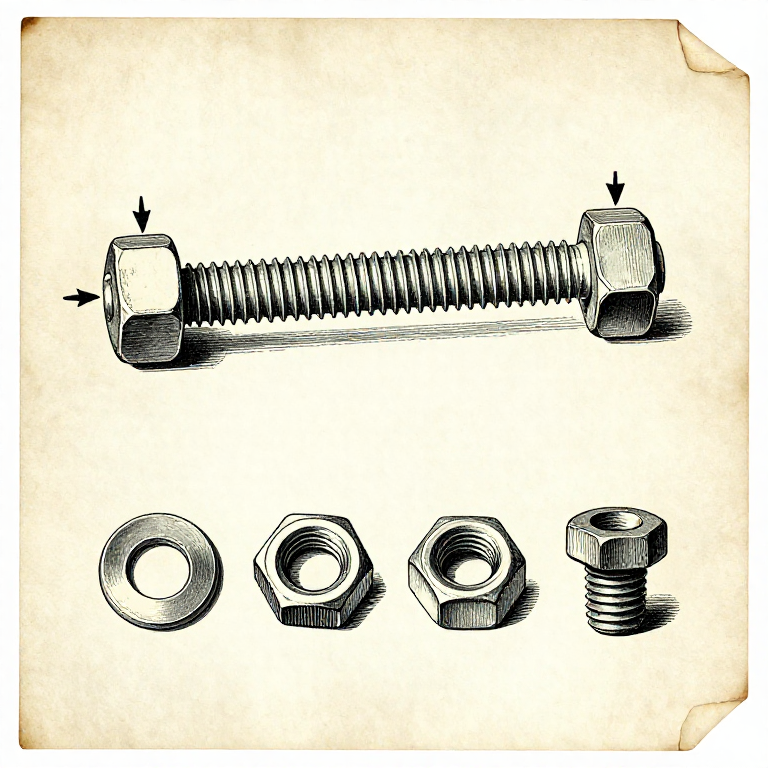


Tightening: How Tight Is Right, and Making It Stay
Tightening a bolt is not about making it hard to undo. It is about STRETCHING it — a tightened bolt is a very stiff spring, and the clamping force holding the joint together is the tension in that spring.
Which is why 'as tight as it will go' is the wrong target in both directions. Too little and the joint relies on the bolt taking shear, works loose and eventually breaks from fatigue. Too much and you take the bolt past its yield point, where it stretches permanently and loses the tension you were trying to create.
And a thread engaged far enough is stronger than the bolt itself, so tightening harder into a shallow hole does not help — it just strips it.
Trung cấp
3 hours
Hướng dẫn
1
1
The bolt is a spring you are winding up
The bolt is a spring you are winding up
As the nut turns, the bolt stretches by a fraction of a millimetre. That stretch is elastic, so the bolt pulls back with a force proportional to it, and that force clamps the joint.
The stretch is tiny — well under a tenth of a millimetre on a short bolt at full tension — which is why a fraction of a turn past snug makes such a difference, and why a joint that settles by even a few hundredths loses much of its clamp.
A LONGER bolt is a softer spring, so it holds its tension better through settlement and thermal movement. That is a genuine design tool: where a joint keeps coming loose, a longer bolt through a spacer often fixes it where a tighter short one will not.
Công cụ cần thiết:
 Bộ bu lông lục giác nhiều cỡ
 Bộ đai ốc và long đen
 Thước cặp
2
2
Thread engagement: deeper than 1.5 diameters buys nothing
Thread engagement: deeper than 1.5 diameters buys nothing
Đang tải sổ tay Jupyter…
Công cụ cần thiết:
 Máy tính bỏ túi
 Bộ ta-rô và bàn ren
3
3
Torque is a proxy, and a poor one
Torque is a proxy, and a poor one
A torque wrench does not measure tension. It measures the twisting force you apply, and most of that force is spent on friction — under the head and in the threads — with only a fraction becoming clamping tension.
Which means a dry bolt and an oiled bolt at the same torque end up at very different tensions; oiled can be a third tighter and may well be past yield. Torque figures always assume a lubrication condition, so if a specification says dry, it means dry.
Use a torque wrench where a figure is specified, and tighten progressively in a criss-cross pattern on any joint with several bolts. Tightening one fully before starting the next distorts the parts and leaves the first one loose once the others pull down.
Vật liệu cho bước này:
 Dầu cắt gọt1 cái
Công cụ cần thiết:
 Cờ lê lực
 Bộ cờ lêBộ bu lông lục giác nhiều cỡ
4
4
Locking: correct tension first, then a locking method
Locking: correct tension first, then a locking method
A properly tensioned bolt is already largely self-locking. Most fasteners that vibrate loose were never tight enough in the first place, and adding a lock washer to an under-tightened bolt fixes nothing.
THREAD LOCKER is an anaerobic adhesive that cures in the absence of air between the threads. Medium strength comes apart with hand tools; high strength usually needs heat. It also seals the thread against corrosion, which is often the real benefit.
A NYLOC nut has a nylon insert gripping the thread and is reliable and reusable a few times. A SPLIT LOCK WASHER is the traditional answer and is genuinely weak against vibration; a serrated flange or a wedge-lock pair works far better. WIRE LOCKING is fully mechanical and cannot fail chemically, which is why aircraft still use it — and it is the right answer whenever a fastener coming loose would be dangerous rather than merely annoying.
Vật liệu cho bước này:
 Keo khóa ren1 cái
Công cụ cần thiết:
 Vòng đệm vênhBộ đai ốc và long đenBộ cờ lêCờ lê lực
Vật liệu
2- 1 cáiTạm thời
- 1 cáiTạm thời
Blueprint liên quan
Các blueprint này chia sẻ kiến thức — kỹ thuật, vật liệu hoặc nguyên tắc
CC0 Phạm vi công cộng
Bản thiết kế này được phát hành theo CC0. Bạn tự do sao chép, sửa đổi, phân phối và sử dụng cho bất kỳ mục đích nào mà không cần xin phép.
Hỗ trợ nhà sáng tạo bằng cách mua sản phẩm qua bản thiết kế, nơi họ nhận Hoa hồng nhà sáng tạo do nhà bán hàng đặt, hoặc tạo phiên bản mới và kết nối trong bản thiết kế riêng để chia sẻ doanh thu.