NGHỆ THUẬT
LÀM ĐẸP VÀ SỨC KHỎE
THỦ CÔNG
VĂN HÓA VÀ LỊCH SỬ
GIẢI TRÍ
MÔI TRƯỜNG
THỰC PHẨM VÀ ĐỒ UỐNG
KỸ THUẬT NGƯỢC
KHOA HỌC
THỂ THAO
CÔNG NGHỆ
THIẾT BỊ ĐEO
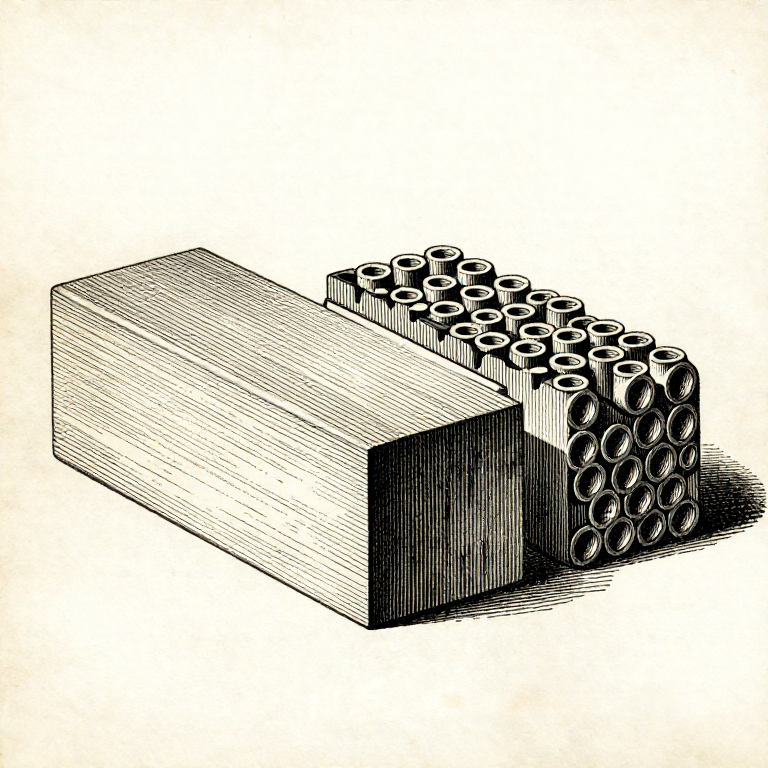


Why a Butt Joint Fails: End Grain Does Not Glue
Glue two long-grain faces together properly and the joint is stronger than the wood — break it and it tears out fibres either side. Glue two END-grain faces together and it comes apart in your hands.
The reason is the cell structure. Long grain presents cell WALLS to be bonded; end grain presents the open ends of hollow tubes, which drink the glue away from the surface and leave a starved joint over very little real contact area.
Every traditional joint in woodworking is, at bottom, a way of turning an end-grain meeting into a long-grain glue surface, a mechanical interlock, or both. Knowing that makes the whole catalogue of joints look less like tradition and more like solutions.
Cơ bản
2 hours
Hướng dẫn
1
1
What end grain does to glue
What end grain does to glue
End grain wicks glue into the open tubes by capillary action. The surface is left starved, so the bond line has too little adhesive exactly where it is needed — the starvation failure the glue batch describes, produced by the timber rather than by the clamps.
The contact area is also far smaller than it looks. A long-grain surface is a field of cell walls to bond to; an end-grain surface is mostly open holes, and glue bridging a hole is not holding anything.
SIZING helps and does not cure it: brush on thinned glue, let it soak in and become tacky, then glue normally. That fills the tubes first so the real joint is not starved. It typically gets an end-grain joint to a useful fraction of long-grain strength — better than nothing, nowhere near enough to rely on.
Vật liệu cho bước này:
 Khối gỗ cứng1 cái
 Keo gỗ PVA1 cái
Công cụ cần thiết:
 Kẹp thanh
2
2
The three cures, and every joint is one of them
The three cures, and every joint is one of them
**Add long grain.** A mortise and tenon works because the tenon's cheeks are long grain glued to the mortise's long-grain walls. The end grain at the bottom of the tenon contributes nothing and is not asked to.
**Add mechanical interlock.** A dovetail resists being pulled apart by its shape alone — the glue is a bonus, which is why antique dovetailed drawers survive with the glue long since failed.
**Add a separate piece of long grain.** A dowel, a loose tenon, a biscuit, a spline. Each one crosses the joint with its own grain running the useful way, turning two end-grain faces into several long-grain glue surfaces.
Vật liệu cho bước này:
 Thanh chốt gỗ1 cáiKeo gỗ PVA1 cái
 Tấm gỗ cứng1 cái
Công cụ cần thiết:
 Đục gỗ
 Cưa lưng cứng
 Cữ vạch
3
3
Long grain to long grain is the joint that needs nothing
Long grain to long grain is the joint that needs nothing
An edge joint — two boards glued edge to edge to make a wider panel — is long grain to long grain the whole way. Properly made it needs no dowels, no biscuits and no splines, and it will not be where the panel breaks.
Dowels and biscuits in an edge joint are for ALIGNMENT during glue-up, not strength. That is a perfectly good reason to use them, but adding them for strength is effort spent on the one part of the joint that was never going to fail.
What an edge joint does need is a straight, square, well-fitted edge and even clamping. That is the clamping-pressure rung, and it is where edge joints actually go wrong.
Vật liệu cho bước này:
Tấm gỗ cứng2 cáiKeo gỗ PVA1 cáiCông cụ cần thiết:
 Bào tayKẹp thanh
 Thước ke tổ hợp
4
4
Cross-grain gluing: the mistake that waits a year
Cross-grain gluing: the mistake that waits a year
Gluing one board ACROSS another's width — a solid batten glued across a panel, a wide top glued to a wide rail — puts one piece's several millimetres of seasonal movement against the other's near zero. One of them will give.
It never fails during the build, which is what makes it so common. The glue holds perfectly, the piece looks fine for a season, and it splits in the first dry winter — by which time the cause is not obvious.
The cures are all forms of letting it slide: glue only the middle few centimetres and let the rest float, use slotted screw holes, use tabletop buttons that hook into a groove. A breadboard end does all three at once, and the last rung of this batch is that joint in detail.
Vật liệu cho bước này:
Tấm gỗ cứng1 cáiKeo gỗ PVA1 cáiCông cụ cần thiết:
Kẹp thanhCữ vạchVật liệu
4- 1 cáiTạm thời
- 4 cáiTạm thời
- 1 cáiTạm thời
- 2 cáiTạm thời
Blueprint liên quan
Các blueprint này chia sẻ kiến thức — kỹ thuật, vật liệu hoặc nguyên tắc


CC0 Phạm vi công cộng
Bản thiết kế này được phát hành theo CC0. Bạn tự do sao chép, sửa đổi, phân phối và sử dụng cho bất kỳ mục đích nào mà không cần xin phép.
Hỗ trợ nhà sáng tạo bằng cách mua sản phẩm qua bản thiết kế, nơi họ nhận Hoa hồng nhà sáng tạo do nhà bán hàng đặt, hoặc tạo phiên bản mới và kết nối trong bản thiết kế riêng để chia sẻ doanh thu.