ARTE
BELEZA E BEM-ESTAR
ARTESANATO
CULTURA E HISTÓRIA
ENTRETENIMENTO
MEIO AMBIENTE
COMIDA E BEBIDAS
ENGENHARIA REVERSA
CIÊNCIAS
ESPORTES
TECNOLOGIA
TECNOLOGIA VESTÍVEL
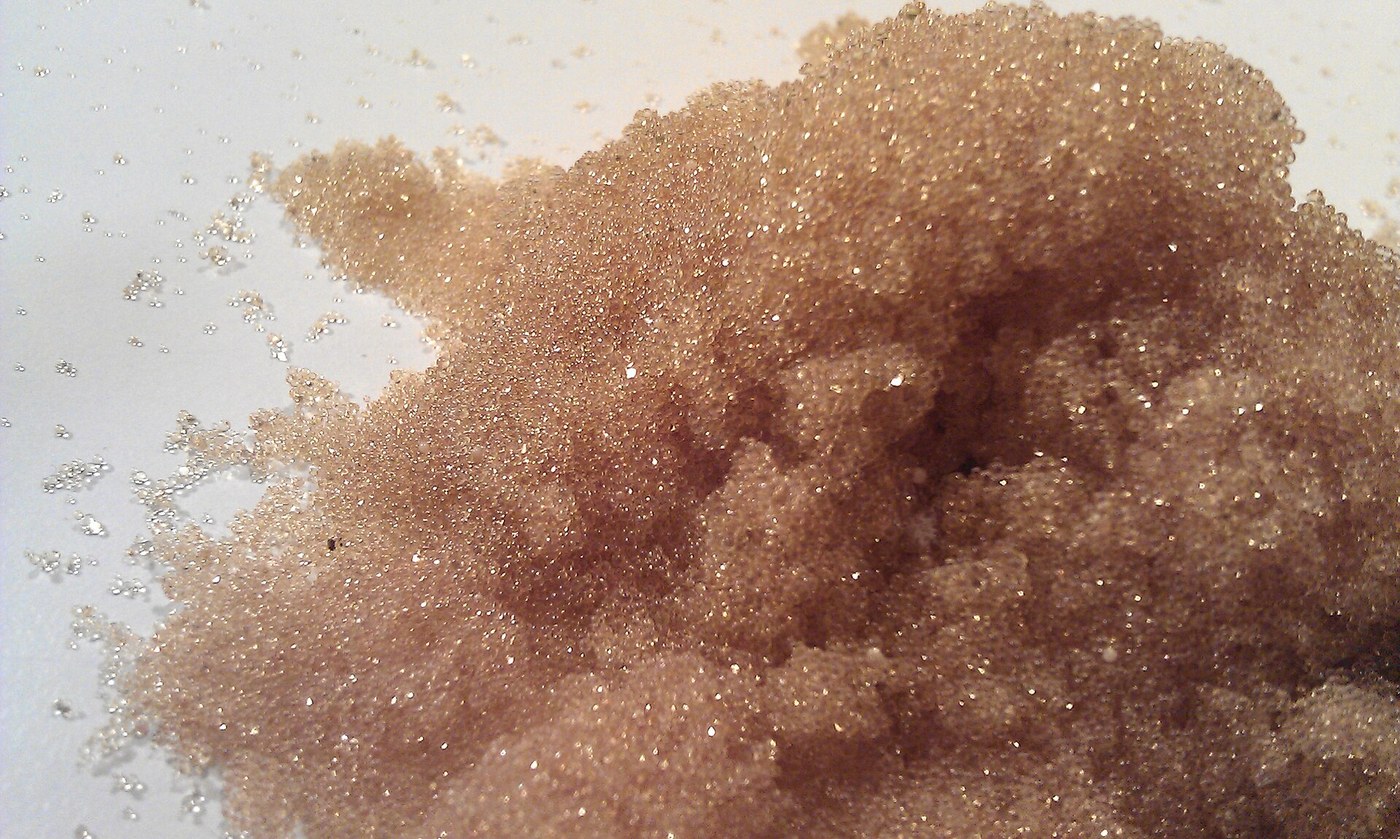


Ion-Exchange Water Softening
Hardness is calcium and magnesium dissolved in water, and it is a nuisance rather than a danger. It wastes soap, because the calcium reacts with the soap to make the grey curd on the side of a bath instead of lather. It builds scale in kettles, boilers and pipes, and scale in a boiler is a genuine hazard, insulating the metal from the water until the metal overheats.
Every earlier answer was to precipitate the hardness out. Add lime and soda ash, form insoluble calcium carbonate and magnesium hydroxide, and settle them. It works, it treats enormous flows cheaply, and it produces sludge by the tonne and needs a chemist watching the dose.
Robert Gans took an entirely different route in 1905. He used a solid that holds sodium ions loosely and calcium ions tightly, and simply let the water walk past it. Sodium leaves the solid, calcium takes its place, and the water comes out soft. Nothing is precipitated and nothing settles. When the solid is full of calcium you flush it with strong salt solution, mass action drives the exchange backwards, and it is ready again. He used a synthetic sodium aluminosilicate — a zeolite — and sold it as Permutit.
The honest limit, which matters more than the trick: this removes hardness but not dissolved solids. Every calcium ion that leaves is replaced by two sodium ions. The water is softer and slightly saltier, and its conductivity barely changes. If your problem is scale or soap, it is the right tool. If your problem is total salinity, it makes it marginally worse.
You will build a column, measure hardness before and after by titration, run it to breakthrough, regenerate with brine, and measure the trade between how much salt you spend and how much capacity you get back. That trade is the whole economics of the device.
Intermediário
5 hours
Instruções
1
1
Measure hardness by titration, so you have a number to move
Measure hardness by titration, so you have a number to move
Everything downstream depends on being able to say how hard the water is, so build that skill first.
Total hardness is measured by EDTA titration. EDTA is a chelating agent that grips calcium and magnesium ions one-to-one. Eriochrome Black T is the indicator: it binds those same ions and goes wine-red while any remain free, and turns blue the instant the EDTA has taken them all. The end point is a genuine colour change, not a judgement of shade.
The procedure: take 50 ml of sample in a conical flask, add 1 ml of ammonia buffer to bring it to pH 10 — the indicator only works in that window — and a few grains of Eriochrome Black T. It goes wine-red. Titrate with 0.01 molar EDTA until the last trace of red goes and the solution is clearly blue. Note the volume.
Hardness is conventionally reported as milligrams per litre of calcium carbonate equivalent, whether or not any carbonate is present, because that convention lets you compare waters containing different proportions of calcium and magnesium. With 0.01 M EDTA and a 50 ml sample, each millilitre used is 20 mg/l as calcium carbonate. Soft water is under 60; hard is 120 to 180; over 180 is very hard.
Make your own hard water so you know the answer in advance and can trust the method. Dissolve 0.30 g of calcium chloride and 0.25 g of magnesium sulfate in 10 litres of distilled water. Titrate it. If your titration does not land near the value the next step calculates, the fault is in your technique, not your column, and it is far cheaper to find that out now.
Materiais para este passo:
 EDTA sal dissódico50 gram
 Indicador negro de eriocromo T5 gram
 Solução de amoníaco diluída100 millilitre
 Solução de cloreto de cálcio250 millilitre
 Sulfato de magnésio (sal de Epsom)250 gram
 Água destilada20 litros
Ferramentas necessárias:
 Bureta (de vidro)
 Copo de vidro (gobelé)
 Proveta graduada
 Balança digital de precisão
 Medidor de pH digital portátil
2
2
Pack the column, and pack it without a single air pocket
Pack the column, and pack it without a single air pocket
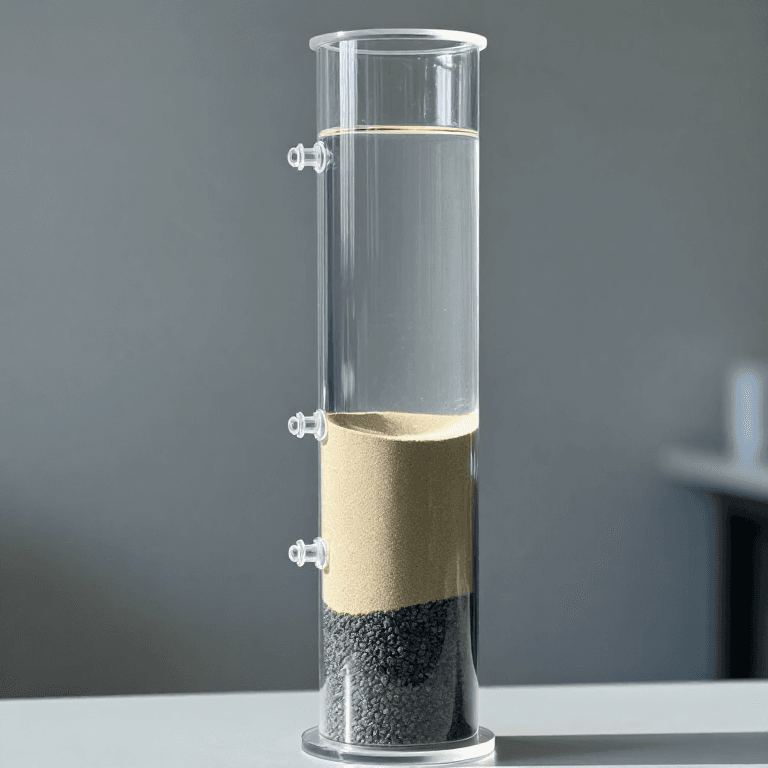
Use a 500 mm length of 50 mm clear acrylic tube, capped at both ends with a fitting carrying a tube barb, and a disc of fine plastic mesh above and below the bed to stop the beads escaping. Clear tube is not a luxury here — you need to see the bed, because the two things that ruin a column are both visible.
The medium: strong-acid cation exchange resin in the sodium form, the ordinary sulfonated polystyrene-divinylbenzene beads sold for domestic softeners. Gans' 1905 zeolite worked identically in principle and held far less: a gel zeolite manages roughly 0.2 to 0.35 equivalents per litre of bed, where modern resin has a total capacity around 2 equivalents per litre and delivers something like 0.7 to 1.4 in service depending on how hard you regenerate it. That is the measurable difference a century of chemistry bought, and you can verify the modern half of it yourself in step four.
Pack it wet. Fill the tube part-way with water first and pour the resin in as a slurry so the beads settle through liquid. Poured dry, air is trapped between beads and you get channelling: water finds a low-resistance path through the voids, contacts a fraction of the bed, and breaks through almost immediately at partial hardness. A channelling column looks like a column that has no capacity, and the fault is entirely in the packing.
Fill to about 300 mm of settled bed, which is roughly 590 ml. Leave at least 50 percent freeboard above it — the bed expands when you backwash it, and a bed with no room to expand cannot be cleaned or unpacked.
Backwash before first use: run water upward until the bed lifts and fluidises, for five minutes, then let it settle. This grades the beads, fines on top, and removes the dust from manufacture. Then rinse downward until the outlet runs clear.
The second visible failure is a shrinking bed. Resin beads swell and shrink as they change ionic form, by a few percent, and that is normal. A bed that keeps getting smaller over many cycles is losing beads through a failed mesh.
Materiais para este passo:
 Tubo acrílico (transparente)1 peça
 Resina de troca catiónica (na forma sódica)1 litro
 Sortido de acessórios para tubo de PVC1 conjunto
 Rede de malha fina1 peça
 Tubo de vinil transparente3 metre
Ferramentas necessárias:
 Serra de arco para metais
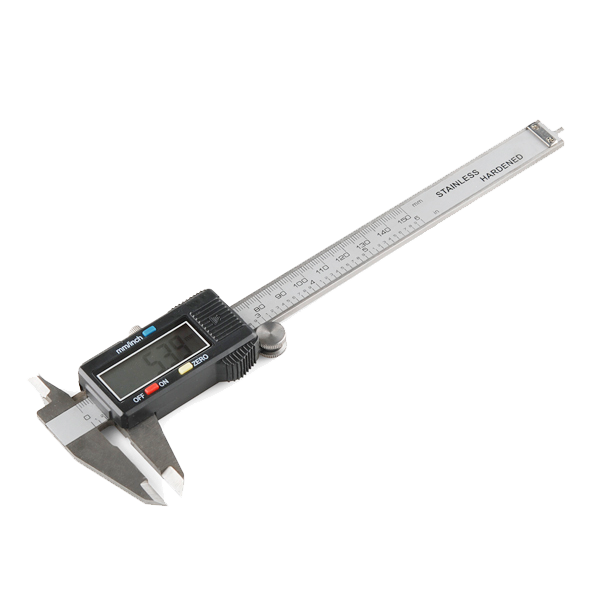 Digital Calipers - 152.4 mmProveta graduada
 Cronómetro
 Balde
Balde3
3
The exchange itself, and why brine reverses it
The exchange itself, and why brine reverses it
The chemistry is one reversible equilibrium, and every practical feature of the device falls out of it.
Write the resin as R-SO3-Na: a polymer backbone carrying fixed sulfonate groups, each holding one loosely-bound sodium ion. In service:
2 R-SO3Na + Ca(2+) <--> (R-SO3)2Ca + 2 Na(+)
Two sodium ions leave for every one calcium ion taken, because charge must balance. That single stoichiometric fact is why the treated water is saltier, and why the exchange is measured in equivalents rather than moles.
The resin prefers calcium to sodium — the selectivity coefficient for calcium over sodium on a strong-acid resin is roughly 2 at ordinary concentrations. So in dilute tap water the equilibrium sits far to the right and the resin strips the hardness almost completely.
Now reverse it. You cannot make the resin prefer sodium; the selectivity is what it is. What you can do is change the concentrations so violently that Le Chatelier's principle does the work for you. Flood the bed with 10 percent sodium chloride — about 1.7 moles per litre, against the roughly 0.002 moles per litre of calcium in hard water, a factor near a thousand — and the mass action of that sodium drives the reaction back to the left. The calcium comes off and goes to drain as calcium chloride.
This also explains the economics you will measure in step four. Regeneration is never complete, because it is fighting a genuine preference. More salt drives it further and gets more capacity back, with diminishing returns: doubling the salt dose does not double the recovered capacity. Every softener in the world is set somewhere on that curve, and where you set it is a choice between salt cost and column size.
Magnesium behaves the same way with a slightly lower preference, which is why a column exhausts for magnesium a little before calcium and why total hardness is the number that matters, not either ion alone.
SERVICE (softening), the forward reaction:
2 R-SO3Na + Ca(2+) --> (R-SO3)2Ca + 2 Na(+)
2 R-SO3Na + Mg(2+) --> (R-SO3)2Mg + 2 Na(+)
R-SO3Na = sulfonated polystyrene-divinylbenzene bead, sodium form
Note the 2:1 stoichiometry — TWO sodium out per ONE calcium in.
Charge balance is what forces it, and it is why softened water
carries more sodium than the water that went in.
REGENERATION, the same equilibrium driven backwards by mass action:
(R-SO3)2Ca + 2 NaCl (excess) --> 2 R-SO3Na + CaCl2 (to drain)
Selectivity still favours Ca(2+) over Na(+) — roughly 2:1 on a
strong-acid resin. Brine wins not by preference but by concentration:
~1.7 mol/L Na(+) against ~0.002 mol/L Ca(2+) in the exhausted bed.
CAPACITY ARITHMETIC (why equivalents, not moles):
1 eq Ca(2+) = 0.5 mol Ca(2+) = 50 g as CaCO3
hardness 200 mg/L as CaCO3 = 4 meq/L
0.59 L bed at 1.0 eq/L = 590 meq -> ~148 L treated to breakthrough
WHAT IS NOT REMOVED — state this as a condition of use:
sodium, chloride, sulfate, nitrate, silica, dissolved organics.
Total dissolved solids is essentially UNCHANGED; only the cation
identity changes. Conductivity before and after will confirm it.
Materiais para este passo:
 Cloreto de sódio (sal)2 kilogram
Ferramentas necessárias:
 Multímetro digital de laboratório
4
4
Run it to breakthrough, and plot the curve that defines the device
Run it to breakthrough, and plot the curve that defines the device
A carregar o notebook Jupyter…
Materiais para este passo:
Cloreto de sódio (sal)2 kilogramEDTA sal dissódico50 gramFerramentas necessárias:
 Computador de secretáriaBureta (de vidro)BaldeCronómetro
5
5
Regenerate, rinse, and prove it came back
Regenerate, rinse, and prove it came back
Regeneration is four operations in a fixed order, and the order is not negotiable.
Backwash first, upward, until the bed fluidises and expands by roughly half its settled depth. Five to ten minutes. This lifts out the fines and the filtered dirt that have collected on top, and it loosens a bed that has compacted under downward flow. Skip it and the brine channels through a packed bed exactly as feedwater does.
Brine second, and slowly. Make up 10 percent sodium chloride — 100 g per litre of water — and pass it downward through the bed over 20 to 30 minutes. Slowness is the point: this is an equilibrium being pushed backwards, and it needs contact time. The same salt pushed through in five minutes regenerates markedly less. For your 590 ml bed at a moderate 160 g of salt per litre of resin, that is about 95 g of salt in roughly a litre of solution.
Slow rinse third, at the same low flow, about two bed volumes. This displaces the brine through the bed so the last of it does useful work on the way out rather than going straight to drain.
Fast rinse last, at service flow, until the outlet conductivity falls back near the feed. Measure this rather than guessing — a multimeter on two probes at fixed spacing is enough to see the trend even without calibration. Rinse too little and the first water out of a freshly regenerated softener is salty; that is the classic complaint and it is always an under-rinse.
Now prove it. Run the column again and titrate to breakthrough a second time. Compare the volume treated with your first run. Getting 85 to 95 percent of the first cycle back is normal and correct; the shortfall is the calcium the brine could not displace, sitting on the sites the resin holds most tightly. That residue is why a softener's capacity settles at a stable working value below its theoretical total, cycle after cycle, for years.
One caution about the waste: the spent brine is calcium and magnesium chloride at high concentration. It is not toxic, but it is salty enough to kill plants and to matter to a septic system. Dilute it heavily or dispose of it to a foul drain.
Materiais para este passo:
Cloreto de sódio (sal)1 kilogramEDTA sal dissódico25 gramIndicador negro de eriocromo T2 gramFerramentas necessárias:
Bureta (de vidro)Multímetro digital de laboratórioBaldeCronómetroBalança digital de precisãoMateriais
12- 125 gramReferência
- Referência
- 100 millilitreReferência
- 250 millilitreReferência
- Referência
- 20 litrosReferência
- Referência
- Referência
- 1 conjuntoReferência
- 1 peçaReferência
- 3 metreReferência
- 5 kilogramReferência
Ferramentas necessárias
11- Referência
- Referência
- Referência
- Referência
- Referência
- Referência
- Digital Calipers - 152.4 mm10% de comissãoR$73.54
- Referência
- Referência
- Referência
- Referência
Blueprints relacionados
Estes blueprints compartilham conhecimento — técnicas, materiais ou princípios


CC0 Domínio Público
Este blueprint é liberado sob CC0. Você é livre para copiar, modificar, distribuir e usar este trabalho para qualquer finalidade, sem pedir permissão.
Apoie o Maker comprando produtos através do Blueprint, onde ele ganha uma Comissão Maker definida pelos vendedores, ou crie uma nova versão deste Blueprint e inclua-o como conexão no seu próprio Blueprint para compartilhar receita.